
North Atlantic circulation shows signs of weakening, studies point to major decline by 2100
A pair of studies published in April 2026 in Science Advances report a consistent decline in observed western-boundary overturning transport across the North Atlantic and suggest that future weakening of the Atlantic Meridional Overturning Circulation (AMOC) could be stronger than standard climate model estimates.
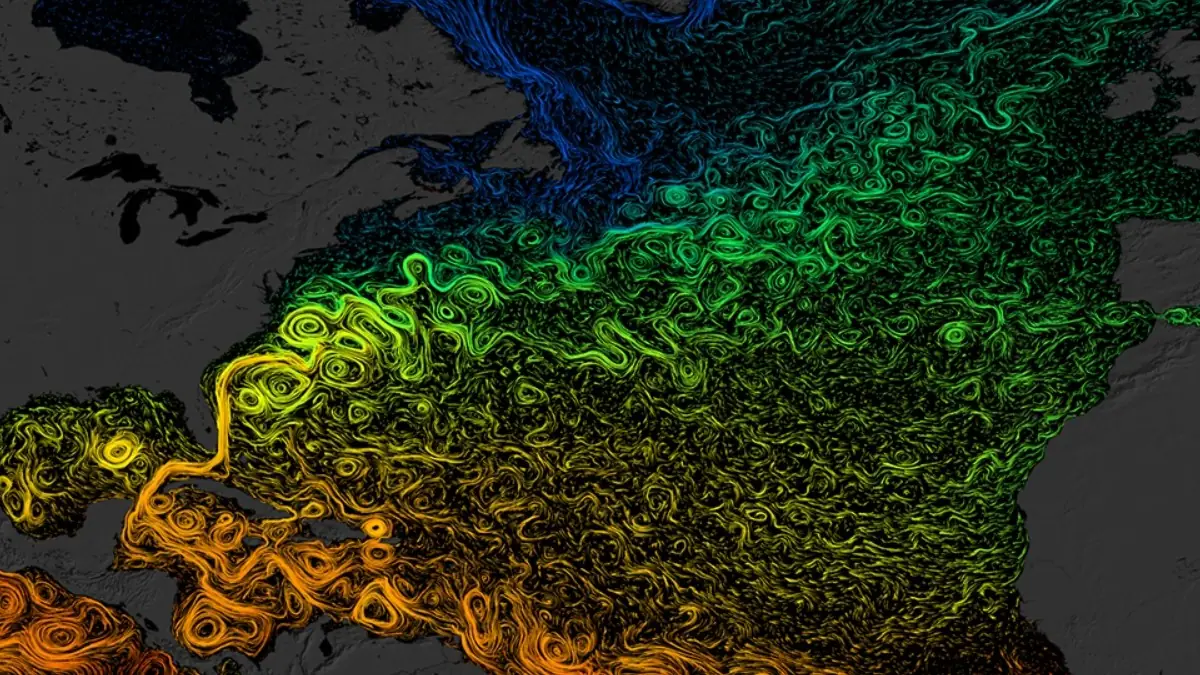
Visualization of ocean currents in the North Atlantic. The colors show sea surface temperature (orange and yellow are warmer, green and blue are colder). Credit: NASA Goddard Space Flight Center
Observational records from four mooring arrays positioned along the western boundary of the North Atlantic reveal a consistent decline in deep overturning transport over the past two decades, providing a new basin-scale perspective on variability linked to the Atlantic Meridional Overturning Circulation (AMOC).
AMOC is a large-scale system of ocean currents that transports warm, salty surface waters northward and returns colder, denser waters southward at depth. This circulation plays a significant role in redistributing heat within the climate system, influencing temperature patterns, rainfall distribution, and regional sea level across the Atlantic basin and surrounding continents.
The analysis, based on data spanning latitudes from 16.5°N to 42.5°N, applies a unified methodology to previously independent observing systems to derive comparable estimates of deep western overturning transport below 1 000 m (3 280 feet), measured in sverdrup (Sv) — a unit equivalent to one million cubic meters of water per second.
The resulting time series shows that southward flow at depth has been weakening at all four locations over observation periods spanning 2000–2023, depending on latitude. The trends are statistically significant at three of the four sites.
The strongest signal is observed at 16.5°N, where transport decreases at a rate of 0.67 ± 0.13 Sv per year between 2000 and 2022. At 26.5°N, the decline reaches 0.26 ± 0.07 Sv per year over 2004–2023, while at 39.5°N the trend is 0.45 ± 0.17 Sv per year over 2004–2014. A weaker, non-significant decline is detected at 42.5°N, but remains consistent in sign with the other latitudes.
The results indicate a consistent pattern of weakening across multiple latitudes in the subtropical and mid-latitude North Atlantic, suggesting that variability originating at higher latitudes is propagating southward along the western boundary. The study shows that deep western overturning transport captures interannual and decadal variability of the AMOC, but does not represent the full overturning circulation across the basin.
Comparisons with full AMOC estimates at 26.5°N show that western-boundary trends are stronger than those derived from complete basin calculations.
This discrepancy arises from opposing contributions at the eastern boundary, where transport trends indicate a partial strengthening that partially offsets the decline observed in the west. As a result, the western-boundary signal correctly identifies the direction of change but overestimates the magnitude of the basin-wide trend when considered in isolation.
Despite this limitation, the western boundary remains a dynamically significant region where variability signals are expected to manifest most prominently — functioning, in the authors’ words, as a “canary in a coal mine” for the overall state of the overturning circulation. The observed decline is therefore interpreted as an indicator of broader changes in AMOC, while further showing the need for sustained monitoring of both western and eastern boundary contributions to fully resolve long-term trends.
A sustained weakening of the AMOC would have far-reaching consequences beyond the ocean itself. With less warm water being carried northward, parts of northwestern Europe and the eastern United States could experience cooler temperatures than current trends would otherwise produce. Rainfall patterns would also shift, including a potential southward displacement of the tropical rain belt, which would affect agriculture and water supplies across parts of Africa and South America.
Along Atlantic coastlines, a weaker circulation would contribute to rising sea levels, particularly along the eastern seaboard of North America, where the ocean surface is partly held down by the current’s pull. The scale of these effects depends on how much and how quickly the AMOC weakens, but the direction of change is consistent across scientific assessments.
A complementary study published one week later applies observational constraint methods to projections from the Coupled Model Intercomparison Project Phase 6 to refine estimates of future AMOC weakening. Standard multimodel averages indicate a decline of 32 ± 37% by the end of the 21st century under the SSP2-4.5 scenario, reflecting substantial spread among models.
To reduce this uncertainty, the study evaluates several constraint approaches using observed variables, including past AMOC strength, sea surface temperature, and sea surface salinity across multiple ocean regions. The most effective method, based on ridge-regularized linear regression, integrates 19 observable variables and minimizes cross-validation error using a leave-one-out framework.
This approach yields a constrained estimate of 51 ± 8% weakening by 2100 under the same emissions scenario, representing a substantially larger decline than the multimodel mean within a model-constrained framework and a significant reduction in model uncertainty. The constrained estimate corresponds to a projected AMOC strength of approximately 8.1 ± 1.4 Sv by the end of the century, compared to about 12.0 ± 6.5 Sv in the unconstrained ensemble.
The difference between constrained and unconstrained projections is primarily attributed to biases in climate models, particularly a fresh bias in South Atlantic surface salinity and a cold bias in North Atlantic sea surface temperatures. These biases affect density gradients and the salt-advection feedback, which are critical components of AMOC stability. Correcting for these discrepancies shifts projections toward a more pronounced weakening.
The study further identifies that model uncertainty dominates total projection uncertainty throughout the 21st century, accounting for approximately 78% of variance by 2100, while scenario uncertainty and internal variability play smaller roles. This reinforces the importance of constraining models with observational data to improve confidence in long-term projections.
The two studies address different components of the AMOC system: one provides direct observational evidence of a consistent weakening-related signal along the western boundary, while the other refines projections of future change by integrating observational constraints into model ensembles.
The combined evidence indicates a weakening-related signal in observations and suggests, based on constrained projections, that future AMOC decline could be stronger than standard model averages, although uncertainties remain regarding basin-wide dynamics and long-term thresholds.
References:
1 Xing, Q., Elipot, S., Johns, W. E., Smeed, D. A., Moat, B. I., & Loder, J. W. (2026). Meridionally consistent decline in the observed western boundary contribution to the Atlantic Meridional Overturning Circulation. Science Advances, 12(15). https://doi.org/10.1126/sciadv.adz7738
2 Portmann, V., Swingedouw, D., Khattab, O., & Chavent, M. (2026). Observational constraints project a ~50% AMOC weakening by the end of this century. Science Advances, 12(16). https://doi.org/10.1126/sciadv.adx4298

I'm a dedicated researcher, journalist, and editor at The Watchers. With over 20 years of experience in the media industry, I specialize in hard science news, focusing on extreme weather, seismic and volcanic activity, space weather, and astronomy, including near-Earth objects and planetary defense strategies. You can reach me at teo /at/ watchers.news.

Commenting rules and guidelines
We value the thoughts and opinions of our readers and welcome healthy discussions on our website. In order to maintain a respectful and positive community, we ask that all commenters follow these rules.