
Adaptive kernel density estimation reveals possible gaps in geomagnetic reversal record
A revised statistical reconstruction of Earth’s magnetic polarity history suggests that some short-duration geomagnetic reversals may be absent from the Geomagnetic Polarity Time Scale, particularly during four intervals following the Cretaceous Normal Superchron approximately 83 million years ago. The study, published in Geophysical Research Letters in 2026, applies a cross-validated adaptive-bandwidth kernel density estimation method to analyze reversal frequency in the GPTS 2020 dataset. The results identify localized dips in modeled reversal frequency that may correspond to undocumented short-lived polarity switches.
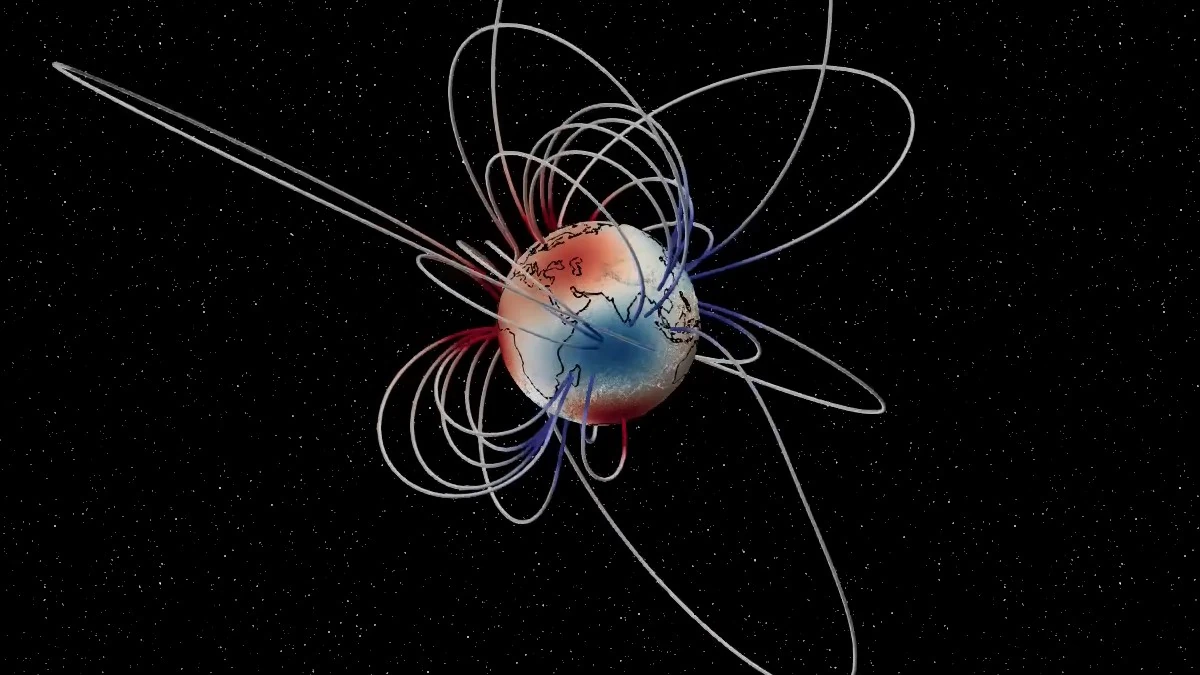
Approximately 41 000 years ago, Earth’s magnetic field briefly reversed during what is known as the Laschamp event. During this time, Earth’s magnetic field weakened significantly—dropping to a minimum of 5% of its current strength—which allowed more cosmic rays to reach Earth’s atmosphere. Credit: ESA/Maximilian Arthus Schanner and Guram Kervalishvili (GFZ)
Earth’s magnetic field periodically reverses polarity, exchanging the positions of magnetic north and magnetic south. The reversals are preserved in volcanic rocks, marine sediments, and oceanic crust, where iron-bearing minerals align with and record the ambient magnetic field at the time of formation.
The records form the Geomagnetic Polarity Time Scale (GPTS), a chronological framework widely used in tectonic reconstructions, marine stratigraphy, and fossil dating.
Reversal frequency varies through geological time. While some intervals are characterized by frequent polarity switches, others show extended stability.
The most prominent example of stability is the Cretaceous Normal Superchron, lasting approximately from 121 to 83 million years ago, during which no confirmed reversals occurred. Outside such superchrons, reversal rates fluctuate over tens of millions of years.
The physical mechanism controlling reversal frequency lies in the geodynamo, the convective motion of electrically conductive fluid in Earth’s outer core that generates the magnetic field. Numerical geodynamo simulations indicate that reversal frequency is sensitive to heat flux distribution across the core–mantle boundary.
Gradual changes in mantle convection patterns and large-scale rotational reorientation of the lithosphere can modify this heat transfer over geological timescales, influencing magnetic-field stability.
Previous statistical analyses using adaptive kernel density estimation (AKDE) suggested that reversal frequency declined progressively from roughly 155 million years ago toward the onset of the Cretaceous Normal Superchron, followed by a gradual increase after its termination. That long-term trend has been interpreted as consistent with slowly evolving mantle-controlled heat-flow variations.
In the 2026 study, the authors refine this statistical approach by selecting the initial smoothing bandwidth through cross-validation rather than empirical assumptions.
Cross-validation systematically tests multiple bandwidth values and selects the parameter that minimizes statistical error, reducing subjectivity in the reconstruction. This adjustment increases temporal resolution and improves sensitivity to short-duration features in the reversal record.
Using GPTS 2020 as the input dataset, the revised model identifies four distinct localized dips in reversal frequency following the Cretaceous Normal Superchron. These dips occur over comparatively short intervals relative to broader long-term trends. The authors interpret them as potential indicators of short-lived reversals that may not be represented in the current time scale because of observational and resolution constraints.
Short-duration reversals are difficult to detect. In marine magnetic anomaly records, closely spaced polarity transitions can be obscured by spreading-rate variability and signal resolution limits. In volcanic and sedimentary sequences, incomplete exposure or dating uncertainties may prevent recognition of brief polarity events. Consequently, the GPTS may preferentially preserve longer-duration chrons while omitting shorter intervals.
To test model sensitivity, the researchers incorporated the Lima–Limo reversals dated to approximately 31 million years ago, identified through high-precision paleomagnetic and geochronological analyses of Ethiopian flood basalts. When the events were included, the modeled dip near 32 million years ago became smoother, consistent with the expectation that genuine short-duration reversals reduce apparent frequency gaps.
The smoothing effect supports the interpretation that abrupt dips in modeled reversal frequency may reflect incomplete sampling rather than true reductions in geomagnetic instability.
The approach, therefore, identifies specific time intervals that warrant targeted high-resolution paleomagnetic investigation, including deep-sea magnetic anomaly surveys, lava flow sequences, and ocean drilling cores.
The findings do not indicate any present-day change in magnetic-field behavior. Instead, they refine reconstruction of long-term geodynamo variability and demonstrate that statistical parameter selection influences perceived frequency trends. Improved bandwidth optimization increases sensitivity to subtle features without introducing artificial smoothing.
If additional reversals are confirmed within the proposed intervals, the post-superchron chronology would gain finer resolution. Even minor additions to the polarity record can improve correlation precision in tectonic reconstructions and paleontological dating frameworks, particularly in intervals currently characterized by sparse polarity markers.
References
1 Yamamoto, Y., et al. (2026). Evidence for Missing Geomagnetic Reversals From Geomagnetic Reversal Frequency Model Using Adaptive Kernel Density Estimation. Geophysical Research Letters, 53(2). https://doi.org/10.1029/2025GL120557

I'm a dedicated researcher, journalist, and editor at The Watchers. With over 20 years of experience in the media industry, I specialize in hard science news, focusing on extreme weather, seismic and volcanic activity, space weather, and astronomy, including near-Earth objects and planetary defense strategies. You can reach me at teo /at/ watchers.news.

Commenting rules and guidelines
We value the thoughts and opinions of our readers and welcome healthy discussions on our website. In order to maintain a respectful and positive community, we ask that all commenters follow these rules.