
Scientists resolve origin of the King’s Trough Complex, the “Grand Canyon of the Atlantic”
An international research team led by the GEOMAR Helmholtz Centre for Ocean Research Kiel has resolved how the King’s Trough Complex formed between 37 and 24 million years ago. The study shows it originated along a temporary plate boundary guided by an early branch of the Azores mantle plume.
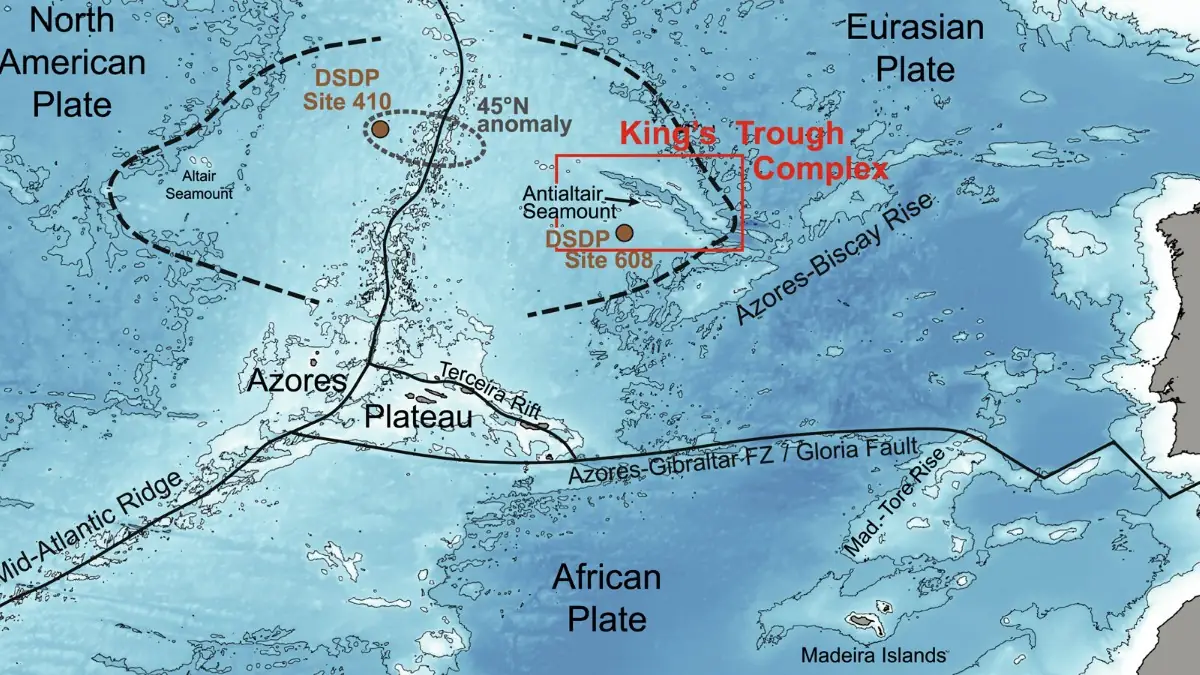
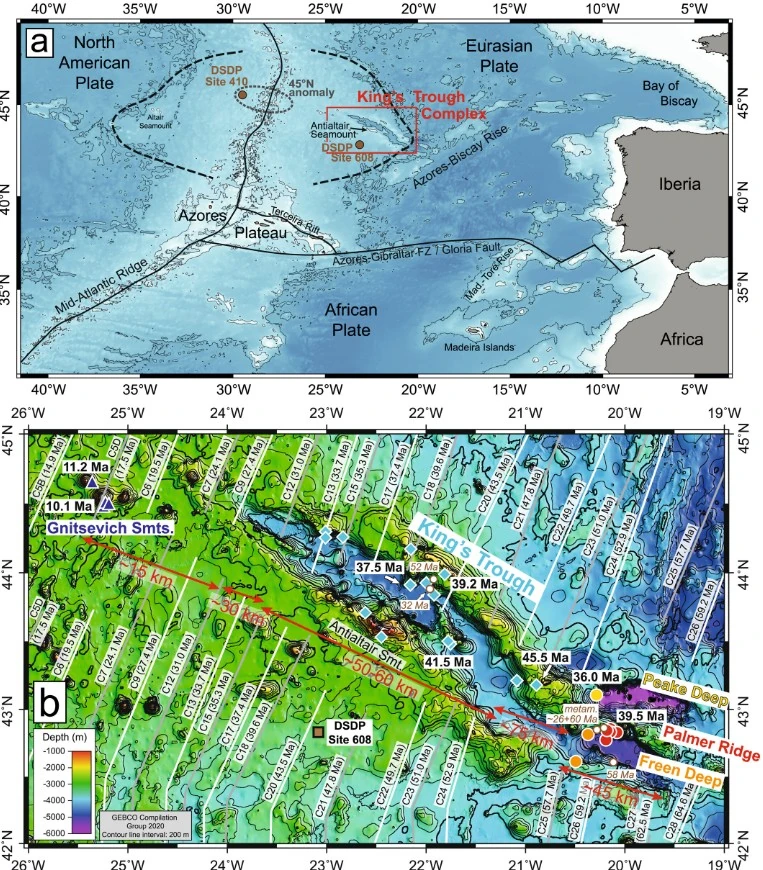
Overview map of the eastern North Atlantic (based on www.gebco.net) with a red frame indicating the location of the King's Trough Complex (detailed map in b) northeast of the Azores Plateau. Credit: Dürkefälden A. et al. (2025)
The King’s Trough Complex is a 500 km (310 miles) long system of deep trenches and basins situated roughly 1 000 km (620 miles) off Portugal’s coast in the North Atlantic Ocean.
Its formation had remained unclear since its discovery in mid-twentieth-century bathymetric surveys. While earlier interpretations proposed that the structure resulted from simple crustal extension within the ocean basin, new research from the GEOMAR Helmholtz Centre for Ocean Research Kiel provides a comprehensive alternative model rooted in plate-boundary dynamics and mantle upwelling.
The new study was published in Geochemistry, Geophysics, Geosystems (G-Cubed) on January 29, 2026. It identifies a transient plate boundary that once separated the Eurasian Plate and the African Plate as the driving mechanism behind the trough’s formation.
Between approximately 37 and 24 million years ago, this boundary unzipped the oceanic crust east to west “like a zipper,” creating a series of parallel depressions and deep basins. At the eastern end, Peake Deep marks one of the Atlantic’s deepest known points.
Chemical and geophysical evidence show that before this boundary developed, the underlying oceanic crust was already anomalously thick and hot. Upwelling mantle material had weakened the lithosphere, making it a natural path for plate movement.
The researchers attribute this thermal anomaly to an early offshoot of the modern Azores hotspot, which today still generates volcanic activity around the islands. Once the boundary shifted southward toward the present Azores region, tectonic activity within the King’s Trough ceased, leaving a fossil plate boundary preserved in the seafloor topography.
Lead author Dr. Antje Dürkefälden explains that the interaction between plume-induced crustal weakening and lateral plate motion offers a clear mechanism for localized rift formation in otherwise stable oceanic lithosphere.
“This thickened, heated crust may have made the region mechanically weaker, so that the plate boundary preferentially shifted here,” explains co-author PD Dr. Jörg Geldmacher, marine geologist at GEOMAR.
“When the plate boundary later moved further south towards the modern Azores, the formation of the King’s Trough also came to a halt.”
Data supporting their conclusions comes from research cruise M168 aboard the RV METEOR in 2020. The team used high-resolution multibeam sonar to map the region and retrieved volcanic rocks with dredging gear from key locations along the trough.
Laboratory analyses of chemical composition and isotopic signatures at GEOMAR and the University of Wisconsin–Madison provided precise age constraints for the magmatic events. Additional bathymetric data were supplied by the Estrutura de Missão para a Extensão da Plataforma Continental (EMEPC), with collaboration from Kiel University and Martin Luther University Halle‑Wittenberg.
The findings of the new study show that mantle-plume activity can predetermine future sites of tectonic deformation by thermally modifying the oceanic crust. This mechanism may also apply to modern settings such as the Terceira Rift, where active trench formation occurs within plume-thickened lithosphere.
The King’s Trough thus serves as a geologic archive linking past and present mantle dynamics in the North Atlantic.
The research adds to the growing understanding that deep-Earth processes and surface tectonics are inseparably connected. By decoding this ancient fossil plate boundary, scientists have effectively solved a long-standing geodynamic puzzle hidden beneath the Atlantic Ocean.
References:
Dürkefälden, A., Geldmacher, J., Hauff, F., Stipp, M., Garbe-Schönberg, D., Frick, D. A., Jicha, B., Ribeiro, L. P., Gutjahr, M., Schenk, J., & Hoernle, K. (2025). Origin of the King’s Trough Complex (North Atlantic): Interplay between a transient plate boundary and the early Azores mantle plume. Geochemistry, Geophysics, Geosystems, 26 (12), e2025GC012616. https://doi.org/10.1029/2025GC012616

I'm a dedicated researcher, journalist, and editor at The Watchers. With over 20 years of experience in the media industry, I specialize in hard science news, focusing on extreme weather, seismic and volcanic activity, space weather, and astronomy, including near-Earth objects and planetary defense strategies. You can reach me at teo /at/ watchers.news.

Commenting rules and guidelines
We value the thoughts and opinions of our readers and welcome healthy discussions on our website. In order to maintain a respectful and positive community, we ask that all commenters follow these rules.