
Grand Canyon origin tied to ancient lake spillover, new geological evidence shows
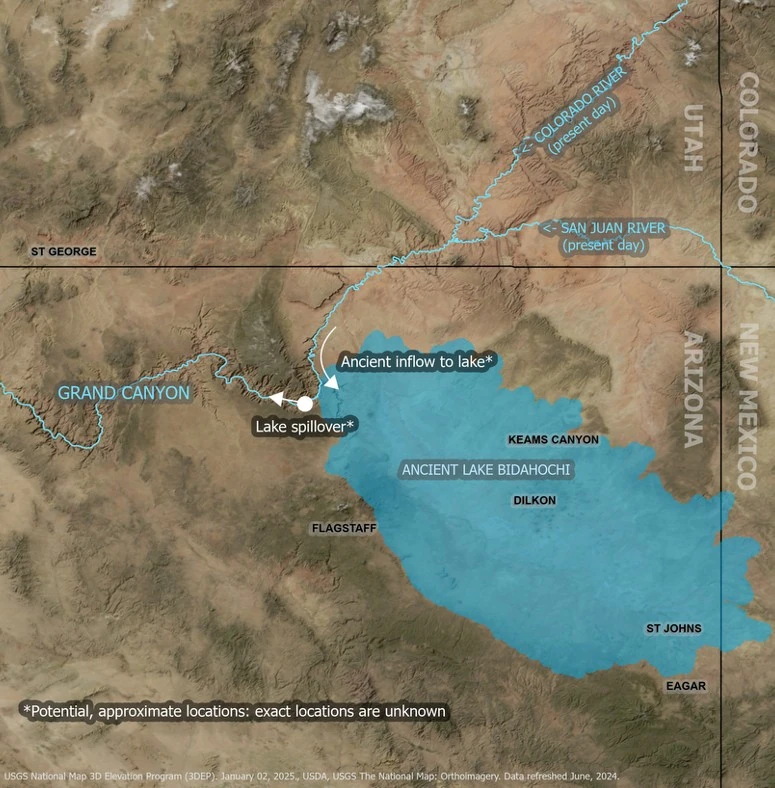
An ancient lake that filled, pooled, and ultimately spilled over may hold the answer to one of geology’s most debated questions: how did the Colorado River carve the Grand Canyon? New evidence published April 16, 2026, in Science supports spillover flooding from Lake Bidahochi as a key mechanism in the river’s integration and the canyon’s formation, with mineral grain analysis placing Colorado River sediment in the Bidahochi Basin of northern Arizona by approximately 6.6 million years ago.
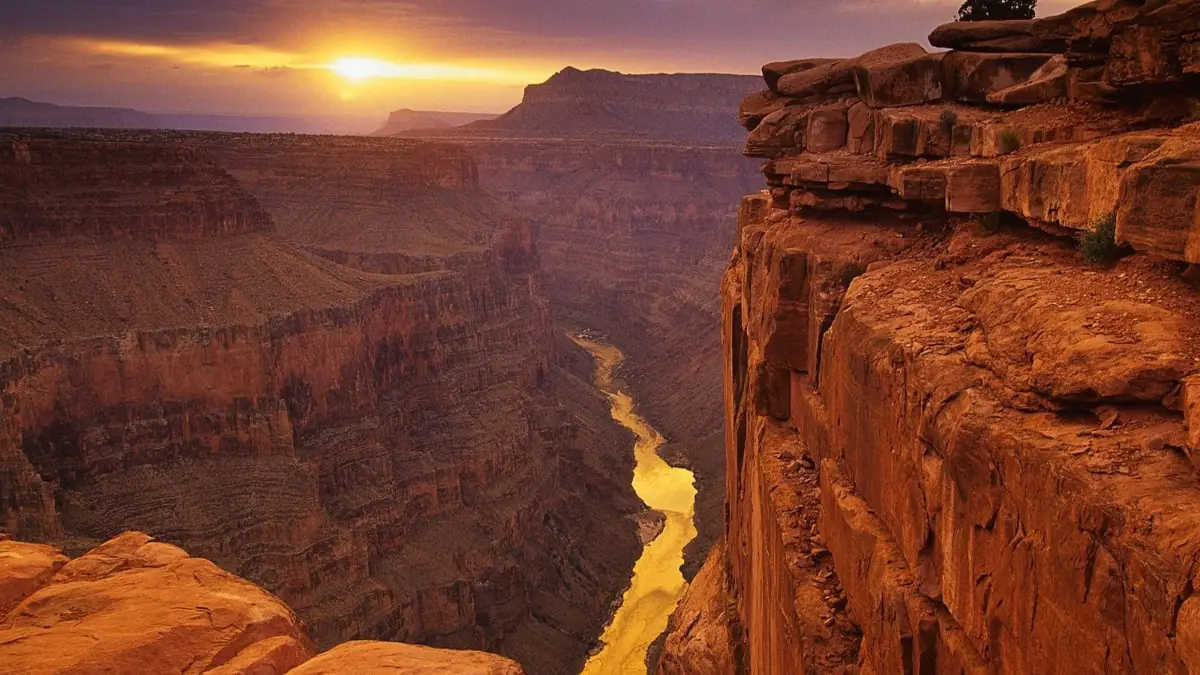
Image credit: Pradeep Bisht
The evidence comes from an unlikely archive: microscopic mineral grains locked in ancient lake sediments.
The study, led by researchers from the U.S. Geological Survey (USGS) and collaborating institutions, analyzed detrital zircon mineral grains preserved in sediments of the Bidahochi Formation. Uranium–lead dating of these grains identified a distinctive population aged between 40 and 25 million years, a signature characteristic of sediment derived from the upper Colorado River watershed. This signal appears in the upper part of the formation and is largely absent in older deposits, suggesting the arrival of Colorado River–sourced material into the basin during the late Miocene.
Radiometric dating of interbedded volcanic ash layers constrains the timing of deposition in the upper Bidahochi Formation to between approximately 6.6 and 6.4 million years ago. The youngest detrital zircon grains, dated to about 6.2–6.5 million years, are consistent with these depositional ages and provide a chronological marker for when the Colorado River began delivering sediment into the basin.
Independent lines of evidence support this interpretation. Depositional rates increased from approximately 10–20 m/Ma in older strata to about 100–400 m/Ma in the upper formation, consistent with the introduction of a major new sediment source. Carbonate deposits show elevated 87Sr/86Sr isotope ratios consistent with Colorado River water, while sedimentary facies shift from fine-grained lacustrine deposits to laterally continuous sandstones indicative of deltaic and fluvial environments.
Fossil fish assemblages recovered from the upper Bidahochi Formation provide additional constraints. Specimens reaching lengths of up to 75 cm (30 inches) display morphological features associated with fast-flowing water, including enlarged fins and narrow tail bases, consistent with sustained river inflow into the basin.
Topographic reconstruction indicates that Lake Bidahochi occupied elevations between approximately 1 805 and 2 250 m (5 922–7 382 feet), approaching the estimated elevation of the Kaibab Arch sill at about 2 300 m (7 546 feet). Under these conditions, continued lake filling would be consistent with the possibility of spillover toward the west, initiating pathways for downstream integration.
The findings address a long-standing gap in the geological record between the presence of the Colorado River in western Colorado at about 11 million years ago and its emergence from the Grand Canyon after approximately 5.6 million years ago. By placing the river in the Bidahochi Basin by 6.6 million years ago, the study constrains the timing of drainage integration across the Colorado Plateau.
Multiple hypotheses have been proposed to explain how the Colorado River crossed the Kaibab Arch and established its modern course, including karst processes, groundwater sapping, and headward erosion. The new evidence supports reevaluation of the spillover hypothesis as a mechanism for integration, while not excluding the contribution of other geomorphic processes in shaping the canyon.
The study also finds that the river system feeding the Bidahochi Basin may have included connections to the Green River and possibly more distant source regions associated with late Miocene volcanic centers. Detrital zircon signatures suggest long-distance sediment transport exceeding 800 km (497 miles), consistent with an integrated fluvial network linking multiple upstream sources.
Integration of the Colorado River system continued after spillover through a sequence of downstream basins, ultimately connecting headwaters in the Rocky Mountains to the Gulf of California between approximately 4.8 and 4.6 million years ago. This phased integration reflects a combination of basin filling, overflow, tectonic uplift, and progressive river incision across the region.
References:
1 John J. Y. He et al., Late Miocene Colorado River arrival in the Bidahochi basin supports spillover origin of Grand Canyon. Science 392, 289-295(2026). DOI: 10.1126/science.adz6826

I'm a dedicated researcher, journalist, and editor at The Watchers. With over 20 years of experience in the media industry, I specialize in hard science news, focusing on extreme weather, seismic and volcanic activity, space weather, and astronomy, including near-Earth objects and planetary defense strategies. You can reach me at teo /at/ watchers.news.

Commenting rules and guidelines
We value the thoughts and opinions of our readers and welcome healthy discussions on our website. In order to maintain a respectful and positive community, we ask that all commenters follow these rules.