
New heron-like dinosaur discovered in Patagonia, Argentina
Paleontologists have identified a new species of heron like unenlagiid dinosaur named Kank Australis from Patagonia in southern Argentina. Researchers say it may have hunted fish and other aquatic prey in rivers and wetlands about 70 million years ago.
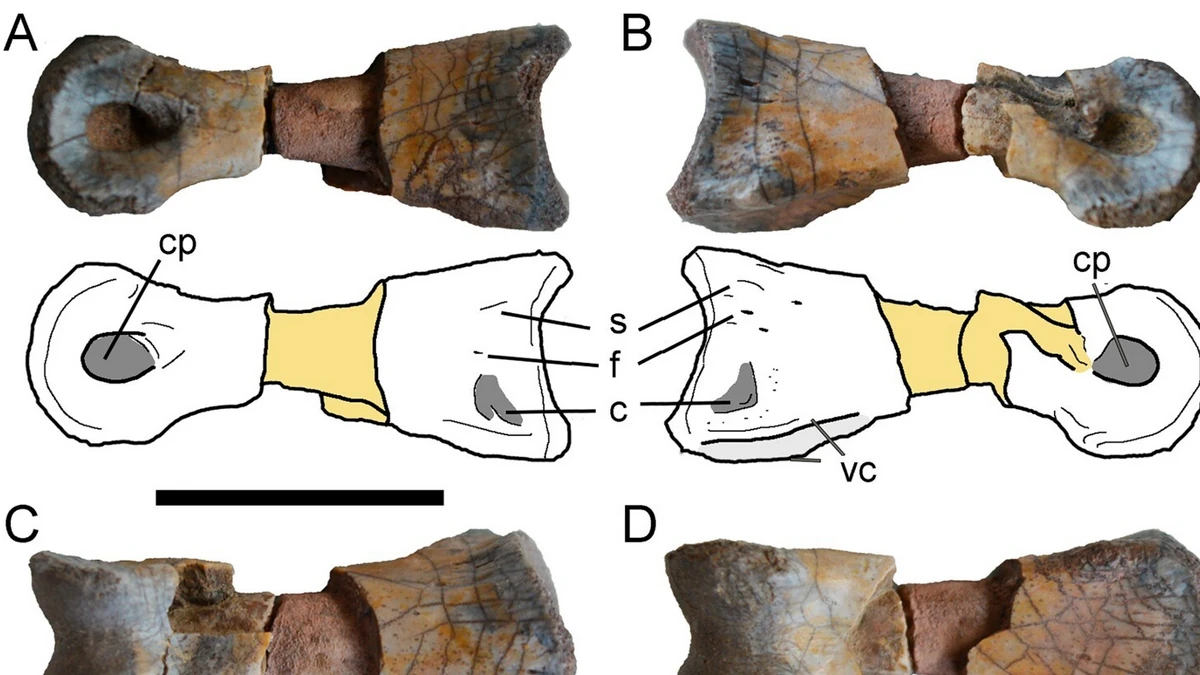
Referred left phalanx III-2 of Kank australis (MPM-PV-22876) in medial. Credit: Matias J. Motta et al. New unenlagiid from the Chorrillo Formation (Late Cretaceous, Maastrichtian), SW Patagonia, Argentina, Taylor Journal of Vertebrate Paleontology.
Paleontologists have identified a new species of dinosaur from Patagonia, Argentina, that researchers believe lived and hunted in a way similar to modern herons.
The dinosaur, named Kank australis, lived about 70 million years ago near the end of the Cretaceous Period, and appears to have fed on fish and other aquatic prey in rivers, ponds, and wetlands.
The discovery adds a new species to the Unenlagiidae, a group of southern-hemisphere theropod dinosaurs related to the broader dromaeosaur, or raptor, lineage.
The fossils include teeth, vertebrae, and toe bones that contained enough unique features for researchers to identify the animal as a previously unknown species.

Although the fossil remains are incomplete, comparisons with related unenlagiids suggest Kank australis measured about 2.5 to 3 m (8.2 to 9.8 feet) in length. Researchers reported that the animal’s anatomy, together with evidence from its environment, is consistent with a predator that searched for food along waterways rather than focusing only on prey found on land.
Kank australis may have relied more heavily on aquatic food sources than most raptor-like dinosaurs. That interpretation led researchers to compare its ecological role with that of modern herons, which hunt fish and other small animals in shallow water.

The comparison does not mean the dinosaur was closely related to herons. Instead, researchers describe a case of ecological convergence, where unrelated animals develop similar lifestyles because they live in similar environments and exploit similar food sources.
Researchers combined information preserved in the fossils with evidence from surrounding rock layers and associated fossil remains to reconstruct the animal’s habitat. That approach allows paleontologists to estimate the type of environment in which extinct animals lived and the food resources that were available to them.

The study suggests that Kank australis lived in a landscape very different from modern Patagonia. Researchers reconstructed an environment that included rivers, ponds, and wetlands populated by fish, mollusks, insects, and aquatic plants.
The discovery is also important for understanding the history of Gondwana, the ancient southern supercontinent, and helps researchers build a clearer picture of life in the Southern Hemisphere near the end of the age of dinosaurs. Unenlagiids are known from South America, Antarctica, Australia, and Madagascar.
The identification of Kank australis adds another member to this group and provides further evidence that unenlagiids remained present in southern ecosystems during the final millions of years before the extinction event 66 million years ago.
By combining fossil evidence, geological data, and environmental reconstruction, scientists are continuing to uncover how ancient ecosystems functioned shortly before one of Earth’s most significant extinction events.
References:
1 Motta, M. J., Aranciaga Rolando, A. M., Rozadilla, S., Agnolín, F. L., Egli, F. B., Álvarez Herrera, G. P., … Novas, F. E. (2026). New unenlagiid from the Chorrillo Formation (Late Cretaceous, Maastrichtian), SW Patagonia, Argentina. Journal of Vertebrate Paleontology. https://doi.org/10.1080/02724634.2026.2656456

I am an Assistant Editor and Severe Weather & Science Journalist at The Watchers, specializing in real-time severe weather coverage, geophysical event reporting, and research-driven scientific analysis. You can reach me at rishav(at)watchers(.)news.

Commenting rules and guidelines
We value the thoughts and opinions of our readers and welcome healthy discussions on our website. In order to maintain a respectful and positive community, we ask that all commenters follow these rules.