
Continent-scale basin system found beneath East Antarctica’s ice sheet
Scientists have identified a vast fan-shaped basin province beneath East Antarctica that extends under roughly half of the East Antarctic Ice Sheet. The newly recognized structure may preserve evidence of tectonic processes linked to mountain building and the breakup of Gondwana.
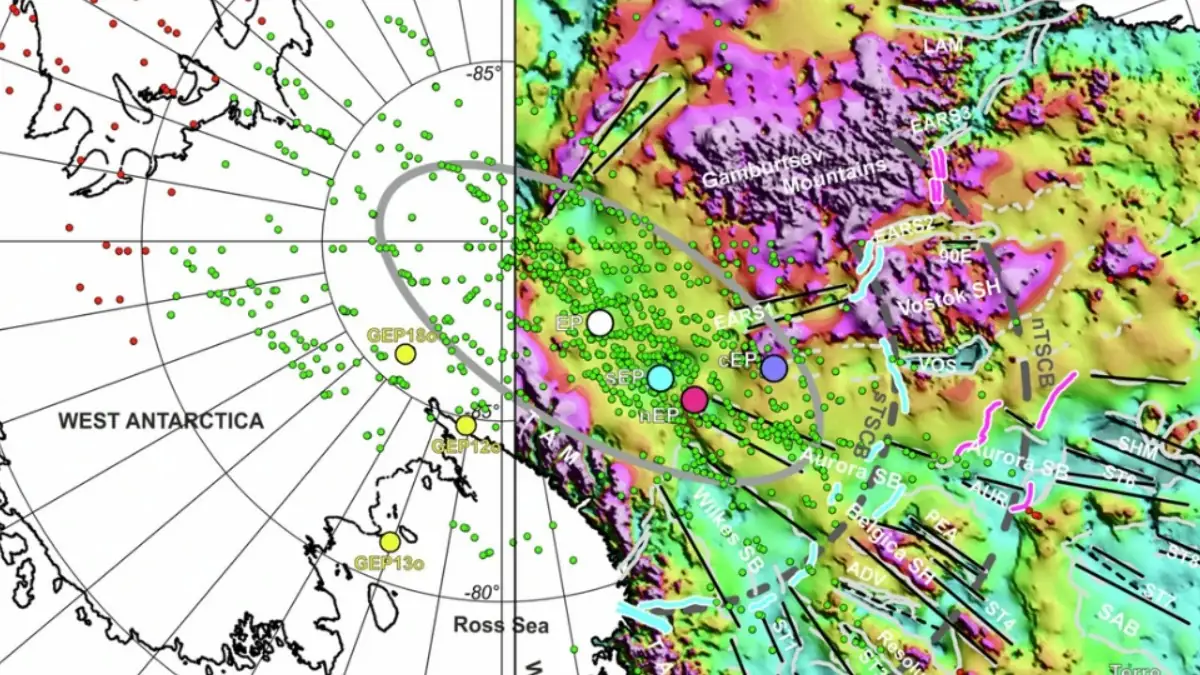
Estimation of the Euler Pole (EP) of the East Antarctic Fan-Shaped Basin Province. Credit: Armadillo, E., Rizzello, D., Balbi, P. et al.
A newly identified geological structure hidden beneath East Antarctica may help explain how part of the continent formed, how major mountain ranges developed, and how the ancient supercontinent Gondwana eventually broke apart.
In a study published in Nature Geoscience, researchers describe a previously unknown continent-scale feature buried beneath the East Antarctic Ice Sheet.
The structure, named the East Antarctic Fan-Shaped Basin Province (EAFBP), consists of a large network of subglacial basins that spreads across a vast region of East Antarctica and lies beneath roughly half of the East Antarctic Ice Sheet. The researchers propose that the province formed through large-scale crustal stretching and rotational movement within Antarctica’s lithosphere before and during the breakup of Gondwana.
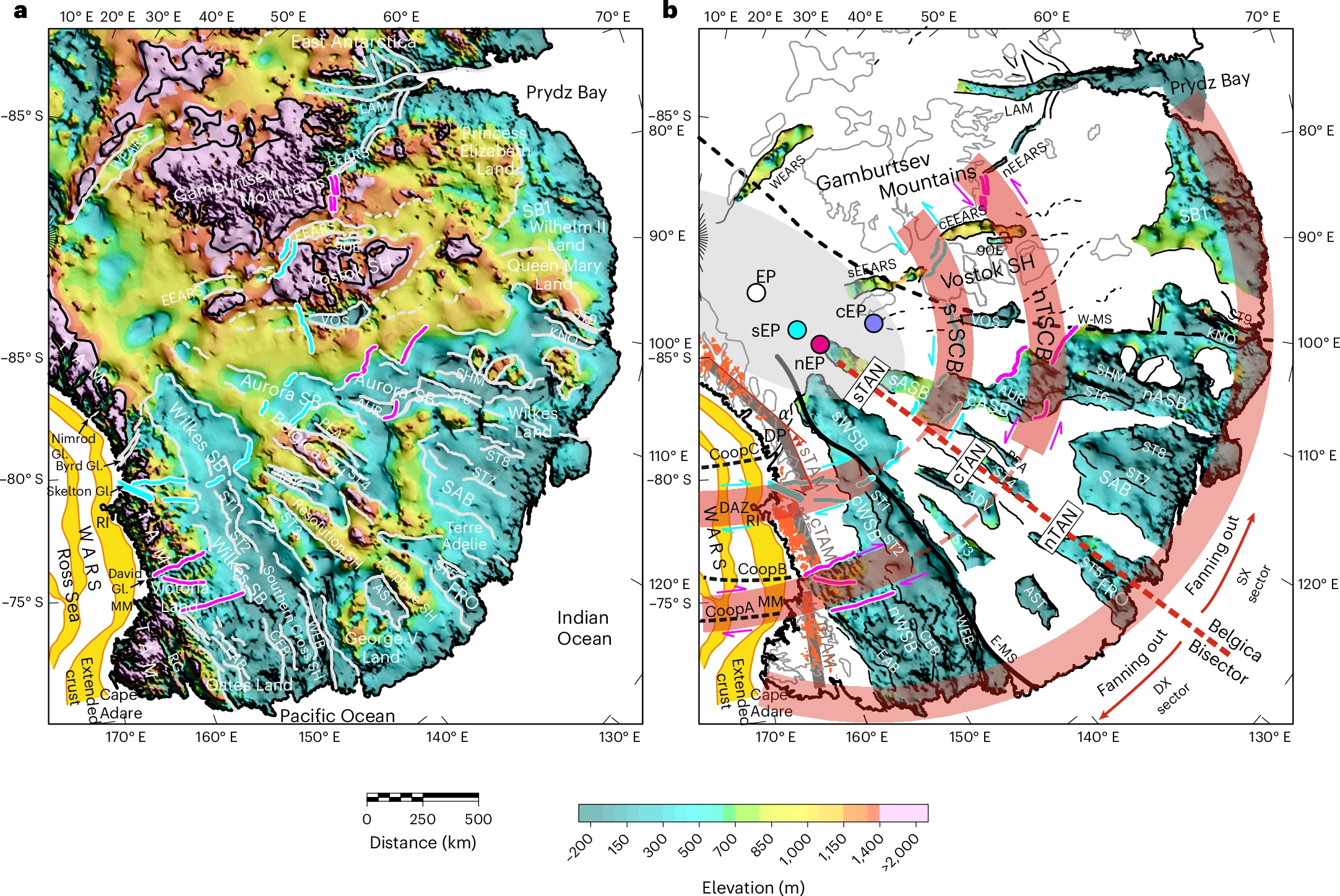
The discovery was made using detailed maps of Antarctica’s hidden bedrock produced from radio-echo sounding surveys and other geophysical datasets.
Although more than 99% of Antarctica is covered by ice, advances in subglacial mapping have allowed scientists to see the landscape beneath the ice sheet with increasing detail. Within the study area, which extends from Prydz Bay to the Transantarctic Mountains, the researchers identified 30 major basins. Many of them have a V-shaped form and follow a north-south orientation. Together, they create a pattern that resembles an opening handheld fan.
To better understand the geometry of the province, the team analyzed the boundaries of the basin system and traced its main structural trends. Their reconstruction identified a common pivot point, known in tectonic studies as an Euler pole, located near 86.4° S and 129.9° E. According to the authors, the way the basins converge toward this point suggests they are part of a single geological system rather than a collection of unrelated depressions beneath the ice.
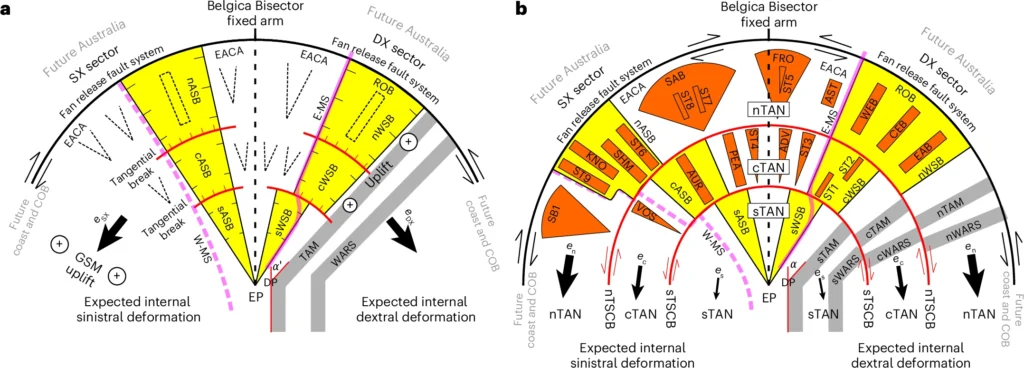
The researchers propose that the East Antarctic Fan-Shaped Basin Province formed through distributed rotational extension, a process in which large sections of the Earth’s crust gradually stretched and rotated around a common center.
This implies that the stretching created the fan-shaped arrangement of basins while also affecting a much larger area of East Antarctica. The authors argue that the process left a geological imprint that can still be seen in Antarctica’s mountains, buried landscapes, and continental margins.
One of the consequences proposed by the study involves the Gamburtsev Mountains, a major mountain range hidden beneath the East Antarctic Ice Sheet.
The authors suggest that compression generated along the western side of the fan-shaped system may have contributed to the uplift of these mountains. Their reconstruction also indicates that increasing tectonic strain toward the eastern part of the province may have helped divide the Transantarctic Mountains into separate blocks and influenced the development of structures within the West Antarctic Rift System.
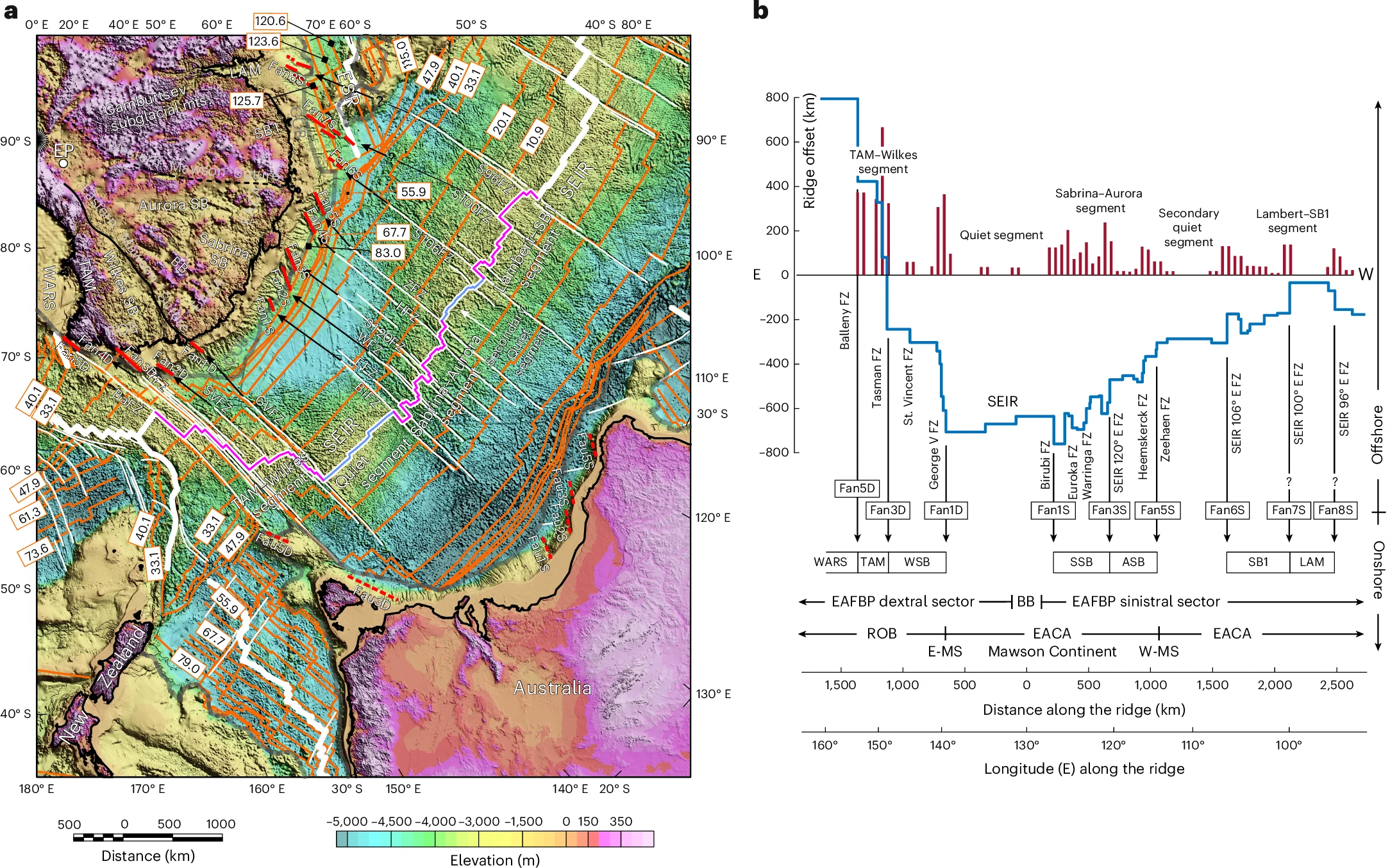
The study also links the newly identified basin province to the separation of Antarctica and Australia. According to the proposed model, the northern edge of the fan-shaped province acted as a zone of weakness within the lithosphere during continental breakup.
According to researchers, deformation along this boundary later evolved into strike-slip faults and pull-apart basins that influenced how Antarctica and Australia separated. In their interpretation, these structures helped create the semi-circular shape of the continental margins seen today and contributed to fracture-zone patterns in the Southeast Indian Ridge.
Several independent datasets support recognition of the East Antarctic Fan-Shaped Basin Province. The researchers combined subglacial topography, crustal-thickness models, gravity measurements, magnetic data, and structural analysis.
They argue that the close match between basin boundaries, fault systems, and larger tectonic features supports the existence of a continent-scale geological framework that remained important throughout later stages of Antarctic evolution.
The discovery is also important for understanding the Antarctic ice sheet. Because the basin province lies beneath approximately half of East Antarctica, its buried topography influences how ice moves across the continent.
The authors suggest that the geological structure of the province has helped shape glacial troughs, outlet glaciers, and long-term ice-sheet development. Understanding how this hidden landscape formed could therefore improve future studies of Antarctic ice-sheet evolution.
The study presents a new way of viewing the hidden geology of East Antarctica. Rather than representing dozens of separate basins, the researchers interpret these features as parts of a single continent-scale system created by rotational extension.
Their model links buried Antarctic landscapes with mountain uplift, continental rifting, ice-sheet evolution, and the breakup of Gondwana, providing a new framework for understanding one of the least explored regions on Earth.
References:
1 Armadillo, E., Rizzello, D., Balbi, P. et al. A fan-shaped subglacial basin province in East Antarctica formed by rotational extension. Nat. Geosci. 19, 715–722 (2026). https://doi.org/10.1038/s41561-026-01991-6

I am an Assistant Editor and Severe Weather & Science Journalist at The Watchers, specializing in real-time severe weather coverage, geophysical event reporting, and research-driven scientific analysis. You can reach me at rishav(at)watchers(.)news.

Commenting rules and guidelines
We value the thoughts and opinions of our readers and welcome healthy discussions on our website. In order to maintain a respectful and positive community, we ask that all commenters follow these rules.