
Greenland ice core connects 686 CE ash layer with Oregon’s Newberry volcano
Microscopic volcanic ash preserved in Greenland ice has been chemically matched to the Newberry Pumice eruption in Oregon, refining the eruption age to 686 ± 2 CE and extending its known ash footprint across the North Atlantic.
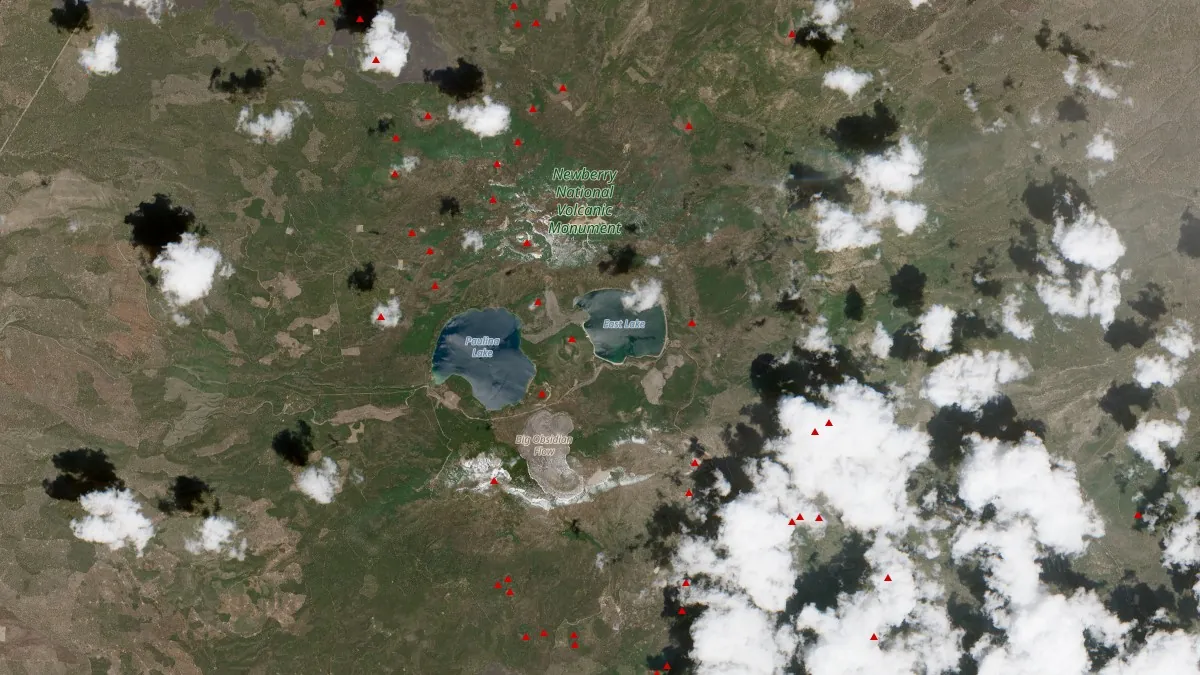
Satellite image of Newberry volcano, Oregon on May 18, 2026. Credit: CopernicusEU/Sentinel-2, The Watchers
Researchers identified ash from Oregon’s Newberry volcano in a Greenland ice core, documenting that the Newberry Pumice eruption transported fine volcanic material more than 5 000 km (3 107 miles) from its source and allowing the eruption to be dated to 686 ± 2 CE. The study is scheduled for publication in Quaternary Science Reviews on May 21, 2026.
The ash was identified as cryptotephra, microscopic volcanic material preserved in ice. Researchers compared the geochemical fingerprint of the Greenland particles with known deposits from the Newberry Pumice eruption and matched them to Newberry’s most recent “Big Obsidian” eruptive period, according to a press release by the University of St. Andrews.
Previous dating placed the eruption within an uncertainty window of about 140 years around the turn of the 7th century CE, but the Greenland ice-core layer narrowed that estimate to within two years of 686 CE, using precise Greenland ice-core age models developed for annual layering.
The eruption reached level 4 on the Volcanic Explosivity Index, placing it in the moderate-to-large explosive range — around 10 times smaller than the Mount St Helens eruption in 1980 (VEI 5), and about 10 times bigger than the VEI 3-4 (moderate-large) Eyjafjallajökull Icelandic eruption in 2010, which caused mass disruption in European airspace.
What was exceptional about this eruption was that its ash was transported across the United States and the Atlantic, over 5 000 km (3 100 miles) from its source
“When we find tiny (0.02 mm) ash fragments in the ice core, it can be really challenging to trace them to their precise volcanic source,” lead author Dr Helen Innes from the School of Earth and Environmental Sciences at the University of St Andrews, said. “So it was a really exciting moment when we compared the geochemical fingerprint to Newberry and it was an exact match.”
“Discoveries like this can unlock so much critical information about past eruptions, their precise timings and importantly, their hazards on a very large scale. Finding such an abundance of ash particles from Newberry thousands of kilometers from the eruption site is key for improving our understanding of how far Cascades volcanoes can send very fine ash particles and what risks they pose in the future to the North Atlantic region.”
The U.S. Geological Survey (USGS) describes the Newberry volcano as having Very High threat potential under the National Volcano Early Warning System (NVEWS), a framework used to prioritize volcano monitoring according to threat.
The 686 AD eruption, identified in the ice cores, is the most recent eruption from it.
“This discovery was really surprising for us. We never would have expected to find so much ash that far away from a moderate sized eruption. This result really highlights the value of investigating past eruptions to understand risks,” Professor Andrea Burke from the University of St Andrews, who led the ice core analysis, said.
Newberry is a broad, low-angle shield volcano east of the Cascade Range, covering about 1 600 km² (618 mi²). Although dominated by basaltic to basaltic-andesite activity and more than 400 cinder cones, it has also produced major silicic eruptions tied to its 6 x 8 km (3.7 x 5 miles) summit caldera, which contains two lakes.
Its eruptive history includes ash-flow and airfall tuffs, basaltic lava flows from flank vents, rhyolitic pumice eruptions, pyroclastic flows, and obsidian flows within the caldera.
References:
1 Innes et al., Precise dating of the 686 ± 2 CE Newberry Pumice eruption and insights into 7th century volcanism from cryptotephra and sulfur isotopes in Greenland ice, Quaternary Science Reviews, DOI: 10.1016/j.quascirev.2026.110036

I'm a dedicated researcher, journalist, and editor at The Watchers. With over 20 years of experience in the media industry, I specialize in hard science news, focusing on extreme weather, seismic and volcanic activity, space weather, and astronomy, including near-Earth objects and planetary defense strategies. You can reach me at teo /at/ watchers.news.

Commenting rules and guidelines
We value the thoughts and opinions of our readers and welcome healthy discussions on our website. In order to maintain a respectful and positive community, we ask that all commenters follow these rules.