I’m a science journalist and researcher at The Watchers, contributing to the Epicenter edition, where I cover peer-reviewed scientific research and emerging discoveries across Earth and space sciences. With a background in astronomy and a passion for environmental science, I’ve worked in shark and coral conservation in Fiji, conducting reef and shark-behavior research, contributing to mangrove restoration, and earning PADI Open Water and Coral Reef Certifications. I bring a blend of scientific rigor and storytelling to illuminate the discoveries shaping our planet and beyond.

  • Solar Orbiter observations reveal avalanche-like reconnection powering a solar flare

    Solar Orbiter has provided direct observational evidence that avalanche-like magnetic reconnection can power a solar flare. The mechanism was observed during a close approach to the Sun on September 30, 2024, as an M7.7-class flare evolved over roughly 40 minutes before reaching peak intensity. The results, published today in Astronomy & Astrophysics, confirm long-standing avalanche models previously supported mainly by statistical flare studies.

  • Polar storms at Jupiter and Saturn reveal hidden differences deep inside the planets

    Scientists at the Massachusetts Institute of Technology report that the radically different polar vortex patterns on Jupiter and Saturn are controlled by how energy flows through their atmospheres and how strongly their deep interiors are stratified, according to research published on January 20, 2026, in Proceedings of the National Academy of Sciences.

  • Tourist helicopter wreckage found near Mount Aso crater after disappearance, Japan

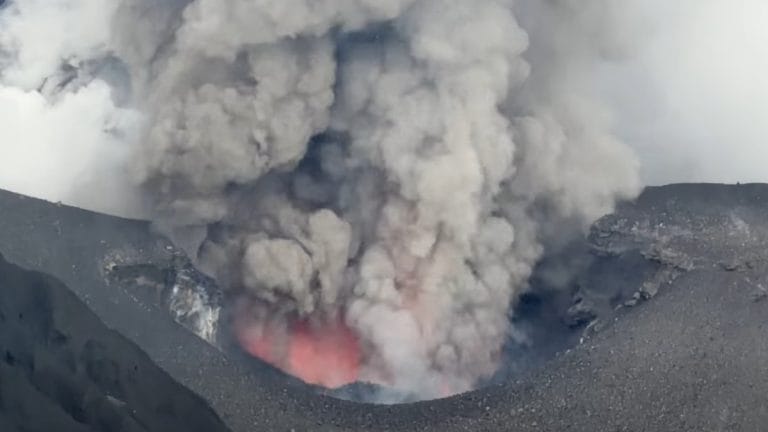
    A sightseeing helicopter carrying two Taiwanese tourists and a Japanese pilot was found wrecked near the crater of Mount Aso in Kumamoto Prefecture, southwestern Japan, on January 20, 2026, after disappearing during a short flight earlier the same day. Rescue operations have been severely hampered by dense volcanic gas emissions and poor visibility around the active crater.

  • Hidden magma oceans shielding rocky exoplanets from harmful radiation

    A study published in Nature Astronomy on January 15, 2026, reports that deep layers of molten rock inside rocky exoplanets known as super-earths could generate powerful magnetic fields, potentially shielding these worlds from harmful cosmic radiation and high-energy particles.

  • Humidity quietly turning U.S. heat waves into a far deadlier threat

    A new peer-reviewed study led by researchers at the University of Florida shows that heat waves across the eastern United States—especially in Florida—are substantially more severe when humidity is included in their measurement, based on nationwide climate data spanning 1981–2023.

  • Nuclear-linked iodine-129 detected in the West Philippine Sea

    Elevated concentrations of iodine-129 were detected in seawater samples collected recently from the West Philippine Sea during a nationwide marine radioisotope survey conducted by the University of the Philippines Marine Science Institute. The concentrations were higher than those measured in other Philippine marine areas, despite the Philippines having no active nuclear power plant or nuclear weapons program.

  • Magma intrusion reshaped plate motion during Antarctica’s largest recent earthquake swarm

    A large earthquake swarm along the Scotia–Antarctica plate boundary between August 2020 and August 2021 was driven primarily by magma intrusion beneath the Bransfield Strait, according to a geodetic study published in Geophysical Journal International on December 13, 2025.