
New gravitational-wave measurement brings astronomers closer to resolving the Hubble tension
Researchers have produced one of the strongest independent measurements yet of the Universe’s expansion rate by revisiting the landmark neutron star merger GW170817 with improved radio observations and gravitational-wave data. The study finds a value for the Hubble constant that is more consistent with measurements of the early Universe than with those based on nearby galaxies, adding important new evidence to one of cosmology’s longest-running debates.
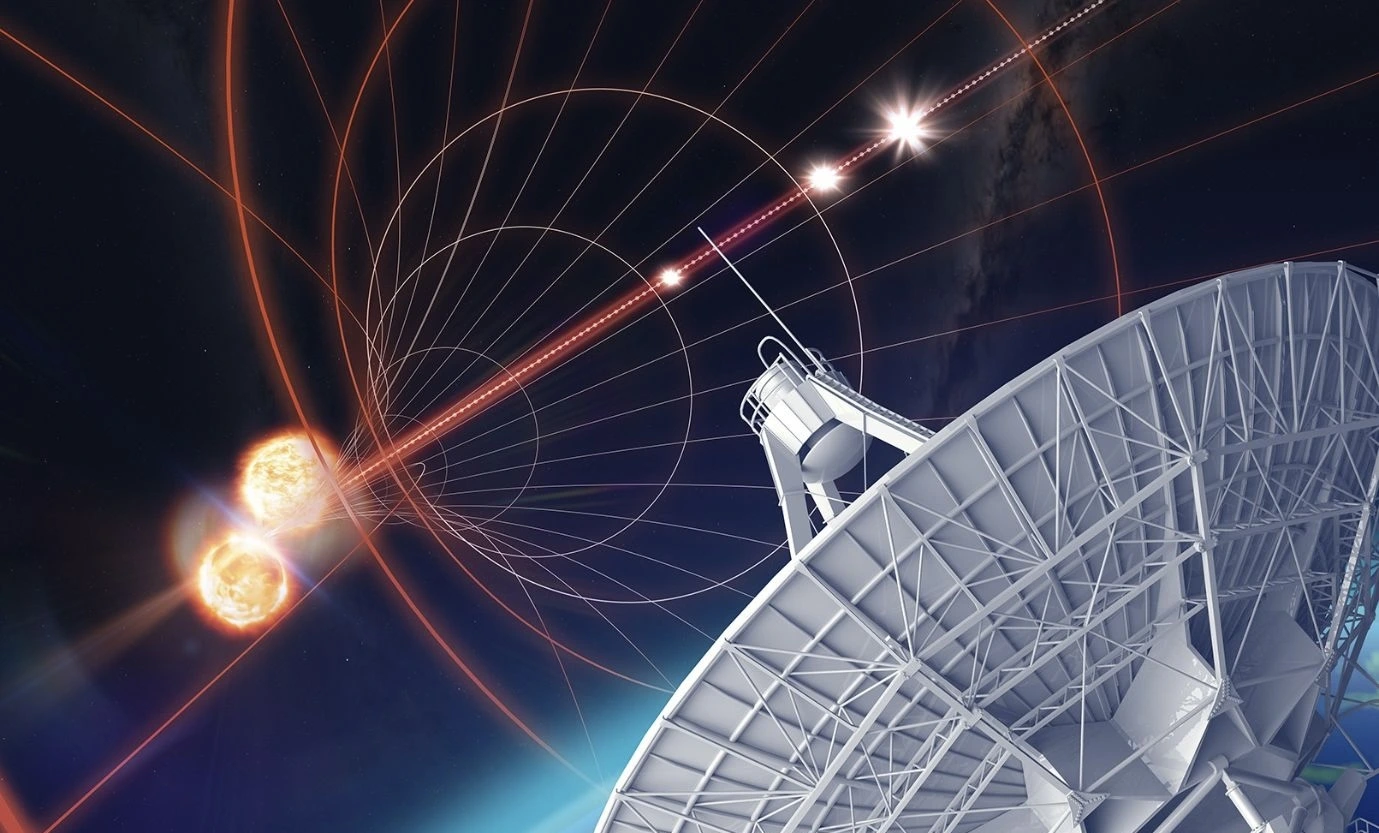
An artists conception of the GW170817 afterglow being observed by an antenna of the Very Large Array. The jet of material launched away from the merging neutron stars causes a radio glow as it interacts with the surrounding gas, which moves with time across the sky. Credit: Carl Knox, OzGrav, Swinburne University of Technology.
For more than a decade, astronomers have been divided over a deceptively simple question: how fast is the Universe expanding?
The disagreement, known as the Hubble tension, stems from two highly precise methods that produce different answers. Measurements based on the cosmic microwave background, the oldest light in the Universe, indicate a slower expansion rate than measurements based on nearby exploding stars. The discrepancy has led some researchers to suggest that new physics beyond the current cosmological model may be required.
Now, an international team led by researchers at Swinburne University of Technology and Australia’s national science agency CSIRO has added one of the strongest independent measurements yet to that debate by revisiting GW170817, the first binary neutron star merger ever detected in both gravitational waves and light.
Their study, published in The Astrophysical Journal on June 29, combines gravitational-wave observations with nearly a year of high-resolution radio observations and optical data to produce a more robust measurement of the Hubble constant, the value that describes how quickly the Universe is expanding.
Unlike traditional methods that rely on a cosmic distance ladder built from multiple types of astronomical objects, gravitational-wave events allow astronomers to measure cosmic distances directly from the physics of the merger itself. That makes them one of the few completely independent ways to estimate the expansion rate of the Universe.
The researchers measured the Hubble constant to be 65.5 ± 4.4 kilometers per second per megaparsec, placing the result much closer to the value measured from the early Universe by the Planck mission than to the higher value obtained from nearby supernova observations by the SH0ES collaboration.
According to the team, their measurement lies within about 0.5 standard deviations of the Planck result but 1.7 standard deviations from the SH0ES measurement. While the uncertainty remains too large to settle the debate, it represents the strongest indication so far from gravitational-wave observations that the lower expansion rate may be correct.
The new measurement was made possible by taking a fresh look at the spectacular aftermath of the 2017 neutron star collision.
The merger launched narrow jets of material moving at nearly the speed of light. Although the jets themselves lasted only a few seconds, they plowed into surrounding gas and produced a radio glow that remained visible for months. By tracking that glow with networks of radio telescopes across the United States and Europe, together with observations from the Hubble Space Telescope, researchers were able to reconstruct the geometry of the explosion with greater precision than before.
“These jets are launched for only a couple of seconds, but as they slam into the surrounding gas, they glow for months afterwards,” said Professor Adam Deller of Swinburne University of Technology, who led the radio observations used in the study.
“We analysed almost a year of observations from the Hubble Space Telescope and two different arrays of radio telescopes spread across the USA and Europe.”
Instead of relying on simplified assumptions used in some previous studies, the team used an improved statistical approach together with advanced computer models of the relativistic jets, allowing them to make fuller use of all available observations while reducing important sources of uncertainty.
The researchers also accounted for the host galaxy’s own motion through space, separate from the overall expansion of the Universe. That random motion remains one of the largest sources of uncertainty when using nearby gravitational-wave events to measure the Hubble constant.
Lead author Dr. Kelly Gourdji said the result adds an important new perspective to the debate.
“Our independent measurement using gravitational waves is a late Universe method, but the result is more consistent with the early Universe value,” Gourdji said.
The finding also places tighter constraints on some proposed explanations for the Hubble tension. If future gravitational-wave measurements continue to favor the lower expansion rate, some models that invoke new physics to explain the discrepancy may become increasingly difficult to support.
Even so, the authors stress that one event is not enough to resolve one of cosmology’s biggest mysteries.
“This would suggest that there is not something wrong with our understanding of cosmology, though we’ll need to examine more neutron star mergers like this one to be sure,” Gourdji said.
“For now, this result adds another data point for cosmologists to consider in the lively Hubble tension debate.”
GW170817 remains the only neutron star merger observed in both gravitational waves and across the electromagnetic spectrum in sufficient detail for this type of analysis. The researchers estimate that roughly a dozen comparable events could reduce the uncertainty in the Hubble constant to around 2 percent, although additional observations will be needed to overcome other sources of uncertainty.
As new generations of gravitational-wave detectors begin operating over the coming years, astronomers expect many more neutron star mergers to be discovered. Each new event will provide another opportunity to determine whether the Universe is expanding at the rate predicted by observations of its earliest light or by measurements of its more recent history.
References:
1 New measurement brings us closer to understanding the Universe’s rate of expansion – Swinburne University – June 29, 2029
2 Revisiting GW170817 at Milliarcsecond Scale: High-precision Constraints on Jet Geometry and H0 – Kelly Gourdji, Adam T. Deller, Chris Flynn, Taya Govreen-Segal, Cullan Howlett, Kunal P. Mooley, and Ehud Nakar et al. – American Astronomical Society – June 29, 2029 – https://iopscience.iop.org/article/10.3847/1538-4357/ae706c – OPEN ACCESS

I’m a science journalist and researcher at The Watchers, contributing to the Epicenter edition, where I cover peer-reviewed scientific research and emerging discoveries across Earth and space sciences. With a background in astronomy and a passion for environmental science, I’ve worked in shark and coral conservation in Fiji, conducting reef and shark-behavior research, contributing to mangrove restoration, and earning PADI Open Water and Coral Reef Certifications. I bring a blend of scientific rigor and storytelling to illuminate the discoveries shaping our planet and beyond.

Commenting rules and guidelines
We value the thoughts and opinions of our readers and welcome healthy discussions on our website. In order to maintain a respectful and positive community, we ask that all commenters follow these rules.