I’m a science journalist and researcher at The Watchers, contributing to the Epicenter edition, where I cover peer-reviewed scientific research and emerging discoveries across Earth and space sciences. With a background in astronomy and a passion for environmental science, I’ve worked in shark and coral conservation in Fiji, conducting reef and shark-behavior research, contributing to mangrove restoration, and earning PADI Open Water and Coral Reef Certifications. I bring a blend of scientific rigor and storytelling to illuminate the discoveries shaping our planet and beyond.

  • Two massive space rock collisions detected around Fomalhaut

    Hubble Space Telescope observations have identified two transient debris clouds produced by separate planetesimal collisions in the Fomalhaut planetary system, located about 25 light-years from Earth, with the second event detected in 2023. The findings indicate that objects previously interpreted as candidate exoplanets are instead the dusty aftermath of rare, high-energy impacts within the system’s debris belt.

  • Ancient African bedrock reveals how Earth became a violent, life-bearing planet

    Ancient rocks exposed in southern Africa show that Earth already had oceans, intense volcanism, strong earthquakes, and microbial life more than 3.2 billion years ago. Preserved in the Makhonjwa Mountains of South Africa and Eswatini, these formations provide one of the clearest geological records of early Earth surface conditions.

  • After five years of monitoring, scientists map Popocatépetl’s interior in 3D

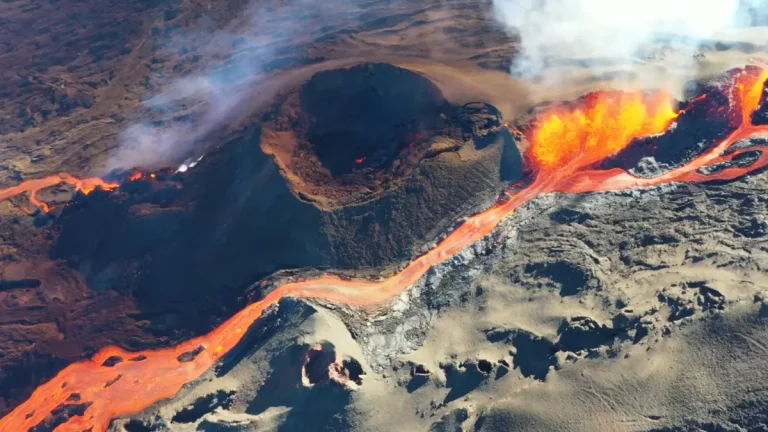
    Before dawn, while most of central Mexico sleeps, a small group of scientists climbs the dark slopes of Popocatépetl, one of the country’s most active volcanoes. Their goal is to recover seismic instruments that, after five years of continuous monitoring, have allowed researchers to construct the first complete three-dimensional image of the volcano’s interior. The model reveals multiple zones where magma accumulates beneath the crater, extending to depths of about 18 km (11 miles), and offers new insight into how Popocatépetl functions and how its eruptions may develop.

  • Temperature inversions in volcanic valleys and the risks they create

    Strong nighttime cooling in volcanic valleys produces deep temperature inversions that suppress mixing and allow gases and ash to accumulate in low-lying areas. The timing of morning breakup governs when pollutants disperse, making these atmospheric structures a critical factor in assessing overnight hazards and morning exposure windows.