
Pico volcano system raised to V1 alert after increased seismicity in Faial–Pico channel, Portugal
Authorities raised the volcanic alert level to V1 in the Faial–Pico channel, Azores, Portugal, on April 9, 2026, following low-magnitude seismic activity that began on April 1. The earthquakes occurred along a NE–SW trend west of Madalena to north of Lagido, spanning depths from 20 km (12 miles) to near the surface. The activity is located within the offshore volcanic system associated with Pico volcano, whose last confirmed eruption occurred in 1720 (VEI 2).

Mount Pico seen from Graciosa island, Portugal. Credit: Dreamsdestroyer
Low-magnitude seismic activity has been recorded since April 1, in the Faial–Pico channel, Azores, Portugal, within a NE–SW oriented structural zone extending from west of Madalena to north of Lagido. The activity encompasses the Cachorro Submarine Volcanic System and includes earthquakes distributed from approximately 20 km (12 miles) depth to near-surface levels.
The Azores Seismovolcanic Information and Monitoring Center (CIVISA) reported that seismicity during this period remained slightly above reference levels. In response to the observed activity, the agency raised the volcanic alert level for the Faial–Pico channel to V1 on April 9.
According to CIVISA’s volcanic alert scale, level V1 corresponds to a system in a meta-stable equilibrium phase with weak activity above reference levels. The activity at this level may be of tectonic, hydrothermal, and/or magmatic origin.
The affected zone includes offshore volcanic structures within the Faial–Pico channel. CIVISA states that, in submarine environments, eruptive activity may occur with limited precursory signals detectable by monitoring systems.
Seismological observations from early April include several small earthquakes recorded near Pico Island and Faial, some of which were felt locally at low intensity.
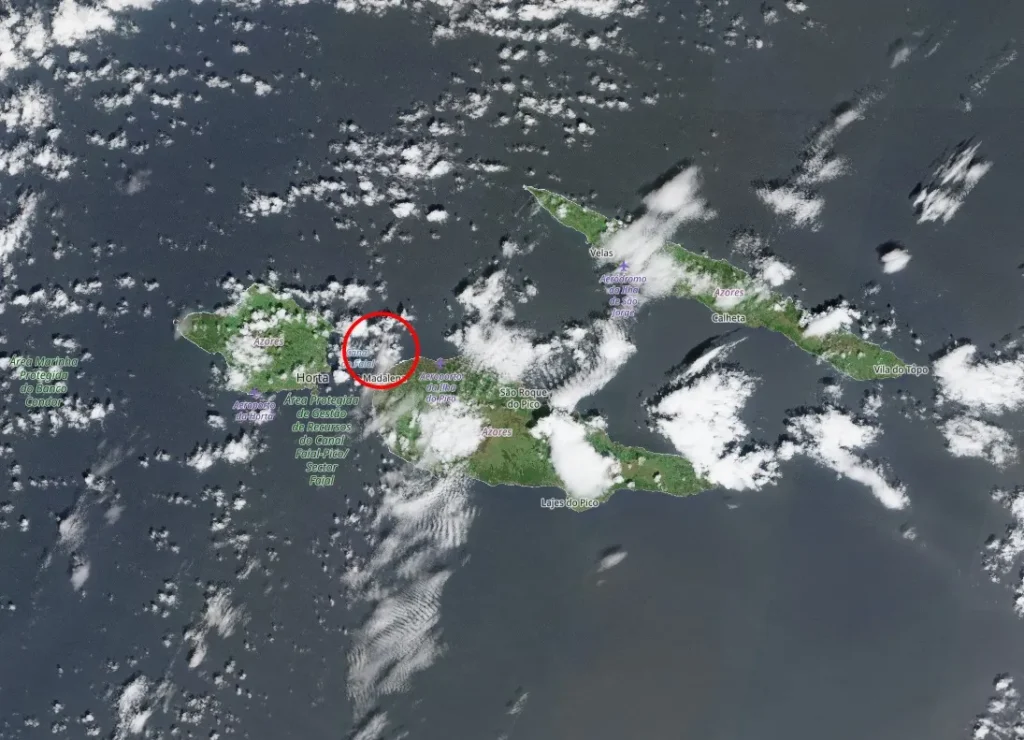
Pico volcano is located on Pico Island and it’s the highest volcano in the Azores, rising to 2 351 m (7 713 feet). The edifice is predominantly basaltic and lies west of an older linear volcanic system with numerous flank cones that form most of the island.
Historical eruptions of Pico have originated primarily from flank fissures. An eruption beginning in 1562 (VEI 2) produced lava flows that reached the northern coast, while fissure eruptions in 1718 (VEI 2) affected both the north and south flanks. During the eruption in 1720 (VEI 2), lava flows from the southeast flank reached the ocean.
The current seismic activity is located within the offshore Faial–Pico channel. No eruption has been reported in association with this episode based on available information from CIVISA.
References:
1 Seismic activity in Faial–Pico channel and alert level update – CIVISA – Accessed April 17, 2026
2 Global Volcanism Program, 2026. Report on Pico (Portugal) (Sennert, S, ed.). Weekly Volcanic Activity Report, 9 April-15 April 2026 – Smithsonian Institution and US Geological Survey.

Teo Blašković founded The Watchers in 2011 and edited it until 2026, covering seismic and volcanic activity, extreme weather, space weather and near-Earth objects. Articles on this page are his archive.
Published in the last 24 hours
- In September 1859, a solar storm lit up the night sky so brightly that gold miners in the Rocky Mountains woke up after midnight and started cooking breakfast, convinced the aurora glowing over their camp was the sunrise Epicenter
- A patch of warm Pacific water that could become the strongest El Niño in more than 70 years sits thousands of miles from any American town, yet it is already the main reason NOAA expects a wetter winter across the South and a milder one across the North
- A 19-year-old Nebraska teacher reportedly tied her pupils together with twine and led them to safety through a blizzard in January 1888 Epicenter
- NASA built the Opportunity rover to last 90 days on Mars, and Martian winds helped keep it alive for nearly 15 years by blowing dust off its solar panels, until a planet-wide dust storm in 2018 blocked sunlight and silenced the rover Epicenter
