
NWS damage survey confirms EF-3 tornado that killed two in Lake Village, Indiana
An EF-3 tornado struck Lake Village, Newton County, Indiana, during the evening of March 10, 2026, killing two people and destroying homes as a long-track supercell moved from northern Illinois into northwestern Indiana. A National Weather Service damage survey determined the tornado produced winds of about 240 km/h (150 mph) and tracked approximately 58.9 km (36.6 miles) across the region.
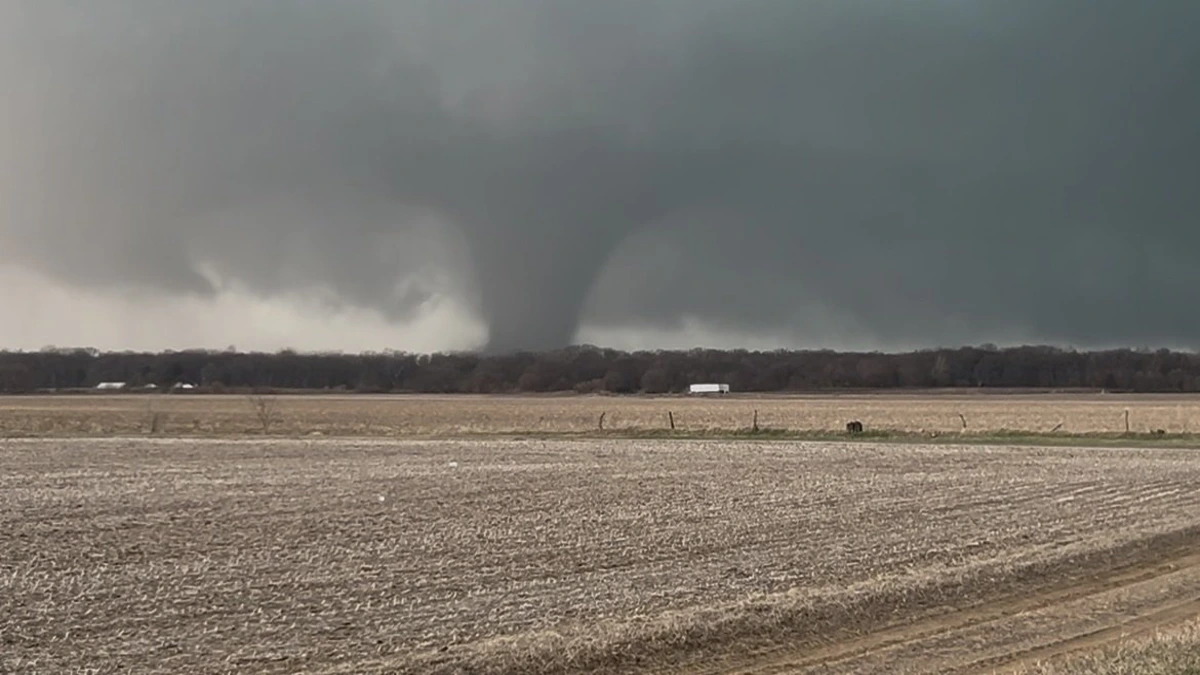
Aroma Park tornado on March 10, 2026. Credit: NWS/Ryan Lapinskas
The National Weather Service (NWS) confirmed that the tornado that struck Lake Village, Newton County, Indiana, during severe storms on March 10, reached EF-3 intensity following a post-storm damage survey. The tornado killed two people and caused significant damage after a long-track supercell moved from northern Illinois into northwestern Indiana.
Survey teams from the NWS Chicago and Northern Indiana forecast offices conducted ground assessments along the tornado path to evaluate structural damage and determine the storm’s intensity using the Enhanced Fujita (EF) scale. Based on the survey findings, the tornado was rated EF-3 with estimated winds of about 240 km/h (150 mph).
The tornado developed just west of Aroma Park in Kankakee County, Illinois, before moving northeast across the Illinois–Indiana border and striking Lake Village. The storm continued toward the DeMotte area before dissipating. Preliminary survey information indicates the tornado remained on the ground for approximately 58.9 km (36.6 miles).
Two residents aged 89 and 84 were killed when the tornado struck their home in Lake Village.
The tornado formed within a long-lived supercell thunderstorm that produced a family of tornadoes across portions of northern Illinois and northwestern Indiana. According to the National Weather Service, this supercell produced tornadoes in Livingston and Kankakee counties in Illinois and in Newton, Jasper, and Starke counties in Indiana.
In addition to the EF-3 tornado affecting Lake Village, NWS surveys confirmed at least two other tornadoes associated with the same storm. These included an EF-1 tornado that tracked from southwest of Wheatfield to near Dunns Bridge, Indiana, and an EF-2 tornado west of Knox in Starke County with estimated peak winds of about 185 km/h (115 mph).
The tornado near Knox prompted the issuance of a Tornado Emergency by the NWS Northern Indiana forecast office as the storm approached the area. This warning was issued as the tornado moved toward Knox and was only the third Tornado Emergency issued by that office.
A Tornado Watch had been issued before the storms developed, and Tornado Warnings were in effect prior to the tornadoes occurring.
The severe weather occurred in an environment favorable for rotating thunderstorms. A sharp temperature gradient developed across northern Illinois and northern Indiana due to a lake-breeze boundary from Lake Michigan, while a warm front remained positioned near the Indiana–Michigan state line. The supercell formed in the warm sector south of the front and remained relatively isolated as it moved across the region.
The Storm Prediction Center had issued a Level 4 out of 5 risk for tornadoes before thunderstorm development.
The supercell also produced exceptionally large hail. Hailstones ranging from approximately 7.6–12.7 cm (3–5 inches) in diameter were reported, and a hailstone measuring 15.2 cm (6.0 inches) in diameter was reported in Kankakee, Illinois. If verified, the Kankakee hailstone could set a new Illinois state record, exceeding the previous record of 12.1 cm (4.75 inches) recorded in June 2015.
Additional thunderstorms developed overnight into March 11 as a strong cold front moved through the region. These storms produced heavy rainfall ranging from approximately 25–75 mm (1–3 inches), with locally higher totals near 100–125 mm (4–5 inches).
Embedded circulations and damaging winds were also observed during storms affecting Wells and Jay counties in eastern Indiana on March 11, and meteorologists continue to review damage reports and imagery from those areas.
References:
1 March 10, 2026: Strong Tornadoes in the Kankakee River Valley and Giant Hail – NWS – March 12, 2026

I’m a science journalist and researcher at The Watchers, contributing to the Epicenter edition, where I cover peer-reviewed scientific research and emerging discoveries across Earth and space sciences. With a background in astronomy and a passion for environmental science, I’ve worked in shark and coral conservation in Fiji, conducting reef and shark-behavior research, contributing to mangrove restoration, and earning PADI Open Water and Coral Reef Certifications. I bring a blend of scientific rigor and storytelling to illuminate the discoveries shaping our planet and beyond.

Commenting rules and guidelines
We value the thoughts and opinions of our readers and welcome healthy discussions on our website. In order to maintain a respectful and positive community, we ask that all commenters follow these rules.