
Kīlauea enters eruptive episode 39 exactly one year into ongoing summit eruption, with lava fountains rising over 420 m (1 400 feet)
Kīlauea entered eruptive episode 39 at 20:10 HST on December 23, 2025 (06:10 UTC on December 24) as lava fountains rose from twin vents on the floor of Halemaʻumaʻu crater. Within about 95 minutes, fountain heights increased from 10 m (30 feet) to more than 420 m (1 400 feet), with lava flows covering 10–20% of the crater floor by 21:14 HST and a plume reaching 6 000 m (20 000 feet).
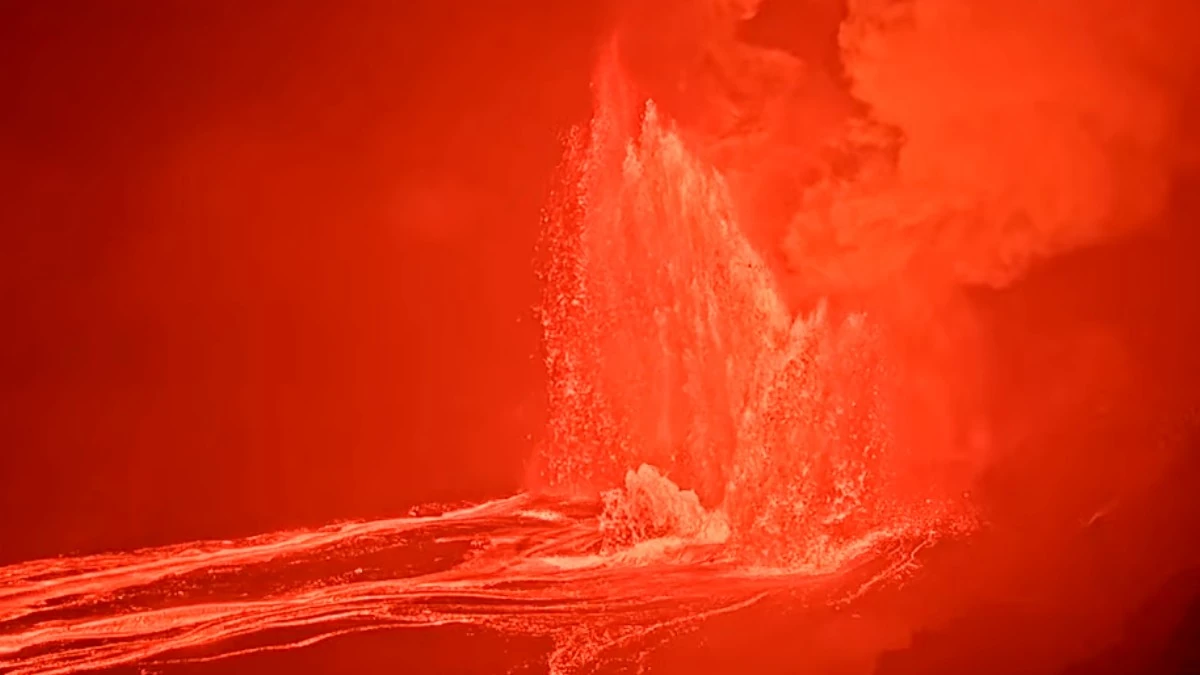
Lava fountains at Kilauea volcano during eruptive Episode 39 at 22:31 HST on December 23, 2025. Credit: USGS/HVO
Eruptive episode 39 at Kīlauea began around 20:10 HST on December 23 (06:10 UTC on December 24) following a series of brief overflows and tremor increases beneath Halemaʻumaʻu crater. This event marks exactly one year since the start of Kīlauea’s ongoing summit eruption sequence that began on December 23, 2024.
HVO field logs show both the north and south vents reactivated almost simultaneously after a short pause at 19:45 HST. Initial fountains measured 10–20 m (30–70 feet) high before increasing rapidly as effusion rates rose.
By 20:27 HST, both vents were producing fountains about 30 m (100 feet) high, shortly after the onset. Fountain heights doubled within minutes, and lava flows advanced across the crater floor. At 20:44 HST, HVO reported fountains reaching 200 m (700 feet), feeding large, active flows. Thirty minutes later, the south fountain climbed to 350 m (1 150 feet) while the north remained near 200 m (700 feet), with an estimated effusion rate of 750 m³/s (900 yd³/s) during the initial phase.
At 21:14 HST, fountains rose to 380 m (1 250 feet) in the south and 280 m (920 feet) in the north, with lava flows covering 10–20% of the floor of Halemaʻumaʻu. By 21:44 HST, the south fountain peaked near 420 m (1 400 feet) while the north decreased to about 210 m (700 feet).
As a result, a strong eruption plume rose to approximately 6 000 m (20 000 feet), drifting southwest and southeast with altitude.
Over the past year, 38 discrete eruptive episodes have originated from the same north and south vents within Halemaʻumaʻu, each lasting several hours and separated by pauses of days to weeks during which the summit inflates.
The most recent HVO daily update issued at 18:24 UTC on December 23 forecasted that episode 39 was likely to begin between December 24 and 25, based on increased summit inflation and sustained low-level tremor.
Sulfur dioxide (SO2) emission rates measured on December 17 were approximately 3 400 tonnes per day, elevated relative to non-eruptive levels of around 100 tonnes per day.
High SO2 concentrations and the resulting volcanic smog (vog) continue to pose health hazards downwind. Lava fountains also produce Pele’s hair and other fine volcanic glass fragments that can travel over 15 km (10 miles) from the vent and cause skin or eye irritation and contamination of water catchments.
As of the last available HVO message at 21:44 HST (07:44 UTC on December 24), lava fountaining and surface flows continued within Halemaʻumaʻu crater.

I'm a dedicated researcher, journalist, and editor at The Watchers. With over 20 years of experience in the media industry, I specialize in hard science news, focusing on extreme weather, seismic and volcanic activity, space weather, and astronomy, including near-Earth objects and planetary defense strategies. You can reach me at teo /at/ watchers.news.

Commenting rules and guidelines
We value the thoughts and opinions of our readers and welcome healthy discussions on our website. In order to maintain a respectful and positive community, we ask that all commenters follow these rules.