
Episode 38 at Kīlauea produces extremely rare triple-fountain event and destroys USGS camera, Hawaiʻi
Kīlauea’s Halemaʻumaʻu crater, Hawaiʻi, began erupting at 08:45 HST (18:45 UTC) on December 6, 2025, when fountains emerged from the north vent, marking the start of Episode 38 of the ongoing summit eruption. Within minutes, a south vent opened, and by 09:15 HST a rare triple-vent lava fountain was active, producing jets up to 370 m (1 200 feet) high and a 6 km (20 000 feet) plume above the summit. The eruption lasted 12.1 hours, covered more than half of Halemaʻumaʻu crater with new lava, destroyed the USGS V3 streaming camera, and ended abruptly at 20:52 HST on the same day (06:52 UTC on December 7).
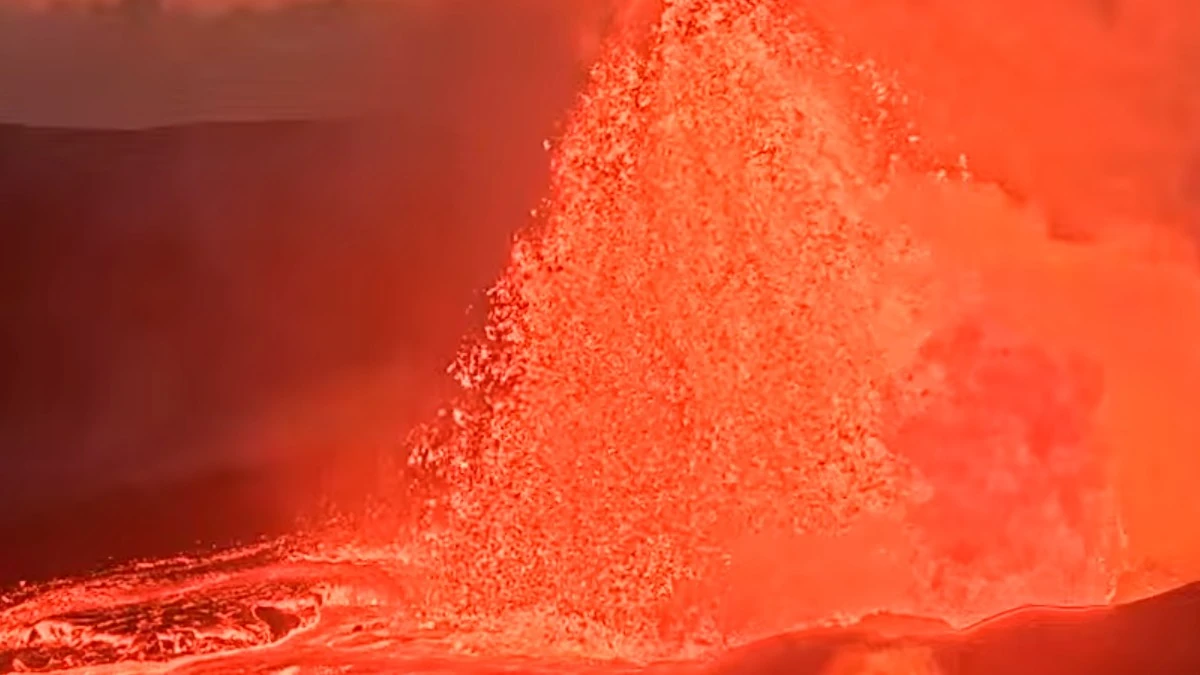
Kilauea volcano, Hawaii eruption on December 6, 2025. Credit: USGS/HVO
Eruption Episode 38 at Kīlauea began at 08:45 HST (18:45 UTC) on December 6 after several hours of north-vent overflows inside Halemaʻumaʻu crater. Sustained fountains quickly developed from two vents in the north cone and one in the south vent, producing a rare triple-fountain event — the first of its kind in the current summit eruption sequence that started in December 2024.
At 08:49 HST, the south vent became active, and by 09:15 HST, three fountains were erupting simultaneously at heights of 120–150 m (400–500 feet). By 09:40 HST the south vent dominated, generating inclined fountains over 300 m (1 000 feet) tall.
“This triple fountain is an extremely rare event, and this is the first time during this eruption it has been observed,” USGS HVO volcanologists said.
The eruption continued for 12.1 hours before ceasing abruptly at 20:52 HST (06:52 UTC on December 7). Fountain activity produced an estimated 12 million m³ (16 million yd³) of lava, with an average discharge rate of 190 m³/s (250 yd³/s) and a peak effusion of 1 000 m³/s (1 300 yd³/s).
Lava flows from Episode 38 covered 50–60 percent of the Halemaʻumaʻu crater floor within southern Kaluapele (Kīlauea caldera).
Video and imagery released by the Hawaiian Volcano Observatory show that the V3 streaming camera, installed on the south rim of Halemaʻumaʻu, was buried by tephra from the inclined south-vent fountain between 09:55 and 09:57 HST. USGS confirmed that the site was destroyed by hot pumice and spatter.
The camera streamed its own destruction live before the feed terminated:
The loss of V3 camera represents the first documented destruction of a monitoring instrument during this eruption sequence. As of early December 7, no replacement or relocation details have been published.
The high discharge rate generated a plume extending more than 6 km (20 000 feet) above sea level. It consisted primarily of water vapor (H2O), sulfur dioxide (SO2), and minor ash. Pele’s hair and fine tephra were reported in Pāhala and adjacent communities, while larger reticulite fragments, up to baseball size, fell along Chain of Craters Road east of Kīlauea’s summit.
Satellite analyses from the Washington VAAC confirmed ash and SO2 plumes rising to about 10.7 km (35 000 feet) above sea level and secondary layers between 4.6 and 7 km (15 000–23 000 feet) drifting south and east. All analyses described ash content as low to moderate, dominated by SO2.
The Uēkahuna (UWD) tiltmeter recorded 33.1 microradians of summit deflation during the event, followed by rapid inflation coincident with eruption end. All activity remained confined within Halemaʻumaʻu crater, with no changes observed in the East Rift Zone or Southwest Rift Zone.
Kīlauea’s Alert Level and Aviation Color Code remained WATCH/ORANGE throughout.
References:
1 Volcano Updates for Kīlauea – USGS/HVO – December 6 and 7, 2025

I'm a dedicated researcher, journalist, and editor at The Watchers. With over 20 years of experience in the media industry, I specialize in hard science news, focusing on extreme weather, seismic and volcanic activity, space weather, and astronomy, including near-Earth objects and planetary defense strategies. You can reach me at teo /at/ watchers.news.

Commenting rules and guidelines
We value the thoughts and opinions of our readers and welcome healthy discussions on our website. In order to maintain a respectful and positive community, we ask that all commenters follow these rules.