
Large tornado carves a 37.1 km (23.1 miles) forest scar in Khanty-Mansi, Siberia, Russia
A long-track tornado up to 2.5 km (1.6 miles) wide crossed remote forest near Taylakovo, Khanty-Mansi Autonomous Okrug, Russia, at around 14:15 UTC on June 17, 2025.

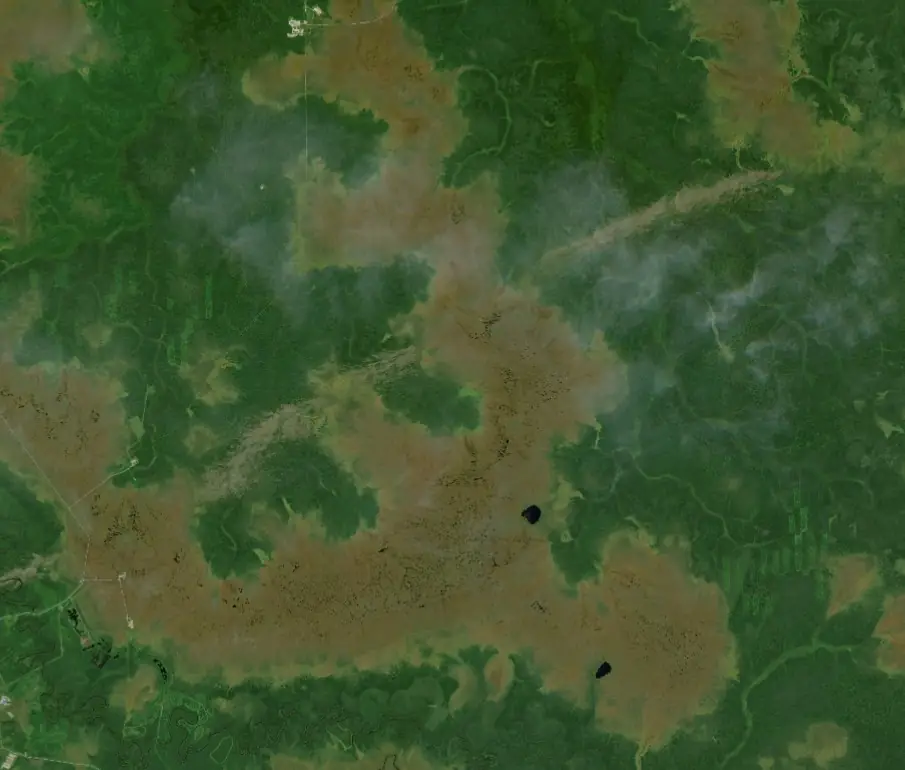
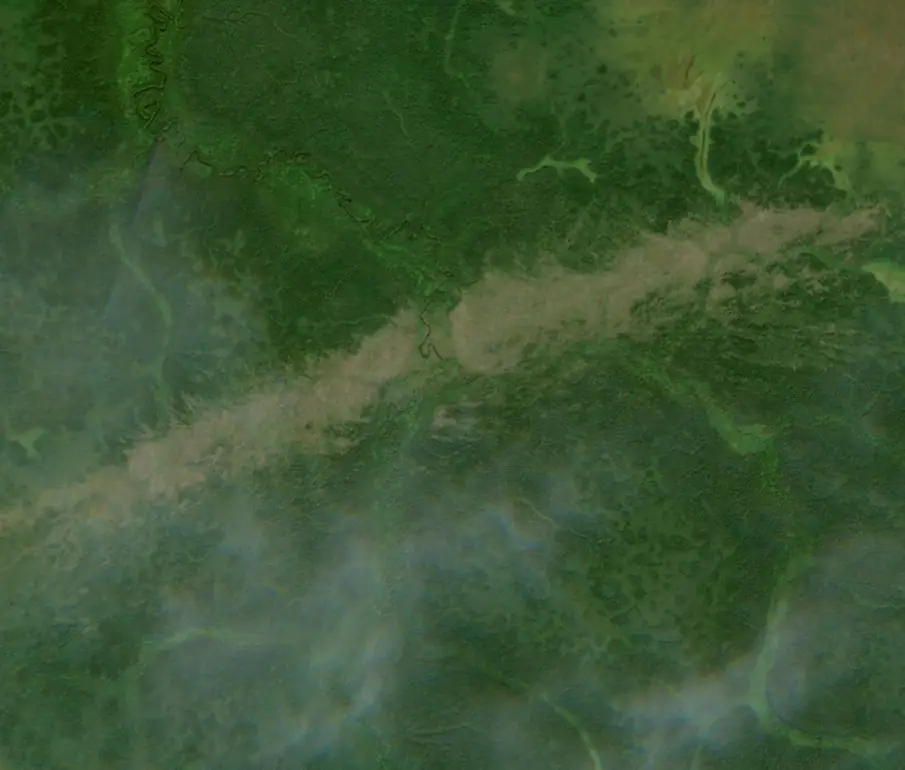
Tornado scar produced on June 17, 2025 in Siberia, Russia. Image credit: Copernicus EU/Sentinel-2, The Watchers. Image acquired on August 1, 2025
A very large tornado crossed remote taiga near Taylakovo, Khanty-Mansi Autonomous Okrug (Yugra), Russia, around 14:15 UTC (± 30 min) on June 17.
According to a confirmed ESWD record (QC1), the tornado moved WSW–ENE, caused forest blowdown, and reached a maximum path width of 2 500 m (1.6 miles) along a 37.1 km (23.1 miles) track. ESWD lists forest impacts only, with no populated places noted.
The ESWD lists the event near 58.78° N, 74.18° E with path start near 58.74° N, 73.99° E and path end near 58.88° N, 74.56° E.
Analysts identified the widest portion of the swath between 58.77109° N, 74.20672° E and 58.78884° N, 74.17934° E using Sentinel-2 L1C (Copernicus) imagery and Landsat data to support the intensity assessment. The report notes forests damaged or destroyed across mixed coniferous–deciduous stands, including birch.
The tornado is rated IF1.5 in the ESWD, using Damage Indicator TSW (trees) with Degree of Damage 4, based on photographs/video and satellite analysis. However, the tornado was likely much stronger.
The IF-scale (International Fujita scale) is ESSL’s European adaptation of the Fujita/Enhanced Fujita approach, with ratings based on calibrated damage indicators and degrees of damage to estimate wind speeds.
Remote-sensing analysis was performed after the event using Sentinel-2 scenes from August 1 and 19, showing a long, high-contrast blowdown corridor.


On June 18, another tornado of IF2 tornado snapped reinforced concrete power poles in southern Russia.
Such events in Russia are considered rare but not exceptional phenomena. Studies suggest that around 150 tornadoes occur annually across northern Eurasia, with most being weak (≤IF1) and short-lived.
Only about 10 per year reach IF2 intensity, and fewer than 3% exceed IF3. The season typically peaks between May and August, with June being the most active month.

I’m a science journalist and researcher at The Watchers, contributing to the Epicenter edition, where I cover peer-reviewed scientific research and emerging discoveries across Earth and space sciences. With a background in astronomy and a passion for environmental science, I’ve worked in shark and coral conservation in Fiji, conducting reef and shark-behavior research, contributing to mangrove restoration, and earning PADI Open Water and Coral Reef Certifications. I bring a blend of scientific rigor and storytelling to illuminate the discoveries shaping our planet and beyond.
Published in the last 24 hours
- One dead, 15 injured and 152 homes left uninhabitable across five regions of Peru after the M6.7 Junín earthquake of 20 November, COEN-INDECI reports.
- WPC flags a Slight Risk of excessive rainfall for the coastal Carolinas on Wednesday as a low forms off Florida and tracks up the East Coast on Thanksgiving Day.
- Scientists directly observe how submarine landslides unfold in western Canada Epicenter
- Odisha evacuated 983,642 people before Phailin crossed near Gopalpur on 12 October 2013 with winds of 200-210 km/h gusting to 220, and 44 died, against 9,885 in the 1999 super cyclone. Cyclone Akvan crossed the same coast on 20 November 2026. Epicenter
