
Reconstruction of high-energy meteorite impact behind Yilan Crater
A new study of the Yilan Crater in northeastern China offers a rare glimpse into the aftermath of a powerful ancient impact. By listening to subtle ground vibrations with passive seismic tools, researchers uncovered a bowl-shaped structure hidden beneath the surface, evidence of a meteorite strike that took place around 49 000 years ago. Their analysis suggests the object hit with such force that the Yilan event ranks among the most powerful known impacts on Earth in the past 80 000 years, likely leaving lasting effects across the surrounding region.

The Yilan Crater in Heilongjiang, China. Credit: Heilongjiang
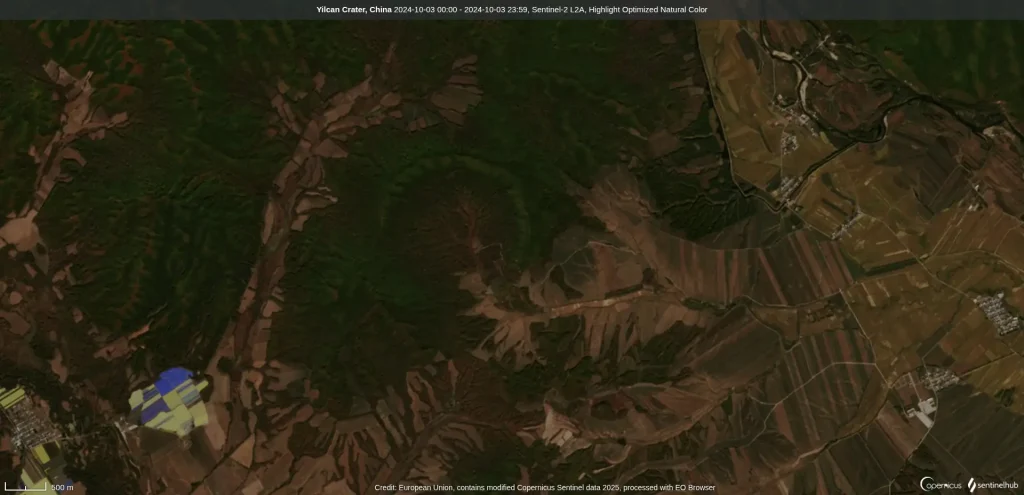
Violent asteroid impacts have shaped Earth’s surface for billions of years, leaving behind craters that serve as geological records of rare, high-energy events. The Yilan Crater in northeastern China, measuring 1.85 km (1.14 miles) in diameter, is one such remnant, a relatively young and well-preserved structure formed by a meteorite strike during the Late Pleistocene.
Buried beneath lake sediments, the crater holds clear shock signatures including fractured granite, melt features, and high-pressure minerals indicative of hypervelocity impact. Radiocarbon dating of charcoal within the infill suggests the event occurred approximately 49 000 years ago, making Yilan the second confirmed impact structure in China, after the Xiuyan Crater.
Detailed geophysical exploration of the Yilan Crater’s subsurface had not been carried out until recently. In 2023, researchers installed a dense array of seismic sensors across the site to fill this gap. By capturing ambient ground vibrations and seismic waves from distant earthquakes, they were able to map the crater’s internal structure. The data also allowed them to reconstruct the impact event, estimating the size, velocity, and energy of the object that created the crater.
Mapping the subsurface geology of the crater through seismic methods
To get a clearer picture of what lies below the surface, the team set up a grid of seismic sensors across the crater. By analyzing natural ground vibrations using methods like ambient noise tomography and Horizontal-to-Vertical Spectral Ratio (HVSR), they uncovered a distinct bowl-shaped structure beneath the site. This area showed slower seismic wave speeds, which matched what you’d expect from a thick layer of loose material and fractured rock.
The ground shook much more strongly near the center of the crater, sometimes up to ten times more than in surrounding areas. This happened because the loose, broken material inside the crater reacts differently to seismic waves than the solid rock below it. That difference in response points to a weakened, fractured zone beneath the surface, which fits what scientists expect from a meteorite impact.
Using data from all their seismic stations, the team calculated how thick the sediment layer inside the crater might be. At the center, they found a very low natural vibration frequency (0.579 Hz). When they ran that through known formulas that link frequency to sediment depth, it pointed to a layer about 125 to 165 m (410 to 540 feet) thick. This lined up well with the 110 m (360 feet) seen in earlier drilling and matched changes in wave speed picked up in their other tests.
The force behind Yilan Crater
To understand what kind of object created the Yilan Crater, the researchers tested a wide range of possible impact scenarios. They adjusted things like the object’s size, speed, angle of entry, and whether it was made of rock or iron. These simulations explored impact speeds from 10 to 70 km/s (6.2 to 43.5 mi/s) and angles between 30° and 60°.
Even though many combinations could have created a crater the size of Yilan’s, the amount of energy delivered to the ground stayed fairly consistent. Most of the results showed an impact energy between 0.75 and 2 × 10¹⁷ joules. Realistically, the most likely scenario involves a mid-sized rocky object hitting the Earth at a 45° angle, releasing around 1 × 10¹⁷ joules of energy. This is comparable to a magnitude 5.5 earthquake.
This makes the Yilan impact one of the strongest recorded on Earth in the past 80 000 years.
Impact and regional consequences
While the Yilan impact wasn’t anywhere near the scale of the Chicxulub event that ended the age of dinosaurs, it still packed far more energy than the well-known Meteor Crater in Arizona. The blast would have been powerful enough to cause serious environmental changes in the surrounding region.
The crater’s formation time (49 300 years ago, based on carbon-14 dating of charcoal layers) coincides with the presence of megafaunal species such as mammoths in the region. Fossils dated to 48 000 to 42 000 years ago have been found in northeastern China, raising the question of whether the impact may have influenced local extinction or migration patterns. Though speculative, such hypotheses open avenues for further interdisciplinary study.
Importance of passive seismic methods to study craters
Studies like this help fill in the gaps when it comes to smaller impact craters, which often go unnoticed because they’ve been eroded, buried, or are hard to identify. Yilan Crater stands out because it’s both well-preserved and easy to study, making it a useful comparison for scientists looking at similar features on the Moon, Mars, and other rocky planets.
This research also shows how passive seismic methods combined with modeling can work well for studying craters. It’s especially useful in places where active surveys aren’t practical. Even low-frequency ground noise can reveal clear details about what lies beneath the surface.
References:
1 Subsurface structure and impact process of Yilan Crater, northeastern China – Yangfan Deng, Samuel Bignardi, Zhou Zhang, et al. – Communications Earth & Environment – April 17, 2025 – DOI https://doi.org/10.1038/s43247-025-02274-5

My passions include trying my best to save a dying planet, be it through carpooling or by spreading awareness about it. Research comes naturally to me, complemented by a keen interest in writing and journalism. Guided by a curious mind and a drive to look beyond the surface, I strive to bring thoughtful attention and clarity to subjects across Earth, sciences, environment, and everything in between.

Commenting rules and guidelines
We value the thoughts and opinions of our readers and welcome healthy discussions on our website. In order to maintain a respectful and positive community, we ask that all commenters follow these rules.