
Most intense solar storm ever recorded struck Earth in 12 350 BC
A massive solar storm that struck Earth over 14 000 years ago has been identified as the strongest ever recorded. Traces of the event were discovered in ancient tree rings, revealing a sharp spike in radiocarbon levels in 12 350 BC. The finding extends the known limits of solar activity and provides a rare reference point for dating events in the Late Glacial period.

Vivid red aurora in Poland triggered by intense solar activity in 2024. Credit: NASA/Mariusz Durlej
An international team of researchers has identified the strongest solar particle event on record, dated to 12 350 BC during the Late Glacial period. The discovery was made by detecting a sharp increase in radiocarbon levels preserved in ancient tree rings, enabled by a new atmospheric model tailored for glacial-era conditions.
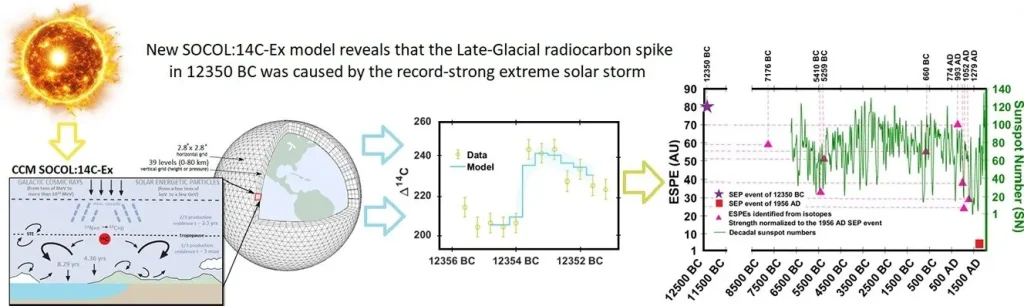
Led by Kseniia Golubenko and Ilya Usoskin, the team developed a new chemistry–climate model named SOlar Climate Ozone Links: Carbon-14 Extended (SOCOL:14C-Ex). The model simulates how high-energy solar particles interact with Earth’s atmosphere under varying climatic and geomagnetic conditions. Previous models were largely limited to the stable conditions of the Holocene, but this version allows simulations during glacial periods as well.
With the help of SOCOL:14C-Ex, the researchers verified that a sudden rise in carbon-14 levels found in tree rings from southwestern Europe around 12 350 BC was triggered by a major solar energetic particle (SEP) event. This burst was about 18 percent stronger than the 775 AD event, which had long held the record for intensity.
The radiocarbon spike reached about 37‰, nearly twice the 20‰ recorded for the 775 AD event. This might seem to point to a much stronger solar outburst. But the team found that the difference mostly reflects glacial-era conditions like lower carbon dioxide, a weaker magnetic field, and different air circulation. Even after correcting for these factors, the 12 350 BC event stands as the most powerful on record.
The team modeled how carbon-14 was produced and moved through the atmosphere after an SEP event. They based it on the shape of the 2005 Ground Level Enhancement (GLE) #69 solar storm but boosted its scale by over 500 times. The estimated timing of the event came between January and April of 12 350 BC, most likely in early March.
This finding sets a new upper limit for solar storm strength and also opens the door to refining radiocarbon dating far earlier than the Holocene. Since tree-ring records become less certain deeper in time, a worldwide carbon-14 spike like this gives a rare reference point for aligning and calibrating ancient timelines.
The study also serves as a reminder of the risks posed by extreme solar activity. A comparable event today would have widespread consequences for satellites, communications, power grids, and aviation. The speculated fluence of particles with energies above 200 MeV (3.2 × 10⁻¹¹ joules) was roughly 1.4 × 10¹⁰ particles per cm2. This is more than enough to overwhelm modern-day technology.
This is the first confirmed solar event of its kind outside the Holocene epoch. It expands our historical knowledge of solar activity and offers a new reference point for paleoclimate and archaeological research.
The solar storm occurred during the Late Glacial period, in the early part of the Bølling–Allerød interstadial, a relatively warm phase following the Last Glacial Maximum. This interval was characterized by rapid warming, widespread glacier retreat, and rising sea levels across many regions.
At the time, Earth’s climate was approaching a major shift into the Younger Dryas, a period of abrupt cooling that began around 12 900 years ago and lasted for approximately 1 200 years. These transitions significantly changed ecosystems throughout the Northern Hemisphere, impacting megafaunal populations such as mammoths, mastodons, and giant ground sloths, which were already under ecological pressure.
Homo sapiens were widely distributed across Eurasia, living in hunter-gatherer groups. In Europe, the Magdalenian culture was gradually being replaced by Epigravettian and early Mesolithic groups. People used advanced stone tools, atlatls, and created symbolic art, including cave paintings and carved objects. Agriculture had not yet begun, as farming would not appear until roughly 3 000 years later.
Boreal forests and tundra-steppe environments dominated the European and Asian landscapes. Human occupation continued at cave sites in regions such as Spain, France, and Siberia. In the Americas, early populations were present, with Clovis culture emerging somewhat later, around 11 500 BC.
The discovery of such an extreme solar storm from this period offers a rare glimpse into solar behavior before the onset of the Younger Dryas. The event adds to our understanding of solar activity during the Late Glacial period and offers new context for interpreting environmental changes leading up to the Younger Dryas.
Some researchers have proposed that abrupt climate shifts around the onset of the Younger Dryas were triggered by a cosmic impact event, an idea known as the Younger Dryas Impact Hypothesis. While the hypothesis remains controversial and is not widely accepted, it has fueled interest in identifying potential high-energy events, such as solar storms or extraterrestrial impacts, that could have influenced Earth’s atmosphere during the Late Glacial period.
References:
1 New SOCOL:14C-Ex model reveals that the Late-Glacial radiocarbon spike in 12350 BC was caused by the record-strong extreme solar storm – Kseniia Golubenko, Ilya Usoskin, et al. – Earth and Planetary Science Letters – April 28, 2025 – DOI https://doi.org/10.1016/j.epsl.2025.119383 – OPEN ACCESS

My passions include trying my best to save a dying planet, be it through carpooling or by spreading awareness about it. Research comes naturally to me, complemented by a keen interest in writing and journalism. Guided by a curious mind and a drive to look beyond the surface, I strive to bring thoughtful attention and clarity to subjects across Earth, sciences, environment, and everything in between.

Commenting rules and guidelines
We value the thoughts and opinions of our readers and welcome healthy discussions on our website. In order to maintain a respectful and positive community, we ask that all commenters follow these rules.