
Solar flares trigger rhythmic changes in Earth’s skies
A new study shows that Earth’s upper atmosphere can pulse in near-perfect sync with subtle rhythms from the Sun. Researchers tracked minute-scale bursts from a powerful solar flare and found matching fluctuations in electron density overhead. The discovery reveals a direct, finely timed link between solar activity and conditions in Earth’s ionosphere.

Image credit: NASA
A new study shows that rapid, rhythmic bursts of energy from a solar flare can cause the upper atmosphere to pulse in sync. These tiny fluctuations, called quasi-periodic pulsations (QPPs), were once thought too subtle to have an impact. However, new research from Queen’s University Belfast challenges that assumption.
According to Aisling O’Hare, the lead author of the study, their research demonstrated for the first time that the Sun’s flare pulsations were mirrored by synchronized pulses in Earth’s atmosphere. She added that the findings reveal just how strongly solar activity can influence our planet.
Researchers examined a powerful X5.4 solar flare on March 7, 2012. Using instruments on NASA’s Solar Dynamics Observatory (SDO) and Geostationary Operational Environmental Satellite 15 (GOES-15) satellite, they recorded sharp rises in extreme ultraviolet light. This energy is strong enough to knock electrons out of atoms in Earth’s upper atmosphere.
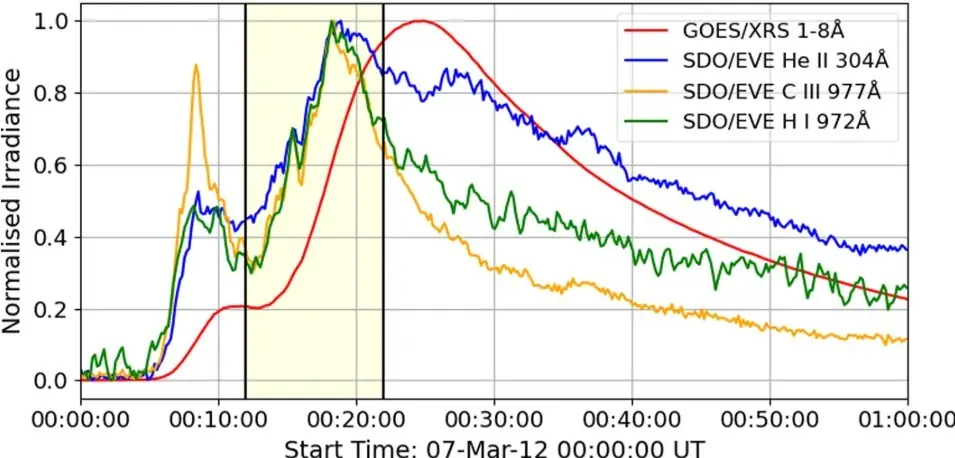
Researchers noted that every 85 seconds, pulses of extreme ultraviolet radiation shot out from the Sun rhythmically. And the Earth’s ionosphere reacted to each pulse.
To assess the ionospheric response, researchers analyzed data from over 250 GPS stations globally. They measured Total Electron Content (TEC), the number of electrons along a vertical column of the atmosphere, using signals transmitted from GPS satellites.

Each burst of ultraviolet energy from the Sun hit at specific wavelengths, like He II 304 Å, C III 977 Å, and H I 972 Å. These wavelengths are known to affect the E and F layers of the ionosphere. As each burst of ultraviolet energy from the Sun arrived, the electron levels went up and down in step with it. The delay between the Sun’s pulse and Earth’s response was only 30 seconds. For the first time, these solar rhythms were clearly reflected in the TEC data.
The 30-second lag, referred to as “ionospheric sluggishness,” represents the ionosphere’s response time to incoming radiation. Although previously recognized, the mechanism remains poorly understood. The researchers suggest that quantifying this delay could improve ionospheric models and help constrain electron recombination rates—factors critical for predicting space weather impacts on GPS and radio communication.
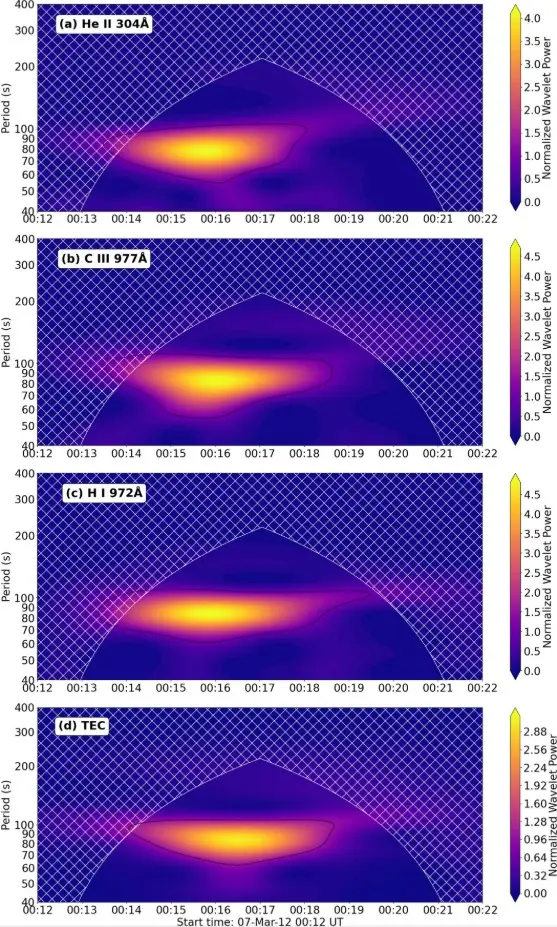
While previous studies have focused on large-scale solar flares and geomagnetic storms, this research shows that minute-scale fluctuations—lasting just over a minute—can propagate across 150–200 million km (93–124 million miles) and measurably influence Earth’s ionosphere. The team intends to explore whether other solar emissions produce similar effects and how these vary under different solar conditions.
References:
1 Quasi-Periodic Pulsations in Ionospheric TEC Synchronized With Solar Flare EUV Emission – Aisling N. O’Hare, Susanna Bekker, Laura A. Hayes and Ryan O. Milligan – JGR Space Physics – April 28, 2025 – DOI https://doi.org/10.1029/2024JA033493 – OPEN ACCESS
2 Sun’s explosions echo in Earth’s skies – Queen’s University Belfast – April 28, 2025

My passions include trying my best to save a dying planet, be it through carpooling or by spreading awareness about it. Research comes naturally to me, complemented by a keen interest in writing and journalism. Guided by a curious mind and a drive to look beyond the surface, I strive to bring thoughtful attention and clarity to subjects across Earth, sciences, environment, and everything in between.

Commenting rules and guidelines
We value the thoughts and opinions of our readers and welcome healthy discussions on our website. In order to maintain a respectful and positive community, we ask that all commenters follow these rules.