
Central Texas under Critical Fire Weather Outlook
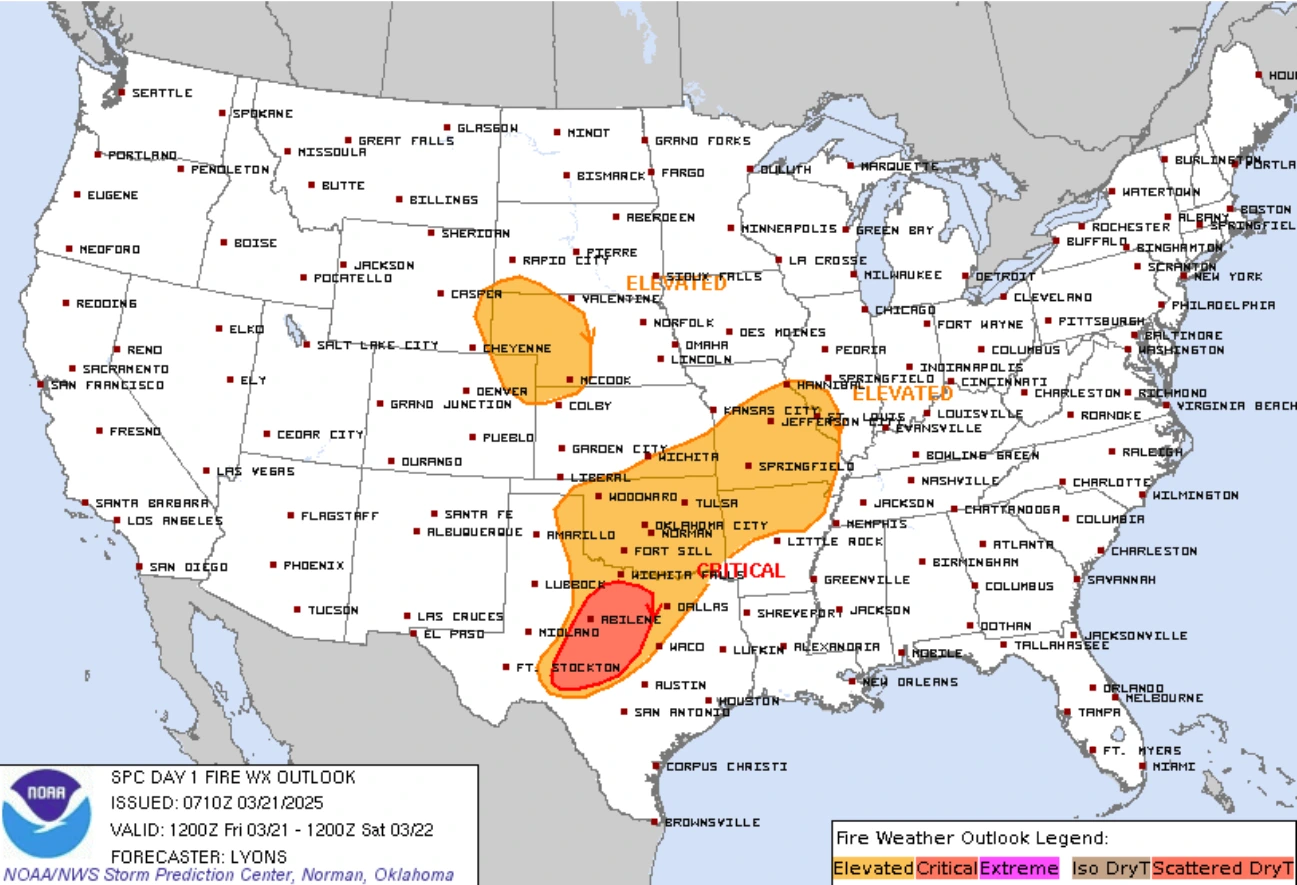
A Critical Fire Weather Outlook has been issued for over 93 240 km² (36 000 square miles) of central Texas on Friday, March 21, 2025, with gusty winds and low humidity expected to create dangerous fire conditions for approximately 1.5 million residents.

Critical Fire Weather Outlook map for March 21, 2025. Image credit: NWS
A Critical Fire Weather Outlook has been issued for much of central Texas for the afternoon and evening of Friday, March 21. Gusty winds and low humidity are expected near a cold front, supporting widespread fire weather concerns due to dry fuels.
An Elevated Fire Weather Outlook is in effect for much of the remaining central and northern Texas and nearly all of Oklahoma. The Critical Fire Weather Outlook covers an area of over 93 240 km² (36 000 square miles), affecting a population of approximately 1.5 million.
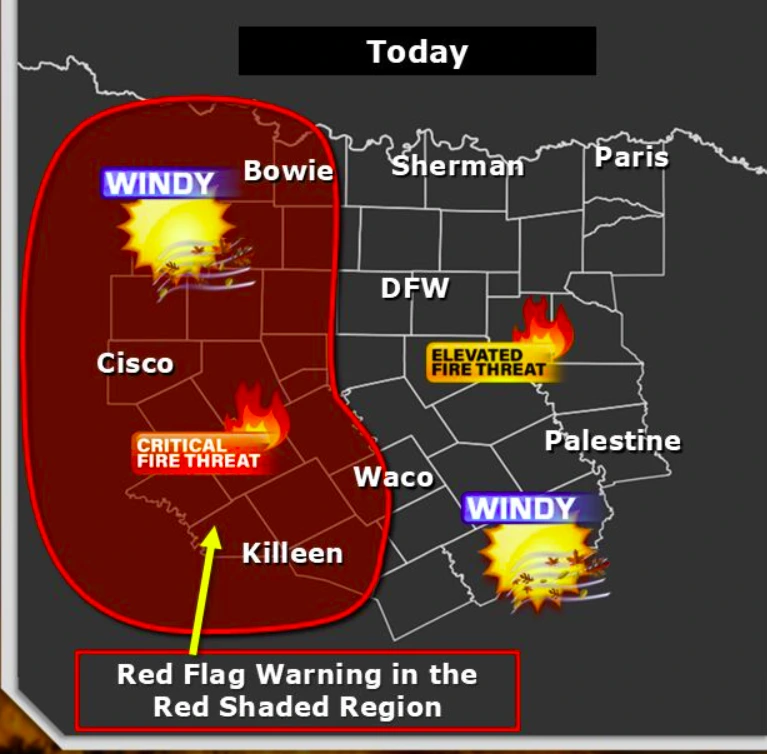
High-population areas in Texas under the Critical Fire Weather Outlook include Abilene, San Angelo, Weatherford, Benbrook, and Brownwood.
The Elevated Fire Weather Outlook also extends to parts of southwestern Illinois, covering large portions of Missouri and Arkansas. Portions of southeastern and northwestern Kansas, northeastern Colorado, western Nebraska, and southeastern Wyoming are also included.
A shortwave trough embedded in northwesterly winds will move from the central Rockies to the southern Plains. A weak surface low will move eastward over the Midwest, with a cold front pushing south into the Plains. This setup will result in gusty winds and low humidity, increasing the risk of fire weather in the central United States due to widespread dry vegetation.
Ahead of the cold front, southerly winds of 24–32 km/h (15–20 mph) are expected during the afternoon. Dewpoints in the range of 1.1–4.4 °C (30s °F) along the northwest Gulf Coast indicate dry air, with relative humidity (RH) dropping to 20–25 %. Widespread elevated to locally critical fire weather conditions are likely due to dry fuels and recent fire activity.
Northwesterly downslope winds gusting at 24–40 km/h (15–25 mph) will follow the cold front, with RH values of 15–25 % due to warming and drying effects. Elevated fire weather conditions are expected from the Nebraska Panhandle southward into the High Plains. Recent rain and snow have slightly reduced fuel dryness, but the risk remains sufficient for elevated fire weather.
References:
1 Day 1 Fire Weather Outlook – NOAA/SPC – March 21, 2025

Rishav Kothari is Editor-in-Chief of The Watchers, where he runs the newsroom and covers earthquakes, volcanoes, severe weather and space weather.
Published in the last 24 hours
- Strong El Niño reinforces above-normal winter precipitation outlook across southern and eastern U.S.
- Scientists directly observe how submarine landslides unfold in western Canada Epicenter
- Odisha evacuated 983,642 people before Phailin crossed near Gopalpur on 12 October 2013 with winds of 200-210 km/h gusting to 220, and 44 died, against 9,885 in the 1999 super cyclone. Cyclone Akvan crossed the same coast on 20 November 2026. Epicenter
- Lava fountains reached 1,900 feet (580 m) at Kīlauea Iki in 1959, the highest ever recorded at Kīlauea, as USGS forecasts episode 57 fountaining at Halemaʻumaʻu for November 22-26. Epicenter
