
New open-access tool enhances volcanic eruption forecasting
Breakthrough research led by a University of Canterbury team has resulted in a new tool, developed using artificial intelligence (AI), to improve the prediction of volcanic eruptions worldwide. This innovative system, designed to recognize seismic patterns, could become part of early warning systems for predicting future eruptions. To maximize its impact, the team plans to release the forecasting models as open-access resources, enabling volcano observatories worldwide to apply them in real-time monitoring and prediction.
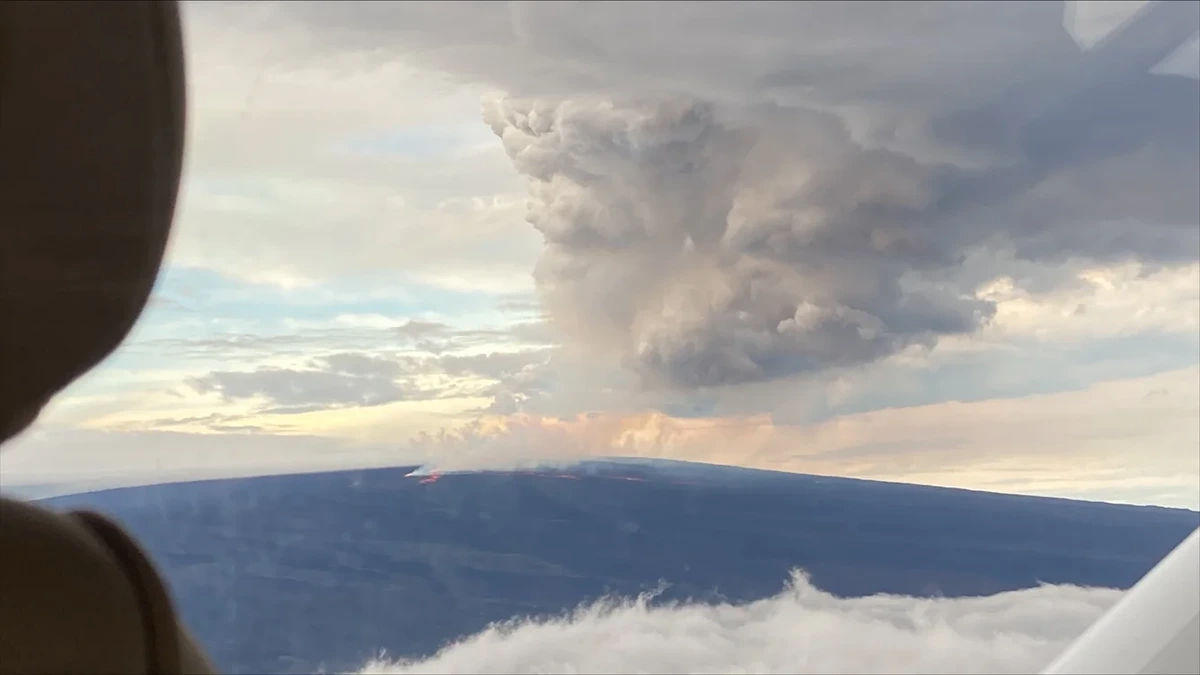
Aerial view of Northeast rift zone eruption of Mauna Loa on November 28, 2022. Image credit: USGS
A research team led by the University of Canterbury has created a machine-learning (ML) model capable of identifying early seismic warning signs of volcanic eruptions. The study analyzed 41 eruptions across 24 volcanoes over 73 years, revealing patterns in pre-eruption seismic activity that can be applied to less-monitored volcanoes.
“This finding could be a breakthrough for eruption forecasting, allowing us to use data from well-monitored volcanoes to improve monitoring and risk mitigation at under-monitored sites, enhancing volcano safety globally,” said Dr. Alberto Ardid, Research Engineer at the University of Canterbury’s Civil and Natural Resources Engineering department.
The research introduces an ML technique known as transfer learning, which identifies shared precursor signals across multiple volcanoes. The approach allows for forecasting eruptions at sites with little to no prior instrumental eruption records. The tool provides a scalable and cost-effective solution for volcanic monitoring by leveraging the common patterns.
Impact on global volcanic risk mitigation
Approximately 29 million people worldwide live within 10 km (6.2 miles) of active volcanoes, making accurate forecasting a critical component of disaster preparedness. Volcanic eruptions can disrupt air travel, agriculture, and global supply chains, causing severe economic and environmental consequences.
“Timely and accurate eruption forecasting can save lives, reduce economic losses, and minimize losses due to disruptions to air travel, agriculture, and global supply chains. Our method provides a cost-effective and scalable solution for improving forecasting at under-monitored volcanoes, benefiting communities and disaster management agencies globally,” Dr. Ardid stated.
The AI-based model also aims to support regions with limited monitoring infrastructure, such as Southeast Asia and Central America, where many active volcanoes remain understudied.
“It will be particularly valuable in developing countries where data is scarce, such as Southeast Asia and Central America, and that is a big motivation behind this project,” Dr. Ardid added.
Collaboration with global volcano observatories
The research team, led by Dr. Ardid and Associate Professor David Dempsey, worked alongside international volcano observatories to ensure the forecasting model provides actionable data. The collaborative approach enables seamless integration with existing volcanic monitoring frameworks. The study also includes contributions from Professor Ben Kennedy at the UC School of Earth and Environment and University of Auckland Professor Shane Cronin, along with 18 researchers from nine countries.
“The modeling tool we’ve come up with is relatively simple, and it’s complementary to existing practices of volcanic observations, but it provides an extra layer of information. It means we can start to think about forecasting eruptions at volcanoes that have never had instrumentally recorded eruptions, such as Mount Taranaki,” Associate Professor Dempsey noted.
The team plans to release the forecasting models as open-access resources, making them available to volcano observatories worldwide for real-time application.
Scientific basis of AI model
The study analyzed 41 volcanic eruptions from 24 different volcanoes, spanning 73 years of seismic data. The researchers categorized volcanoes into three groups based on eruption type: magmatic, phreatic, and a global pool that included all volcanoes. The ML model used a 48-hour window of seismic data leading up to eruptions to train forecasting models.
The model’s performance was assessed through a cross-validation process that withheld test volcano data during training, mimicking real-time forecasting conditions. The accuracy of the AI model was measured using the Receiver Operating Characteristic (ROC) curve, with an Area Under the Curve (AUC) score of approximately 0.8. This score indicates a strong ability to differentiate pre-eruptive signals from background seismic activity.
Comparisons with traditional forecasting methods, such as Real-Time Seismic Amplitude Measurement (RSAM), revealed that the ML model outperformed conventional techniques. The model demonstrated better sensitivity to pre-eruptive activity for phreatic eruptions, where RSAM alone showed an AUC of 0.74 compared to the AI model’s 0.8.
Challenges
Some volcanoes, such as Copahue, displayed consistently high forecasting values between closely spaced eruptions, which may require further refinement of the model. Unheralded eruptions, such as the 2011 Cordon Caulle event, presented limitations in forecasting capabilities because of weak pre-eruption seismic signals.
Future improvements may include incorporating gas emission rates, thermal anomalies, and magnetotelluric data into the forecasting models. The researchers also plan to refine the model’s ability to distinguish between different types of volcanic activity, such as open versus closed conduit eruptions.
The open-access release of the AI model is expected to accelerate advancements in eruption forecasting, enabling real-time adaptation by global volcano monitoring agencies. The tool’s ability to detect shared seismic patterns across different volcanoes offers a step forward in predicting eruptions and mitigating volcanic risks.
References:
1 Next-generation forecasting tool for volcanic eruptions – University of Canterbury – February 26, 2025
2 Ergodic seismic precursors and transfer learning for short term eruption forecasting at data scarce volcanoes – Alberto Ardid, David Dempsey, Corentin Caudron, Shane Cronin, et. al., – nature – February 25, 2025 – https://doi.org/10.1038/s41467-025-56689-x

Rishika holds a Master’s in International Studies from Stella Maris College, Chennai, India, where she earned a gold medal, and an MCA from the University of Mysore, Karnataka, India. Previously, she served as a Research Assistant at the National Institute of Advanced Studies, Indian Institute of Science, Bengaluru, India. During her tenure, she contributed as a Junior Writer for Europe Monitor on the Global Politics website and as an Assistant Editor for The World This Week. Her work has also been published in The Hindu newspaper, showing her expertise in global affairs. Rishika is also a recipient of the Women Empowerment Award at the district level in Haryana, India, in 2022.

Commenting rules and guidelines
We value the thoughts and opinions of our readers and welcome healthy discussions on our website. In order to maintain a respectful and positive community, we ask that all commenters follow these rules.