
Sundhnúkur crater row eruption now second largest since 2023, Iceland
The eruption that started on November 20, 2024, at the Sundhnúks crater row near Grindavik, Reykjanes Penisula, Iceland is now the second largest in the volume of the eruptions that have occurred in the Sundhnúks crater row since December 2023.
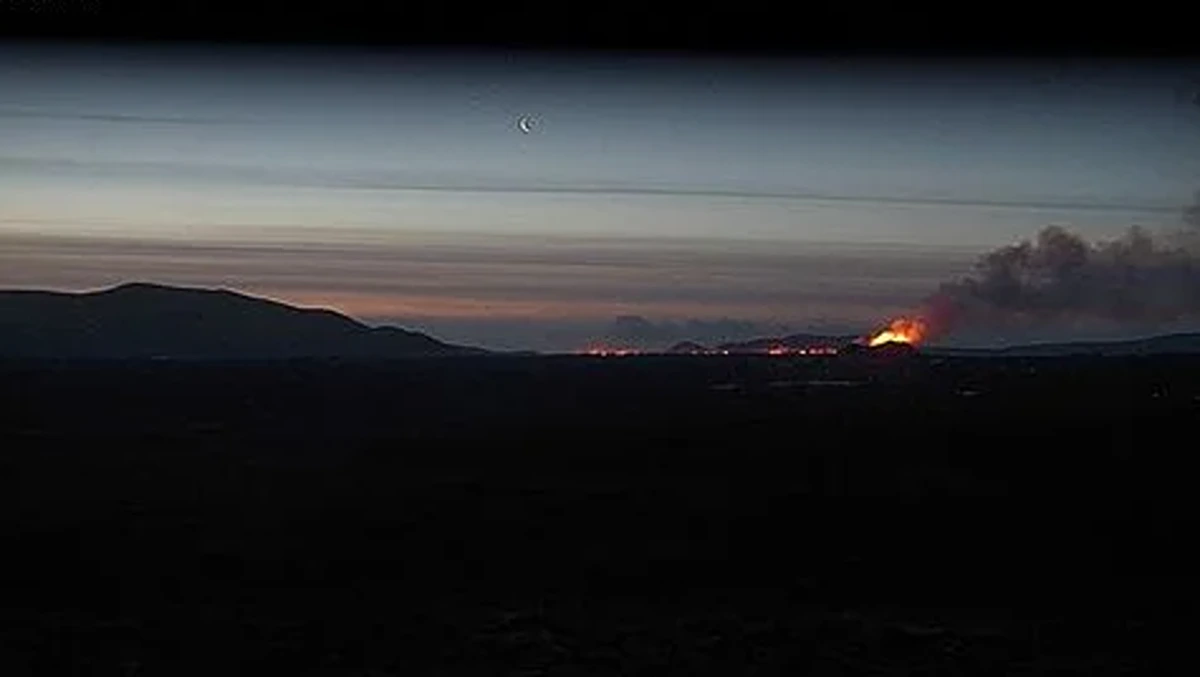
Photo taken at 10:10 LT on November 29, 2024 from the IMO's webcam, installed on November 28 on the western side of Fagradalsfjall, facing northwest towards the active vent and the lava river flowing southeast. Image credit: IMO
The lava flow that has flowed west from the center of the craters has stopped and cooled on the surface, the Icelandic Met Office (IMO) specialists noted early November 30.
“Lava flow can still be expected to continue below the surface towards the defenses at Svartsengi and Blue Lagoon. The northernmost crater is now the only active crater and from it the main lava flow now runs southeast towards Fagradalsfjall.”
The sulfur dioxide (SO2) emission rate, measured on November 28, ranged between 64 and 71 kg/s (141 to 156 pounds/s) creating harmful gas pollution along with hiking trails near the eruption site. Dispersal forecasts predict that wind patterns will direct pollution southwest towards Grindavik.
The Icelandic Meteorological Office (IMO) reported consistent magma inflow beneath Svartsengi contributing to steady volcanic activity on November 29. Lava from the active vent was moving southeast toward Fagradalsfjall.
Deformation measurements in the Svartsengi area show minor daily changes, with magma inflow into the accumulation zone aligning with the observed outflow. Lava flow between November 23 and 28 averaged 11 m3/s (388 feet3/s) This rate decreased to approximately 5 to 10 m3/s (176 to 353 feet3/s).

Aerial surveys by the Icelandic Institute of Natural History on November 28 confirmed that the lava field from this eruption now exceeds 9.1 km2 (3.5 mi2) with an average thickness of more than 5 m (16.4 feet).
The current eruption, ongoing since November 20, has a volume of about 47 million m3 (1.66 billion feet3), surpassing the May-June eruption’s volume of 45 million m3 (1.59 billion feet3) and making it the second largest since December 2023.
The largest eruption in the crater row’s history remains the one between August 22 and September 5, 2024, resulting in a lava volume of 61 million m3 (2.15 billion cubic feet) over 15 days.

The IMO updated its hazard assessment on November 29 which is now valid until December 3.
Gas pollution risk in Zone 1 (Svartsengi) was downgraded from “very high” to “significant,” while overall hazard levels for Grindavik (Zone 4) remain unchanged.
Northeasterly winds, forecasted at 10 – 15 km/h (6 – 9 mph), are expected to direct volcanic gases toward Grindavik raising concerns about air quality.

IMO webcams captured images of the lava river flowing southeast with volcanic tremors remaining stable on November 28. Gas pollution from the eruption had reached areas near Fagradalsfjall. The lava field continued to thicken but expanded only slightly toward the east and southeast.
Activity at the single active vent east of Stóra-Skógfell remained consistent on November 27 with the majority of the lava flowing eastward toward Fagradalsfjall. No uplift was observed although subsidence around Svartsengi decreased requiring further monitoring to assess magma accumulation.
The lava flow rate was as strong as the biggest eruptions at Fagradalsfjall on November 25. The lava moved west putting pressure on barriers near Svartsengi. The danger level for Grindavik was lowered from “high” to “moderate” since the lava was not heading toward the town.
The Sundhnúkur Volcano on the Reykjanes Peninsula in Iceland is erupting! Our guide and pilot Johann Thor Stefansson captured this video showing the expansive fissure and multiple lava rivers flowing from the volcano.
— NatureEye (@natureeye) November 24, 2024
To fly this drone live over the volcano, visit… pic.twitter.com/mJe0dH9ZOZ
The current eruption began at 23:14 UTC on November 20, with a fissure opening between Stóra-Skógfell and Sýlingarfell, about 3 km (1.86 miles) long. Lava initially flowed at 1 300 m3/s (45 908 feet3 per second) but later slowed. Strong north winds blew gas emissions over Grindavik and seismic activity decreased after the eruption began.
GPS measurements near Svartsengi show ongoing ground sinking, indicating significant magma flow to the eruption site. The rate of sinking and ground changes has slowed but experts say more observation is needed to understand long-term trends.
Measurements of the lava field’s size and volume were done by the Icelandic Institute of Natural History, Eflu, Verkis, Svarmi, and the IMO.
Read more:
References:
1 Eruptive Activity Remains Relatively Stable – IMO – November 29, 2024

Rishika holds a Master’s in International Studies from Stella Maris College, Chennai, India, where she earned a gold medal, and an MCA from the University of Mysore, Karnataka, India. Previously, she served as a Research Assistant at the National Institute of Advanced Studies, Indian Institute of Science, Bengaluru, India. During her tenure, she contributed as a Junior Writer for Europe Monitor on the Global Politics website and as an Assistant Editor for The World This Week. Her work has also been published in The Hindu newspaper, showing her expertise in global affairs. Rishika is also a recipient of the Women Empowerment Award at the district level in Haryana, India, in 2022.

Commenting rules and guidelines
We value the thoughts and opinions of our readers and welcome healthy discussions on our website. In order to maintain a respectful and positive community, we ask that all commenters follow these rules.