
Bomb cyclone kills at least 2, leaves over 1.8 million without power in U.S. and Canada
A powerful, rapidly intensifying cyclone wreaked havoc across the northwestern United States and parts of Canada on Wednesday, November 20, 2024, causing at least 2 deaths and leaving more than 600 000 customers (approximately 1.5 million people) in the U.S. without power. Another 140 000 customers (approximately 335 000 people) were left without power in B.C., Canada.

Fallen power line in Seattle due to the impact of Bomb Cyclone on Tuesday November 19 2024. Image credit: Brent Brookler
- A rapidly intensifying storm (bomb cyclone) in the northwestern United States caused 2 fatalities by 19:00 UTC on Wednesday, and injured at least two others, with the most severe incidents occurring near Seattle.
- Over 600 000 customers (1.5 million people) across Washington, southwestern Oregon, and northern California experienced power outages due to the storm, along with an additional 140 000 customers (335 000 people) affected in British Columbia, Canada.
- The storm brought tropical-storm-force winds of 80 km/h (50 mph), gusts up to 113 km/h (70 mph) in the U.S., and up to 160 km/h (100 mph) off the coast of Vancouver Island, causing significant structural damage and fallen trees.
- Heavy rainfall, with up to 200 mm (7.8 inches) predicted in the San Francisco Bay area, has raised concerns over flash floods and mudslides, especially in northern California.
At least two people have been reported dead, and thousands of customers were left without power as a rapidly intensifying cyclone (bomb cyclone) struck the northwestern United States on Tuesday.
The storm brought tropical storm-force winds of 80 km/h (50 mph) and gusts of around 113 km/h (70 mph), toppling trees and power lines across the northwest from Tuesday night into Wednesday morning, November 20.
More than 600 000 customers — approximately 1.5 million people, were left without power across Washington, southwestern Oregon, and northern California.
Two people lost their lives, as of 19:00 UTC on Wednesday. A woman from Lynnwood, north of Seatle, died when a large tree fell on a homeless encampment late Tuesday afternoon. Another woman was killed after a tree fell on her home in King County on Wednesday.
Two others were reported injured after a tree fell on their trailer in Maple Valley, southeast of Seattle.
Visuals shared on social media show fallen trees and widespread damage caused by the storm’s impact across the northwest.
“It’s severe out there. Trees are coming down all over the city, with multiple falling onto homes. If you are able, head to the lowest floor you can and stay away from windows. Do not go outside if you can avoid it,” said the Bellevue Fire Department
Meteorologists at the NWS office in Medford described the storm as one of the most intense on record for this location, exceeding by more than double the threshold required to be classified as a bomb cyclone between Monday night and Tuesday night.
The storm generated extremely rough seas, with multiple buoys in the Pacific Ocean near the Pacific Northwest coast reporting wave heights of nearly 10.4 m (34 feet) overnight on Tuesday.
Schools were closed on Wednesday in parts of Washington State due to fallen trees and widespread power outages.
According to Rich Otto, a meteorologist at the NWS Weather Prediction Center in College Park, Maryland, the storm has just begun, with the biggest surge expected on Thursday, November 21.
“We haven’t gotten a ton of rain yet, just 50 – 75 mm (2 – 3 inches) over southwestern Oregon and northern California,” Otto said.
There is a high chance of flash floods triggered by excessive rain in northern California, leading to the risk of mudslides in the region. The San Francisco Bay could see up to 200 mm (20 cm) of rainfall due to the storm.
Several warnings have been issued by the National Weather Service (NWS) across the northwest due to the storm.
“The active November weather pattern affecting the contiguous United States (CONUS) is expected to persist through the end of the week, bringing hazardous rain, wind, and snow to several regions,” NWS forecaster Snell said.
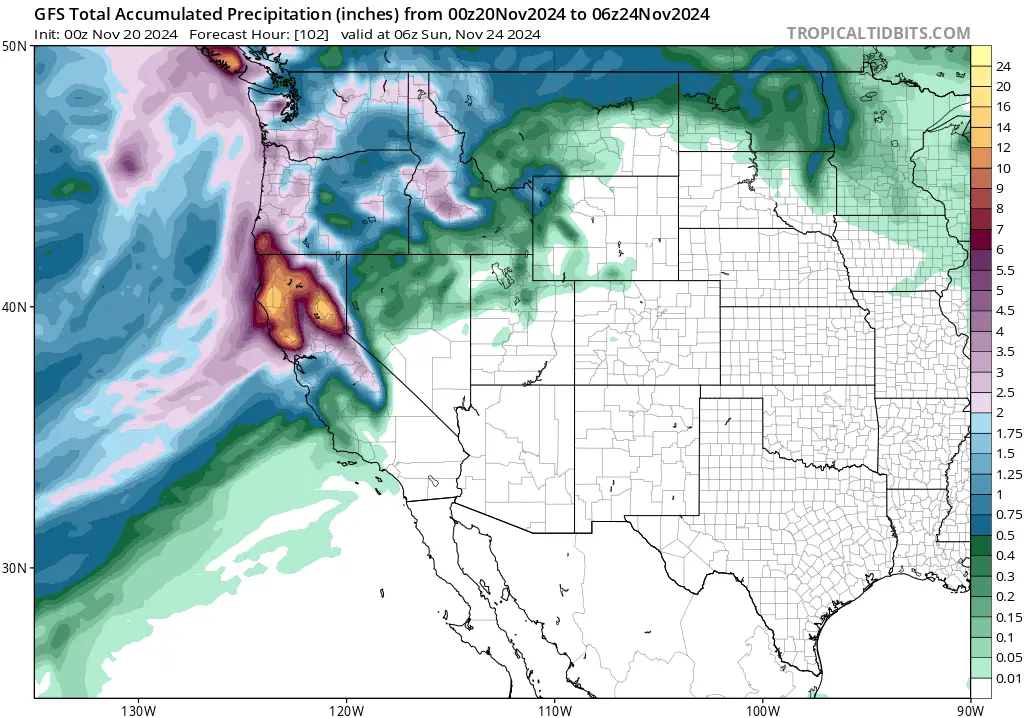
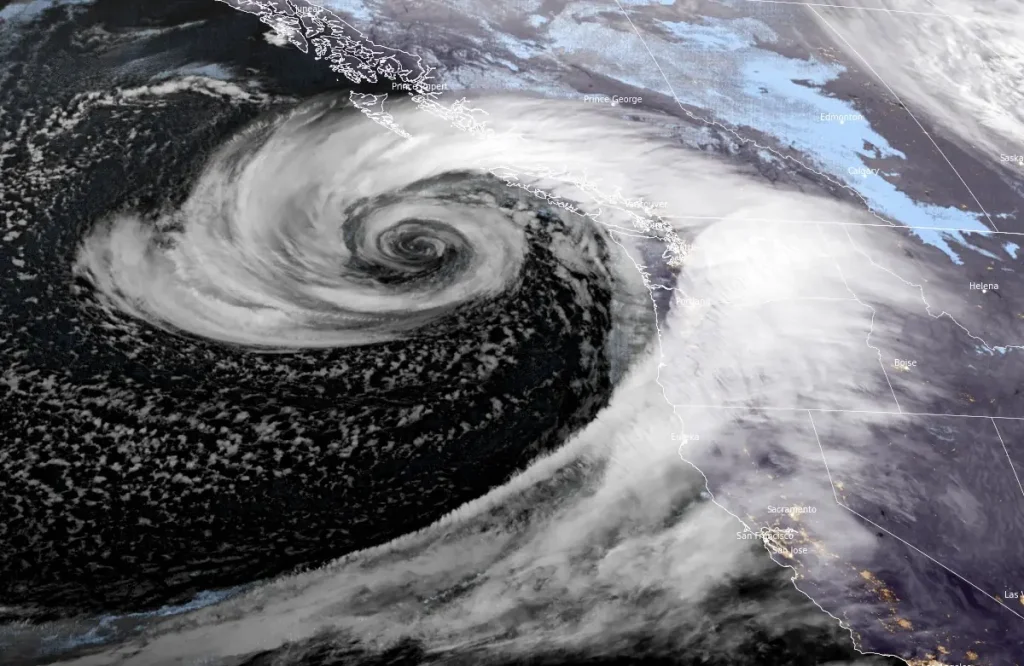
A continuous plume of atmospheric moisture entering northern California this morning is forecast to persist through the end of the week, resulting in extreme rainfall totals. Rainfall exceeding 254 mm (10 inches) along the northern California coast and inland mountain ranges is likely to increase the risk of life-threatening flash flooding, rock slides, and debris flows.
As this corridor of heavy rain lingers along a stationary boundary extending into the Pacific Ocean, a separate low-pressure area is expected to develop and rapidly intensify off the Northwest coast on Friday.
This storm will amplify the atmospheric river flowing into northern California through Friday morning, exacerbating the flood threat. The Weather Prediction Center (WPC) has issued a High Risk (level 4/4) for Excessive Rainfall on Thursday in order to further highlight this concern.
Additionally, another round of strong winds is anticipated from this second low-pressure system across the Northwest by the end of the week.
Residents and visitors in northern California and Washington are advised to monitor road conditions before traveling, follow guidance from local officials, review emergency plans, and ensure they have multiple ways to receive warnings.
The storm is also affecting Canada, with gusts of up to 160 km/h (100 mph) being reported off the coast of Vancouver Island.
Around 140 000 customers (about 335 000 people) were left without power in British Columbia due to the storm, according to the British Columbia Hydro and Power Authority.
References:
1 Short Range Forecast Discussion – NWS/WPC – November 20, 2024
2 Deadly bomb cyclone cuts power for thousands in US north-west – BBC – November 18, 2024
3 Bomb cyclone pounds Northwest US, leaving 600,000 without power – Reuters – November 20, 2024

I am an Assistant Editor and Severe Weather & Science Journalist at The Watchers, specializing in real-time severe weather coverage, geophysical event reporting, and research-driven scientific analysis. You can reach me at rishav(at)watchers(.)news.

Commenting rules and guidelines
We value the thoughts and opinions of our readers and welcome healthy discussions on our website. In order to maintain a respectful and positive community, we ask that all commenters follow these rules.