
20-year study reveals significant ozone depletion due to decades of solar proton events

Image credit: Nature/Authors
A comprehensive study led by Grigoriy Doronin, using data from NASA’s Aura MLS and NOAA’s SWPC, examined mesospheric ozone depletion due to solar proton events (SPEs) over the past two decades. The study, which ran from 2004 to 2024, demonstrated the considerable impact of high-energy protons from the Sun on ozone levels, indicating notable changes in depletion patterns across the northern and southern hemispheres.
- The study sought to quantify the impacts of solar proton events on mesospheric ozone, and found up to 85% depletion in the northern hemisphere and up to 73% in the southern hemisphere, notably during the winter months. The purpose was to understand better how different proton flow intensities affect ozone levels and to improve atmospheric monitoring and forecasting.
- The study examined data from 2004 to 2024, concentrating on global mesospheric ozone, with a particular emphasis on polar regions. Scientists used superimposed epoch analysis on Aura MLS data to examine ozone concentrations before, during, and after SPEs, revealing considerable depletion and 9 to 10-day recovery intervals between hemispheres.
A team of researchers led by Grigoriy Doronin undertook a detailed investigation into mesospheric ozone depletion. Their research, which used data from NASA’s Aura Microwave Limb Sounder (MLS) and the National Weather Service’s Space Weather Prediction Center (SWPC), covers two decades of solar proton events (SPE).
The research that spanned from 2004 to 2024 sheds light on the consequences of solar proton events on mesospheric ozone levels.
The study discovered that SPEs, which are bursts of high-energy protons from the Sun, can cause significant ozone depletion in the mesosphere, especially during the winter months.
Using Aura MLS data, the scientists conducted overlaid epoch analysis to determine how differing proton flux intensities (moderate vs. strong) affect ozone concentrations. Their findings indicate that ozone destruction varies across the northern and southern hemispheres, with considerable depletion detected at altitudes of around 76 km (0.02 hPa pressure level).
The research concentrated on global mesospheric ozone levels, paying special heed to northern and southern hemispheres. The data was collected from the Aura MLS satellite, which provides detailed measurements of atmospheric composition from space. The effects of SPEs were seen in polar regions during the winter months when ozone depletion was most severe.
Over the 20 years that the research spanned through, the SPEs that were analyzed included those that occurred from September to March and from April to August, addressing seasonal variations in ozone depletion. The study gives forth a detailed temporal analysis of ozone levels before, during, and after these events.
Solar proton events are known to disrupt the chemistry of the atmosphere, particularly in the mesosphere. High-energy protons from the sun interact with the Earth’s atmosphere, forming reactive chemicals such as HOx and NOx. These chemicals provide a considerable contribution to ozone destruction.
The study intends to determine the magnitude of this impact based on proton flux intensity, which will aid in anticipating and mitigating the impacts on atmospheric ozone.
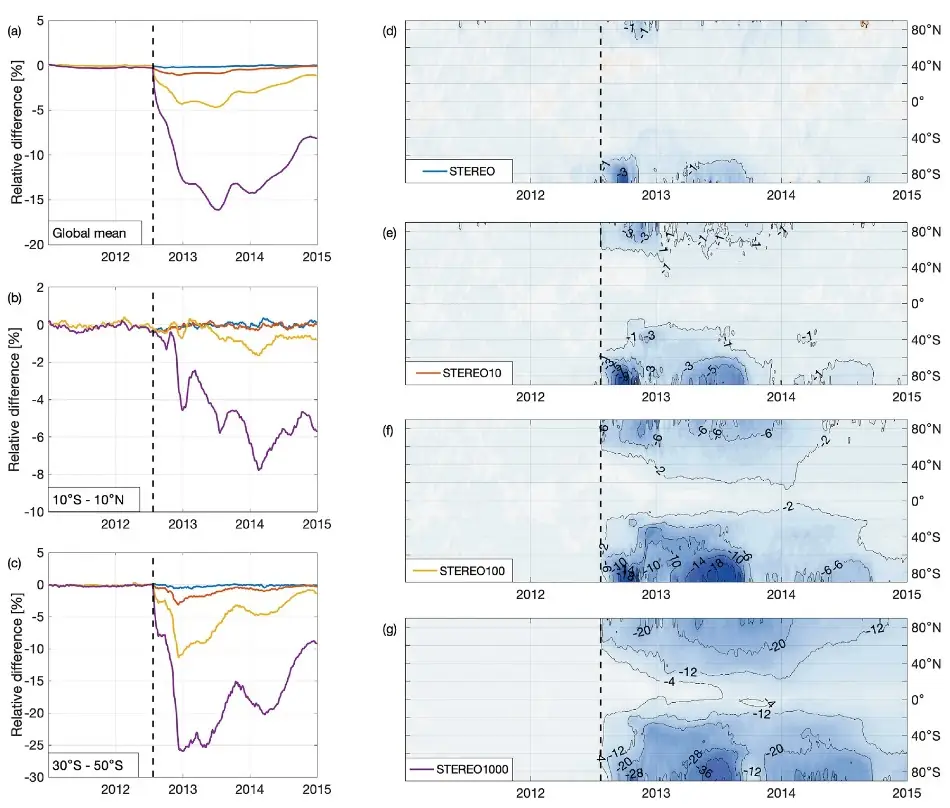

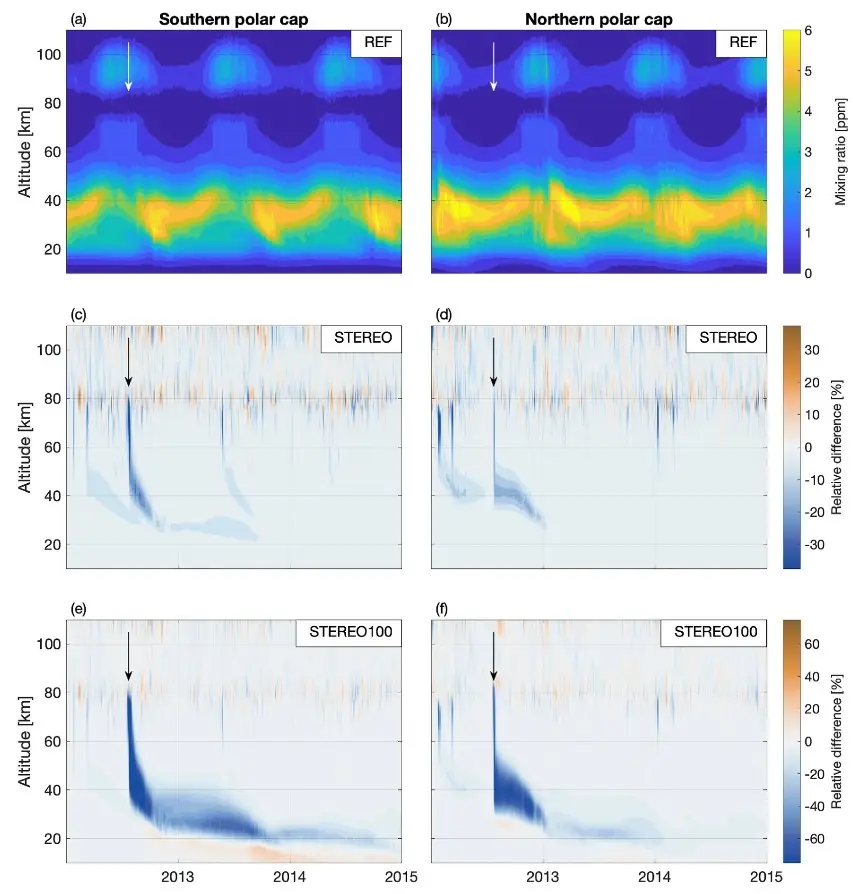
The researchers used superimposed epoch analysis to investigate the effects of solar proton events on mesospheric ozone. This method required averaging ozone concentration data from Aura MLS for the days preceding SPEs, omitting events with intervals shorter than 10 days to prevent overlap.
They compared data from periods of solar proton activity to baseline values measured before and during the events. The analysis revealed that moderate SPEs (proton flux intensity greater than 100 pfu) and strong SPEs (proton flux intensity greater than 1 000 pfu) caused up to 85% ozone depletion in the northern hemisphere and up to 73% in the southern hemisphere, with recovery times ranging from 9 to 10 days depending on the hemisphere.
The study stressed the significance of solar proton events on mesospheric ozone, drawing attention to differences in ozone depletion between hemispheres and the impact of proton flux intensity. These findings advance the understanding of atmospheric reactions to solar activity and weigh in on the importance of ongoing monitoring to assess and manage the long-term effects of solar proton events on the Earth’s atmosphere.
References:
¹ Mesospheric Ozone Depletion during 2004–2024 as a Function of Solar Proton Events Intensity. – Doronin, G.; Mironova, I.; Bobrov, N.; Rozanov, E. – Atmosphere 2024, 15, 944. – Aug 6, 2024 – https://doi.org/10.3390/atmos15080944

Harsha Borah is an experienced content writer with a proven track record in the industry. Harsha has worked with LitSpark Solutions and Whateveryourdose, honing skills in creating engaging content across various platforms. A gold medalist in a state-level writing competition organized by Assam Tourism, Harsha’s travelogue on Tezpur was widely appreciated. Harsha’s article, "The Dark Tale of the Only Judge in India to Be Hanged," ranks second on Google and has garnered over 11 000 views and 8 900 reads on Medium. Outside of writing, Harsha enjoys reading books and solving jigsaw puzzles.

Commenting rules and guidelines
We value the thoughts and opinions of our readers and welcome healthy discussions on our website. In order to maintain a respectful and positive community, we ask that all commenters follow these rules.