
Kepler’s forgotten sunspot observations reshape our understanding of Maunder Minimum, coldest part of Little Ice Age
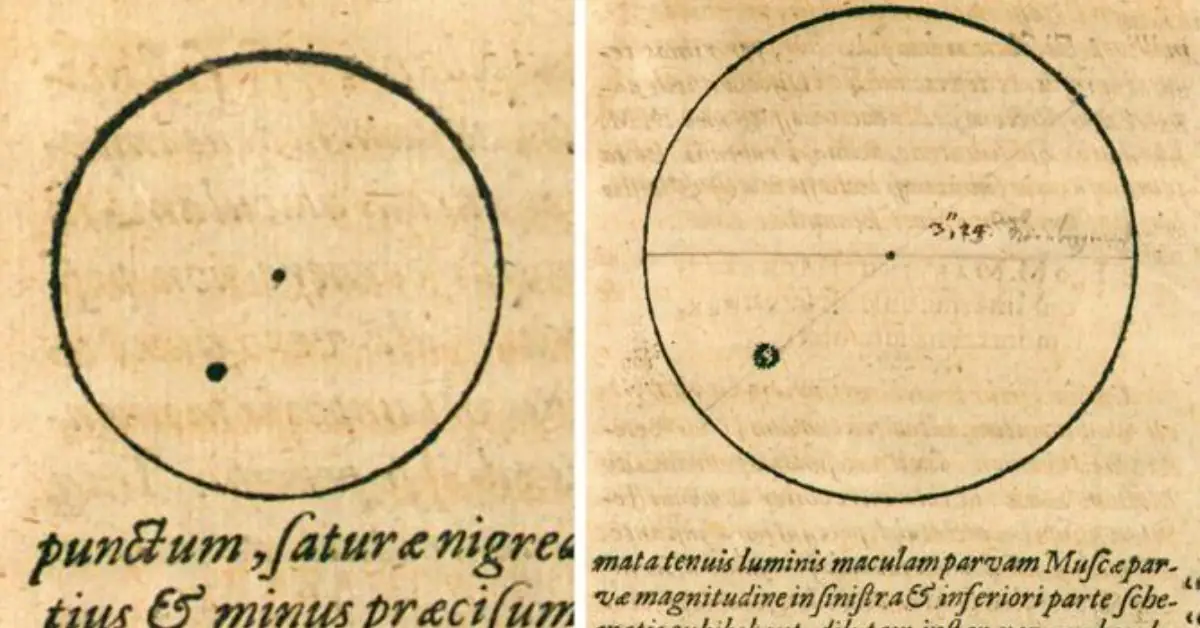
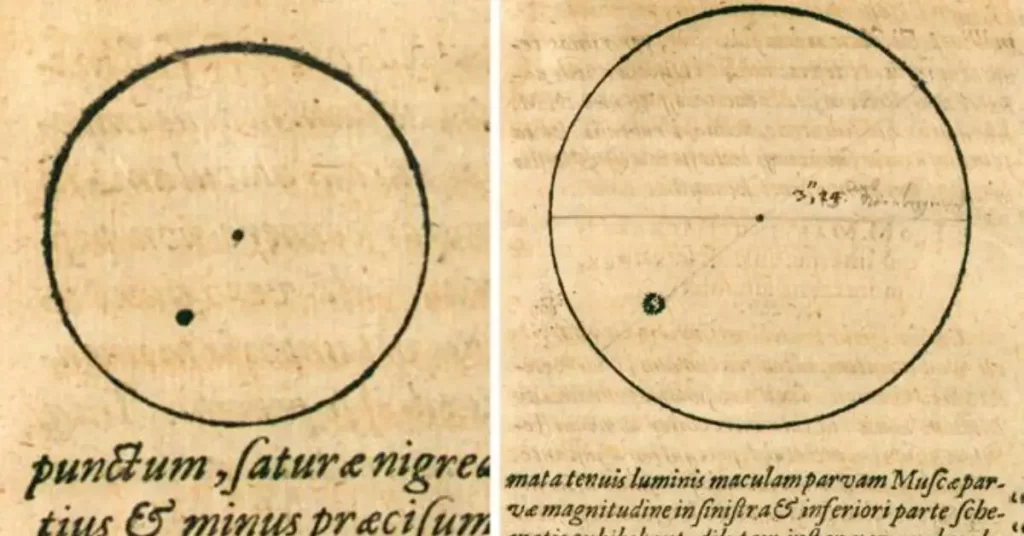
Featured image: The earliest datable sunspot drawings based on Johannes Kepler's solar observations with camera obscura in May 1607. Credit: Kepler, J. 1609, Phaenomenon singulare seu Mercurius in Sole, Thomae Schureri, Lipisiae.
Johannes Kepler’s half-forgotten 1607 sunspot drawings were re-examined in a 2024 study and revealed previously hidden information about the solar cycles before the Maunder Minimum, a unique grand solar minimum in observational history. This study questions previous assumptions and improves on the historical chronology of solar cycles.
- Kepler’s observations are important because the 17th century was a pivotal period in the solar cycle, not only as the time when sunspot observations had just begun but also when solar activity transitioned from normal solar cycles to the Maunder Minimum, a unique grand solar minimum in observational history.
- Kepler’s records suggested a regular duration for Solar Cycle 13, challenging alternative reconstructions that propose an extremely long cycle during this period.
- The discovery helped to close gaps in the historical record of solar activity.
- This precise dating improves projections of future solar activity and models of solar behavior, influencing understanding of solar cycles and their consequences on the Earth’s climate and space weather.
A recent study led by the researcher Hitashi Hayakawa from Nagoya University has provided new information regarding the Sun’s behavior in the early 17th century, based on the drawings of Johannes Kepler, a well-known German astronomer, mathematician, and astrologer of his time. This is the oldest sunspot sketch ever made with an instrumental observation and a projection.
Researchers came up with a better explanation of solar cycles that preceded the Maunder Minimum which is a period that occurred between 1645 and 1715 in which sunspots became very rare. The findings, published in The Astrophysical Journal Letters, challenged previous assumptions and accentuated our understanding of historical solar activity patterns.
The Maunder Minimum coincided with the coldest part of the Little Ice Age, a period of cooling that affected Europe and North America. During this time, the average temperatures in the Northern Hemisphere dropped by about 1 – 2 °C (1.8 – 3.6 °F), leading to harsh winters, shorter growing seasons, and significant agricultural challenges.
The reduction in solar activity likely contributed to these cooler temperatures. Lower solar irradiance reduced the energy received by Earth, which in turn affected atmospheric circulation patterns. This period saw an increase in the frequency and severity of winters, with rivers such as the Thames in London freezing over regularly.
Additionally, the Maunder Minimum had indirect effects on human societies. The colder climate impacted food production, leading to food shortages, higher food prices, and even famines in some regions. These conditions also contributed to social unrest and economic difficulties as communities struggled to adapt to the changing climate.
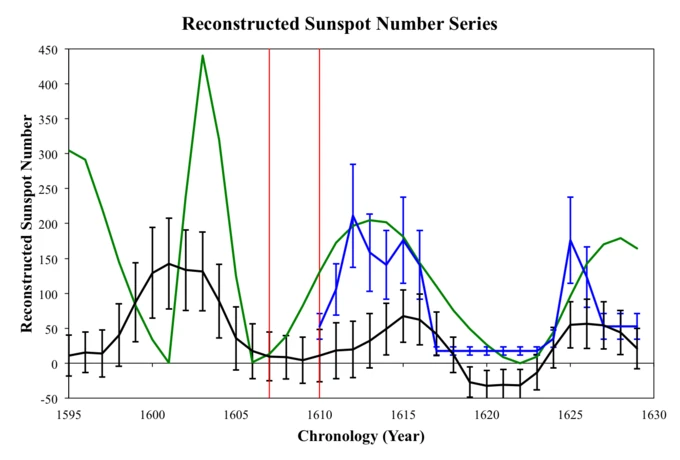
At this time, it is not fully understood how the pattern of solar activity shifted from regular cycles to the grand minimum, other than that the transition was gradual. One of the previous tree-ring-based reconstructions claimed a sequence consisting of an extremely short solar cycle (≈ 5 years) and an extremely long solar cycle (≈ 16 years), associating these anomalous solar-cycle durations with a precursor of the transition from regular solar cycles to the grand solar minimum.
While the exact mechanisms linking solar activity to Earth’s climate are complex and still under study, the Maunder Minimum remains a significant example of how variations in solar activity can influence global climate patterns.
This study demonstrated that Kepler’s sunspot sightings from May 28, 1607 correlate to the end of the Solar Cycle 14, not the beginning of the Solar Cycle 13, as thought earlier. This change indicated that the transition between both solar cycles occurred in 1606 instead of 1609. This conclusion supported certain modern assumptions while it denied many others, offering a more exact date for solar activity and its historical context.
By analyzing Kepler’s records and comparing them with contemporaneous data and modern statistics, the researchers made several important discoveries:
- After ‘deprojecting’ Kepler’s sunspot drawings and compensating for the solar position angle, they placed Kepler’s sunspot group at a low heliographic latitude. This suggests that the famous schematic drawing of the solar image that Kepler diagrammed in his book is not consistent with Kepler’s original text and the two camera obscura images, which show the sunspot in the upper left portion of the solar disk.
- By applying Spörer’s law and the knowledge gained from modern sunspot statistics, they identified the sunspot group as being probably located in the tail-end of Solar Cycle 13 rather than the beginning of Solar Cycle 14.
- Their findings contrast with later telescopic observations, which show sunspots at higher latitudes. This shows a typical transition from the preceding solar cycle to the following cycle, in accordance with Spörer’s law.
- This finding allows the authors to approximate the transition between the previous solar cycle (14) and the next solar cycle (13) between 1607 and 1610, narrowing down the possible dates when it occurred. On this basis, Kepler’s records suggested a regular duration for solar cycle 13, challenging alternative reconstructions that propose an extremely long cycle during this period.
A better comprehension of these solar cycles is important for making more accurate predictions about future solar activity, which can affect Earth’s temperature and space weather. Precise information on previous solar cycles also helps in the refinement of solar behavior models, hence improving projections of solar cycles and their possible effects on Earth.
“Kepler’s legacy extends beyond his observational prowess; it informs ongoing debates about the transition from regular solar cycles to the Maunder Minimum, a period of extremely reduced solar activity and anomalous hemispheric asymmetry between 1645 and 1715,” Hayakawa said.
“By situating Kepler’s findings within broader solar activity reconstructions, scientists gain crucial context for interpreting changes in solar behavior in this pivotal period marking a transition from regular solar cycles to the grand solar minimum.”
“Kepler contributed many historical benchmarks in astronomy and physics in the 17th century, leaving his legacy even in the space age,” said Hayakawa. “Here, we add to that by showing that Kepler’s sunspot records predate the existing telescopic sunspot records from 1610 by several years. His sunspot sketches serve as a testament to his scientific acumen and perseverance in the face of technological constraints.”
Sabrina Bechet, a researcher at the Royal Observatory of Belgium, added, “As one of my colleagues told me, it is fascinating to see historical figures’ legacy records convey crucial scientific implications to modern scientists even centuries later. I doubt if they could have imagined their records would benefit the scientific community much later, well after their deaths. We still have a lot to learn from these historical figures, apart from the history of science itself. In the case of Kepler, we are standing on the shoulders of a scientific giant.”
Kepler used a camera obscura to record his observations of the Sun. This contraption consisted of a small hole in a wall through which sunlight streamed, projecting a picture of the Sun onto a sheet of paper. Kepler utilized this technique to draw the apparent aspects of the Sun.
On May 28, 1607, Kepler initially believed he was watching a Mercury transit. However, it was eventually shown that he had actually filmed a collection of sunspots. This methodology enabled him to record detailed solar activity, which has been analyzed using modern solar models and statistical methods.
Kepler observed two big sunspots on May 28, 1607. The first observation was made at about 15:29 UTC from his Prague House, and the second at about 17:37 UTC from his colleague Justus Burgi’s workshop. Modern researchers reviewed historical paintings and concluded that Kepler’s sunspot group was positioned in low-latitude parts of the Sun, compatible with the conclusion of Solar Cycle 14 rather than the beginning of Solar Cycle 13.
Sunspot records dating back to the early 1600s are rare and inconsistent, which raises considerable questions about the timing of solar cycle changes. The Sun’s activity cycle spans 11 years and is characterized by sunspot numbers. Accurately dating these cycles had been difficult, particularly for periods as far back as the 17th century.
This research also laid importance on the value of historical astronomy records in modern science. It also improved our understanding of solar cycles and their duration, by perfectly tracking the transition between Solar Cycle 14 and Solar Cycle 13, respectively. This knowledge is critical for forecasting future solar activity, which has important consequences for space weather, climate science, and satellite operations.
References:
¹ Analyses of Johannes Kepler’s Sunspot Drawings in 1607: A Revised Scenario for the Solar Cycles in the Early 17th Century – Hisashi Hayakawa, Koji Murata, E. Thomas H. Teague, Sabrina Bechet, and Mitsuru Sôma – The Astrophysical Journal Letters, Vol. 970, No. 2 – July 25, 2024 – DOI 10.3847/2041-8213/ad57c9 – OPEN ACCESS
2 Kepler’s 1607 pioneering sunspot sketches solve solar mysteries 400 years later – Nagoya University – July 25, 2024

Harsha Borah is an experienced content writer with a proven track record in the industry. Harsha has worked with LitSpark Solutions and Whateveryourdose, honing skills in creating engaging content across various platforms. A gold medalist in a state-level writing competition organized by Assam Tourism, Harsha’s travelogue on Tezpur was widely appreciated. Harsha’s article, "The Dark Tale of the Only Judge in India to Be Hanged," ranks second on Google and has garnered over 11 000 views and 8 900 reads on Medium. Outside of writing, Harsha enjoys reading books and solving jigsaw puzzles.

THE CURRENT THEORY OF SOLAR MAGNETIC FIELD CANNOT EXPLAIN THE REVERSAL PROCESS DURING GRAND SOLAR MINIMA: According to current solar physics the reversal of the Sun’s magnetic poles is driven exclusively by sunspots. Specifically, as sunspots emerge close to the equator, they will have an orientation matching the old magnetic field, while sunspots forming closer to the poles will have a magnetic field matching the incoming magnetic orientation, and this is called Hale’s law. Namely, the magnetic field from active regions makes its way toward the poles and eventually causes the reversal. But, if the reversal process is governed exclusively by sunspots, then what makes the Sun reverse its magnetic polarity during grand solar minima? For example, during a 28 years period (1672-1699), a tiny 50 sunspots appeared on the solar surface, and in spite of that the Sun reversed its magnetic polarity twice. So, it is obvious that the reversal of the Sun’s magnetic poles during grand solar minima shows that the current theory is wrong, and the exact underlying cause has to be considered mystery by mainstream scientists. However, like most solar phenomena, the reversal process of the solar magnetic field cannot be understood without taking into consideration the most basic feature about the Sun.