
S1 – Minor solar radiation storm in progress
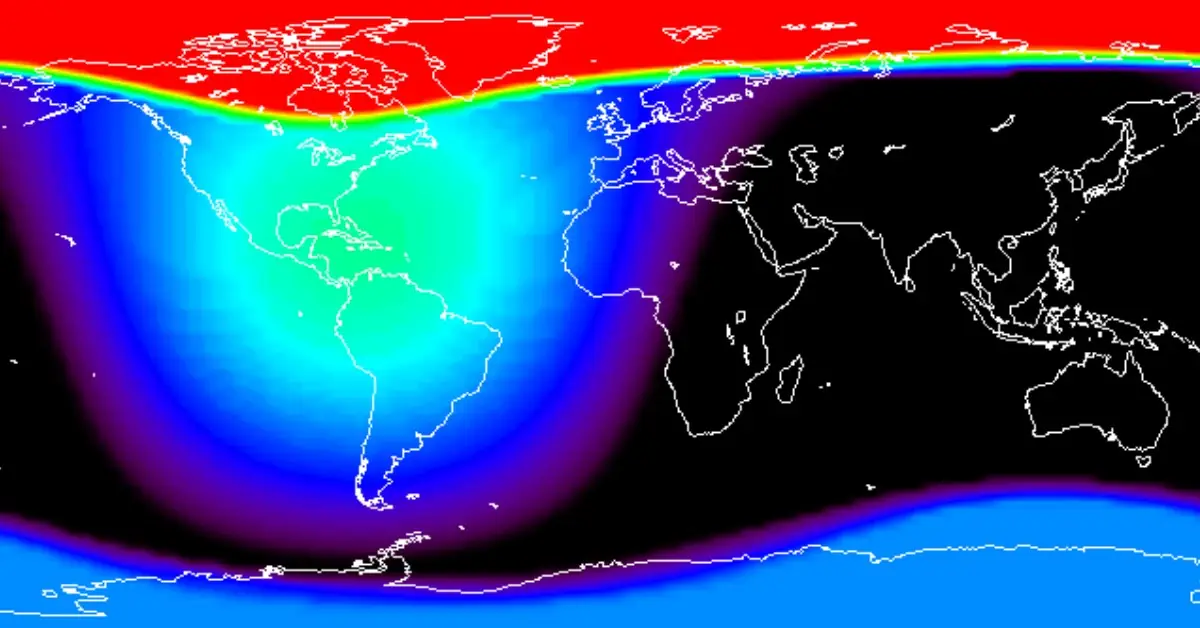
Image credit: NOAA/SWPC
An S1 – Minor solar radiation storm has been in progress since 02:50 UTC on July 23, 2024, and is expected to continue through the rest of the day and possibly into July 24.
Our planet has been experiencing an S1 – Minor solar radiation storm since 02:50 UTC today. This storm is a result of coronal mass ejection (CME) on the far side of the Sun, according to NOAA Space Weather Prediction Center (SWPC).
The storm is expected to continue at S1 levels through July 23 and there’s a slight chance for S1 levels on July 24 and 25.
On average, such storms occur about 50 times per cycle. According to the NOAA, they pose no threat to biological life or satellite operations, but can have minor impacts on HF radio in the polar regions.
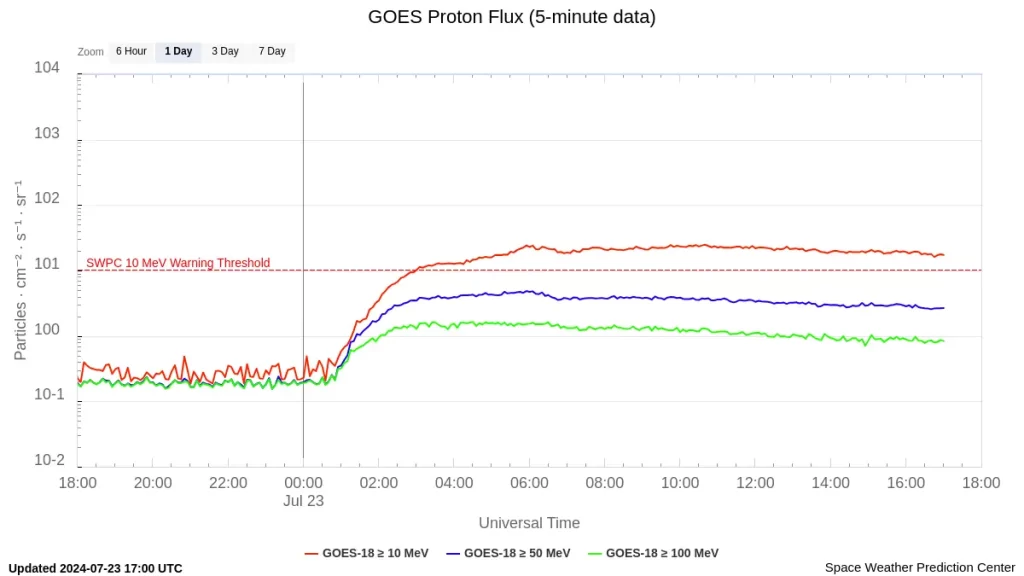

Solar activity was at high levels over the past 24+ hours, with an M2.4 solar flare at 14:28 UTC today and an M1.5 at 13:00 UTC yesterday. There’s a 60% chance of M-class flares and a 15% chance of X-class flares through July 25.

Solar wind parameters were slightly enhanced over the past 24 hours and are expected to continue at or near current levels through late July 23.

According to the SWPC, the onset of influence from a CME that left the Sun on July 21 is expected to enhance conditions over July 24 and 25. Other experts suggest Earth will be hit by two CMEs over this period — one launched on July 19 and the other on July 21.


As a result, G1 – Minor to G2 – Moderate geomagnetic storming is likely on July 24, followed by active conditions on July 25 as CME influences wane.
References:
1 Forecast Discussion Issued – NOAA/SWPC – Issued at 12:00 UTC on July 23, 2024

Teo Blašković founded The Watchers in 2011 and edited it until 2026, covering seismic and volcanic activity, extreme weather, space weather and near-Earth objects. Articles on this page are his archive.
Published in the last 24 hours
- Flying glass cut a teacher in Russia but none of her 44 pupils, because when a meteor flashed across the sky in 2013, she told them to get under their desks Epicenter
- A South Dakota man put the widest and heaviest hailstone on US record in his freezer, and a power cut melted part of it before NOAA measured it at 8 inches across and nearly 2 pounds in 2010 Epicenter
- Black kites and brown falcons in northern Australia have been seen snatching smoldering sticks from wildfires, flying them into unburned grass and dropping them, starting new fires that send lizards, rodents and insects running straight toward the waiting birds Epicenter
- A levee protecting a highway north of San Francisco is pocked with animal burrows and only 3 feet wide in places, and a report warns this winter's El Niño could push water over the top Epicenter
