
Epic solar storm impacts Mars

Image credit: NASA/University of Colorado/LASP
May 2024 saw increased solar activity, leading to numerous significant events including a rare G5 – Extreme geomagnetic storm and a powerful solar flare directed at Mars on May 20. This event, estimated at X12, sent X-rays, gamma rays, and charged particles toward the red planet, providing valuable data for future Mars missions.
Increased solar activity during May produced numerous significant events, including at least one cannibal CME event and a rare G5 – Extreme geomagnetic storm, but while most public attention was focused on these, a group of NASA scientists was monitoring Mars when a powerful solar flare estimated to be X12 sent a barrage of X-rays and charged particles toward the planet.
“The flare sent out X-rays and gamma rays toward the Red Planet, while a subsequent coronal mass ejection launched charged particles. Moving at the speed of light, the X-rays and gamma rays from the flare arrived first, while the charged particles trailed slightly behind, reaching Mars in just tens of minutes,” NASA scientists said.
During the May 20 event, so much energy from the storm struck the surface that black-and-white images from Curiosity’s navigation cameras danced with “snow” — white streaks and specks caused by charged particles hitting the cameras.
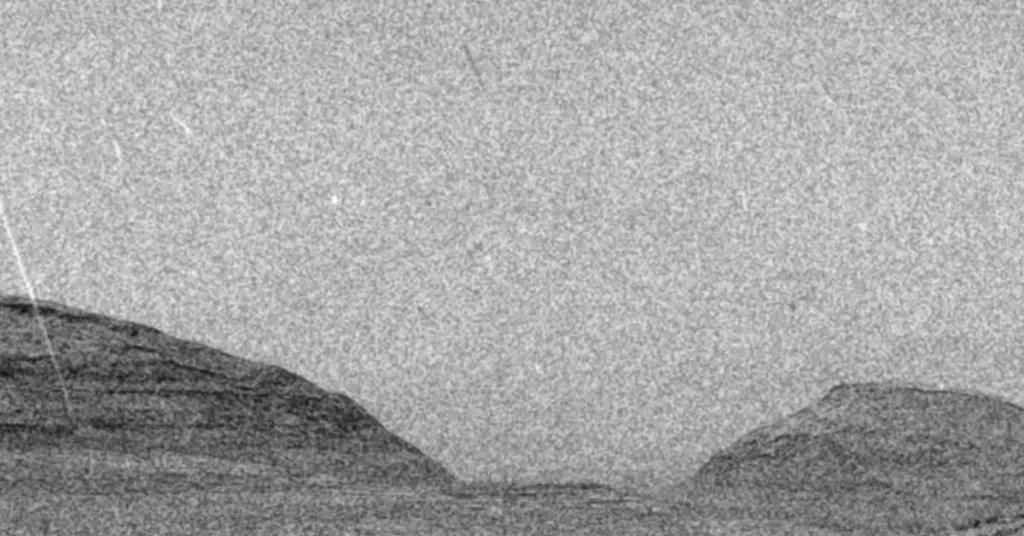
The Curiosity rover was exposed to 8100 micrograys of radiation which is equivalent to 30 chest X-rays, which though not lethal could have serious health implications according to NASA, this data will help scientists plan out for future landing missions on Mars and prepare for the possible radiation exposure to future astronauts.
While not deadly, it was the biggest surge measured by Curiosity’s Radiation Assessment Detector, or RAD, since the rover landed 12 years ago.
“Cliffsides or lava tubes would provide additional shielding for an astronaut from such an event. In Mars orbit or deep space, the dose rate would be significantly more,” said RAD’s principal investigator, Don Hassler of Southwest Research Institute’s Solar System Science and Exploration Division in Boulder, Colorado.
The star camera NASA’s 2001 Mars Odyssey orbiter uses for orientation was inundated with energy from solar particles, momentarily going out. Even with the brief lapse in its star camera, the orbiter collected vital data on X-rays, gamma rays, and charged particles using its High-Energy Neutron Detector.
This was Odyssey’s second significant encounter with a powerful solar flare in 24 years. In 2003, solar particles from a solar flare that was ultimately estimated to be an X45 fried Odyssey’s radiation detector, which was designed to measure such events.
NASA’s Mars Atmosphere and Volatile EvolutioN (MAVEN) orbiter observed auroras over Mars caused by the storm. Unlike Earth, which has a robust magnetic field protecting it from charged particles, Mars’ lack of a magnetic field allows these particles to create planet-wide auroras.
Christina Lee, MAVEN Space Weather Lead at the University of California, Berkeley, noted that this was the largest solar energetic particle event observed by MAVEN. The data from MAVEN’s Solar Energetic Particle instrument will help scientists reconstruct the timeline of the event and understand how it unfolded.

NASA’s spacecraft data is aiding future missions to Mars and enhancing the agency’s heliophysics research. This includes contributions to missions like Voyager, Parker Solar Probe, and the upcoming ESCAPADE mission.
Scheduled for a late-2024 launch, ESCAPADE’s twin satellites will provide detailed dual-perspective observations of space weather around Mars, surpassing MAVEN’s current capabilities.
References:
1 NASA Watches Mars Light Up During Epic Solar Storm – NASA – June 10, 2024

Rishav Kothari is Editor-in-Chief of The Watchers, where he runs the newsroom and covers earthquakes, volcanoes, severe weather and space weather.
Published in the last 24 hours
- Right about now, Voyager 1 is crossing a line no human-made object has ever reached, a full light-day from Earth, which means a message NASA sends tonight won't arrive until tomorrow night, and the spacecraft's answer won't make it home until the night after that
- NASA’s STRIVE mission targets long-standing 3D observing gap in the upper atmosphere Epicenter
- Three Australian estuarine fish species maintain performance across thermal extremes Epicenter
- Lightning killed 323 wild reindeer at once on a Norwegian mountain plateau in 2016, and the crows and ravens that came to eat them left droppings full of crowberry seeds that could still sprout, clustered around the bodies Epicenter
