
Bright Taurid fireball off the coast of Massachusetts and Rhode Island, U.S.
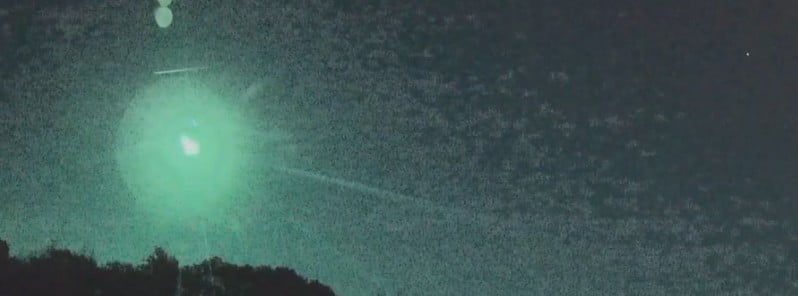
Image credit: Mark Kirschner
A bright Taurid fireball was seen off the coast of Massachusetts and Rhode Island at 01:05 UTC on November 4, 2022 (21:05 EDT, November 3). This fireball was bright enough to be detected by the Geostationary Lightning Mapper onboard the GOES-16 satellite.
The American Meteor Society (AMS) received 169 reports, with most of them from Massachusetts, Rhode Island, Connecticut and New Hampshire.1
An analysis of these accounts using constraints provided by internet-accessible cameras in the region shows that the fireball trajectory was entirely over the Atlantic Ocean, starting about 96 km (59 miles) above a point 37 km (23 miles) south of Nantucket.2

The object moved southwest at 128 700 km/h (80 000 mph), covering a total distance of 75 km (47 miles) before disintegrating at an altitude of 67 km (42 miles) above the ocean.
This meteor was a member of the Taurid meteor shower, which has exhibited increased activity over the past couple of weeks.
There are currently many sightings of Taurids over the United States each night, NASA Meteor Watch staff noted.


References:
1 AMS event 7950 – 22022 – American Meteor Society – November 4, 2022
2 Fireball over Massachusetts and Rhode Island – NASA Meteor Watch – November 4, 2022

Teo Blašković founded The Watchers in 2011 and edited it until 2026, covering seismic and volcanic activity, extreme weather, space weather and near-Earth objects. Articles on this page are his archive.
