
Strong explosive eruption at Bezymianny volcano, Russia

Image credit: KB GS RAS
A strong explosive eruption took place at Bezymianny volcano, Russia on October 23, 2022, ejecting ash up to 10 km (32 800 feet) above sea level. The Aviation Color Code was raised to Red at 12:20 UTC and lowered back to Orange at 22:05.
The maximum phase of the eruption lasted from 11:00 – 14:00 UTC. At 12:30 UTC, an ash column was rising to a height of about 9 km (29 000 feet) above sea level.
The eruption was accompanied by pyroclastic flows along the southeastern slope of the volcano.


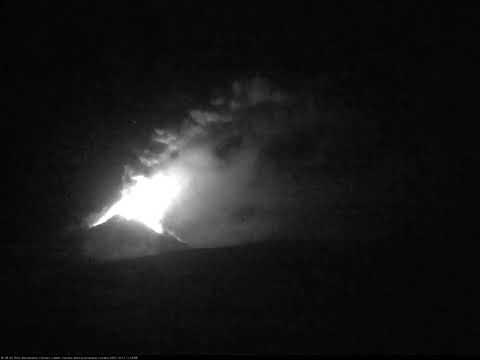
Satellite and visual data showed a gas-steam plume extended to the north-east of the volcano, and a bright thermal anomaly over the volcano, KVERT said.
An extrusive-effusive eruption of the volcano continues, KVERT said, adding that ongoing activity could affect low-flying aircraft.1
Geological summary
Prior to its noted 1955 – 56 eruption, Bezymianny had been considered extinct. The modern volcano, much smaller in size than its massive neighbors Kamen and Kliuchevskoi, was formed about 4 700 years ago over a late-Pleistocene lava-dome complex and an ancestral edifice built about 11 000 – 7 000 years ago.
Three periods of intensified activity have occurred during the past 3 000 years.
The latest period, which was preceded by a 1 000-year quiescence, began with the dramatic 1955/56 eruption. This eruption, similar to that of St. Helens in 1980, produced a large horseshoe-shaped crater that was formed by the collapse of the summit and an associated lateral blast.
Subsequent episodic but ongoing lava-dome growth, accompanied by intermittent explosive activity and pyroclastic flows, has largely filled the 1956 crater.2
References:
1 VONA/KVERT Information Release, October 23, 2022. KVERT, Institute of Volcanology and Seismology FEB RAS
2 Bezymianny – Geological summary – GVP

Teo Blašković founded The Watchers in 2011 and edited it until 2026, covering seismic and volcanic activity, extreme weather, space weather and near-Earth objects. Articles on this page are his archive.
More reporting
- Global simulation reveals how successive solar eruptions overtake and magnetically merge
- Ancient Martian lavas were more fluid than younger basalts, Perseverance study finds
- Howard Carter found an iron dagger on Tutankhamun's right thigh in 1925; modern XRF analysis supports a meteoritic origin of the iron
- Extreme weather exposes weak points in global oil and natural gas shipping, IEA finds
