
Antarctic blast to bring sub-zero temperatures, powerful swells, frost and snow, New Zealand
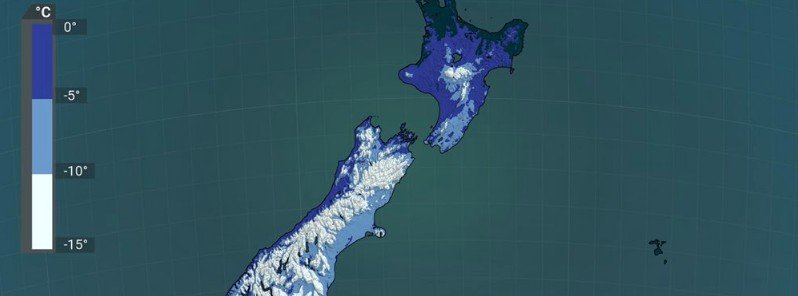
Image credit: NIWA
The New Zealand MetService is forecasting a blast of Antarctic air rolling over the country in the next few days, bringing sub-zero temperatures, powerful swells, strong winds, frost, and snow.
- Not even the 'winterless north' will escape the wrath of the Polar blast, NIWA said.
- Temperatures are expected to drop by 10 °C (18 °F) in some places. The cold will remain after the snow leaves, with settled weather paving the way for overnight temperatures to plummet.
- Expect very large, high-energy waves and frosts with single-digit or sub-zero temperatures.
With strengthening southerly winds for the South Island, south to southwest swells of 6 to 8 m (20 – 26 feet) are expected on June 28 and 29, with a period of 15 seconds for nearly all of the South Island.
These powerful waves will continue to spread up the coasts of the North Island, with Wellington expecting to see 6 m (20 feet) high swells from Tuesday morning, June 29 and other coastal areas a few hours later.
"These are very large, high-energy waves, and can catch people unawares if they're walking on beaches or driving along coastal roads," said MetService meteorologist Alwyn Bakker. "There's also the potential for waves to affect land or property near coasts."
Tuesday’s temperatures: not even the “winterless north” will escape the wrath of the polar blast! pic.twitter.com/KC2Ht7bAF7
— NIWA Weather (@NiwaWeather) June 28, 2021
Despite a very warm June thus far, the month is going to end with plunging temperatures and wintry weather as southerlies bring us an air mass direct from Antarctica.
Make sure your coat, gloves, and hat are ready to go this week, because temperatures are going pic.twitter.com/IpRbduSA2R
— NIWA Weather (@NiwaWeather) June 27, 2021
When you combine Tuesday’s temperatures and winds, this is what you get.
Better (we think!) than 46.6°C in British Columbia, Canada, yesterday, the country’s hottest temperature on record! pic.twitter.com/zNjxznY2WH
— NIWA Weather (@NiwaWeather) June 28, 2021
The winds driving the swell are also a potential risk, with a rash of wind Watches out over the country. Exposed places on the south and east coasts of the South Island may see severe gales at times.
Parts of Nelson, Wellington and the Marlborough Sounds, and the east coast of the North Island from the Wairarapa to Napier are also at risk.
Many in the lower South Island woke up to a dusting of white this morning, with snow down to 200 m (650 feet) in parts of Southland and Otago, and more is expected tomorrow.
"As the polar blast washes over Te Waipounamu/South Island, snow levels will lower to 100 or 200 m (330 – 650 feet) in the south and east, and 600 m (2 000 feet) in the north," Bakker said.
"Aside from Northland, Auckland, and Hamilton, Te Ika-a-Maui/North Island will also see snow levels between 300 and 500 m (1 000 – 1 600 feet) tomorrow."
Driving conditions may be hazardous, and high-level roads will be particularly affected, so keep up to date with MetService's Road Snowfall Warnings.
The cold temperatures will remain after the snow leaves, with settled weather paving the way for overnight temperatures to plummet.
Expect frosts with single-digit or sub-zero temperatures.

Teo Blašković founded The Watchers in 2011 and edited it until 2026, covering seismic and volcanic activity, extreme weather, space weather and near-Earth objects. Articles on this page are his archive.
Published in the last 24 hours
- A broad low over southeastern Florida and the northwestern Bahamas has a 30 percent chance of subtropical or tropical development within 48 hours and a 50 percent chance within 7 days, the National Hurricane Center says
- High Risk of excessive rainfall covers Florida’s Space Coast as St. Johns River near Cocoa reaches 5.67 m
- Asteroid 2026 WJ to pass Earth at 1.7 lunar distances at 04:20 UTC on November 22, with 2026 WD following at 4.4 lunar distances on November 23
- Cyclone Akvan crossed the north Andhra Pradesh and south Odisha coasts close to Gopalpur on November 20 with 70-80 km/h winds gusting to 90, and has weakened into a deep depression
