
Spectacular daylight fireball explodes over northern Croatia, meteorites likely

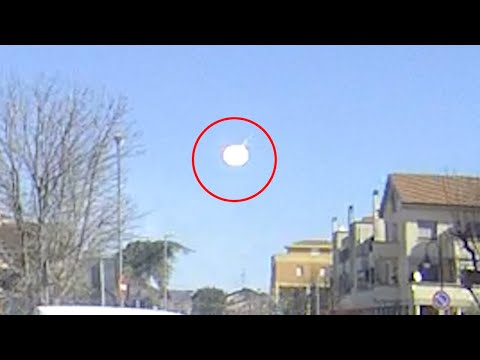
Featured image: Daylight fireball over Croatia on February 28, 2020. Credit: Tomislav Čar
A spectacular daylight fireball exploded over northern Croatia at 09:31 UTC on February 28, 2020. The event was witnessed from all over Croatia, Slovenia, and parts of northern Italy. It was followed by a sonic boom, registered by seismographs as an earthquake. It is possible some pieces of the object survived the atmospheric entry.
Although some residents initially thought it was an airplane breaking the sound barrier or an earthquake, the Croatian Astronomical Union (CAU) confirmed it was, in fact, a bolide — extremely bright meteor.
The sonic boom was registered in capital Zagreb at 09:34 UTC, three minutes after the visual spectacle. The sound lasted for several seconds and was heard across northern Croatia.
Some residents reported their windows shook as a result of the explosion, but there are no reports of material damage.

According to the CAU, the meteor exploded at a height of about 30 km (18.6 miles).
It is possible some pieces survived atmospheric entry, but it's still unclear where they might have landed.
According to unofficial reports, a piece of the object was found in the city of Koprivnica.
If you witnessed the event, please report it to CAU and IMO. Thank you.

Teo Blašković founded The Watchers in 2011 and edited it until 2026, covering seismic and volcanic activity, extreme weather, space weather and near-Earth objects. Articles on this page are his archive.
Published in the last 24 hours
- The interstellar comet 3I/ATLAS is thought to be about twice as old as Earth, and the James Webb Space Telescope has now found that its ice looks less like any comet from our own solar system than like the frozen worlds beyond Neptune, a sign it formed somewhere its star’s light could barely reach Epicenter
- Mount Everest is the highest point above sea level, but because the Earth bulges at the equator, the summit of a volcano in Ecuador sits farther from the centre of the planet, making it the closest piece of land on Earth to outer space Epicenter
- Winds high above the Arctic broke a 68-year record by collapsing in early November, and while the eastern US has already had a taste of the cold it shook loose, forecasters say a second wave could arrive around Thanksgiving weekend
- Weather radar tracked meteorites falling into Cape Cod Bay after a 1.1-kiloton fireball over Massachusetts on 30 May 2026; researchers have now traced its orbit almost out to Jupiter. Epicenter
