
Explosive-extrusive eruption at Sheveluch volcano, Russia
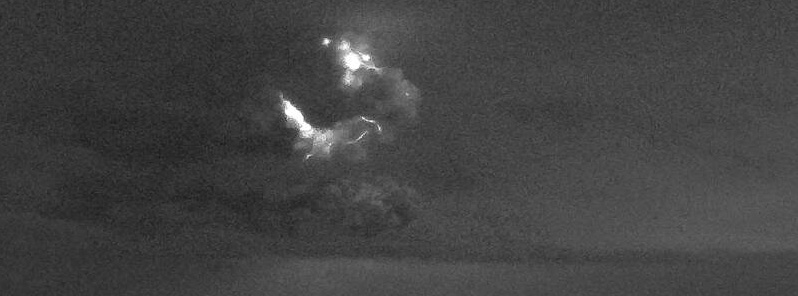
Featured image: Sheveluch eruption on December 26, 2018. Credit: Institute of Volcanology and seismology, KVERT & Weathernews Inc.
A strong gas-steam activity accompanied by ash emission continues at Sheveluch volcano, Kamchatka, Russia. The Aviation Color Code remains Orange.
A gas-steam with ash plume is currently drifting NE of the volcano, KVERT reports.
At 02:30 UTC, volcanic ash was observed rising up to 4.5 and 5 km (14 760 – 16 400 feet) above sea level.
Ash plume/cloud is drifting 70 km (43 miles) WNW of the volcano.

Ash explosions up to 8 – 15 km (26 200 – 49 200 feet) a.s.l. could occur at any time, the observatory warns, adding that ongoing activity could affect international and low-flying aircraft.
A thermal anomaly was identified in satellite images during December 7 and 8 and December 11 – 13. A small explosion on December 12 generated an ash plume that rose 6.5 – 6.8 km (21 300 – 22 300 feet) a.s.l.
That same day a gas-and-steam plume, containing a small amount of ash and drifting 150 km (93 miles) NE, was visible in satellite data.
The Aviation Color Code remains at Orange (the second highest level on a four-color scale).
Sheveluch (also spelled Shiveluch) rises above the lowlands NNE of the Kliuchevskaya volcano group and is one of Kamchatka's largest and most active volcanic structures.
The summit of roughly 65 000-year-old Stary Shiveluch is truncated by a broad 9-km-wide (5.6 miles) late-Pleistocene caldera breached to the south. Many lava domes dot its outer flanks.
At least 60 large eruptions have occurred during the Holocene, making it the most vigorous andesitic volcano of the Kuril-Kamchatka arc.
Frequent collapses of dome complexes, most recently in 1964, have produced debris avalanches whose deposits cover much of the floor of the breached caldera.

I'm a dedicated researcher, journalist, and editor at The Watchers. With over 20 years of experience in the media industry, I specialize in hard science news, focusing on extreme weather, seismic and volcanic activity, space weather, and astronomy, including near-Earth objects and planetary defense strategies. You can reach me at teo /at/ watchers.news.

Commenting rules and guidelines
We value the thoughts and opinions of our readers and welcome healthy discussions on our website. In order to maintain a respectful and positive community, we ask that all commenters follow these rules.