
Krasheninnikov volcano erupts for the first time in 600 years, linked to Kamchatka M8.8 earthquake, Russia
The Krasheninnikov volcano erupted for the first time in 600 year on August 3, 2025, sending an ash plume 6 km (19 700 feet) into the sky. Scientists suggest that the eruption might have been linked to the M8.8 earthquake that struck the Kamchatka peninsula on July 30.
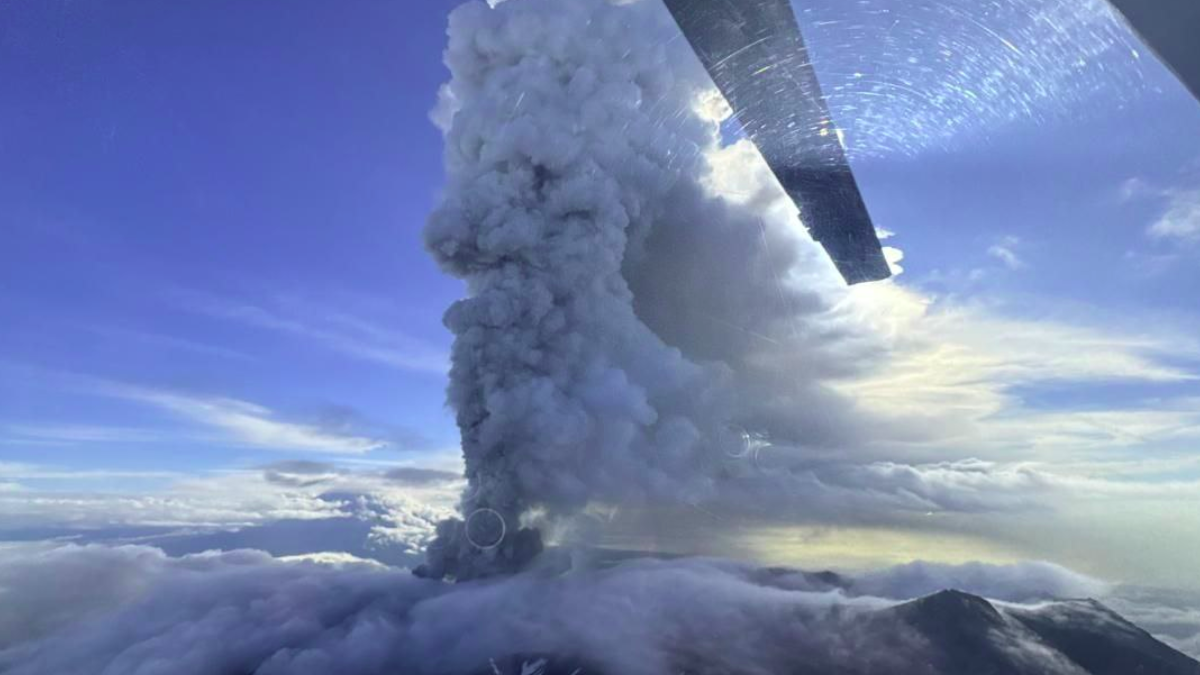
Krasheninnikov volcano erupts for the first time in 600 years. Credit: KVERT
The Krasheninnikov volcano in Russia erupted for the first time in 600 years at 02:50 LT on August 3 (16:50 UTC on August 2), just days after a massive M8.8 earthquake struck the region, generating shockwaves and tsunamis worldwide.
“This is the first historically confirmed eruption of Krasheninnikov volcano in 600 years,” said Olga Girina, head of the Kamchatka Volcanic Eruption Response Team (KVERT).
On the Telegram channel of the Institute of Volcanology and Seismology, Girina stated that Krasheninnikov’s last known lava effusion occurred in 1463, with a margin of ±40 years, and no eruptions have been recorded since.
Initially, KVERT reported ash plumes reaching an altitude of 3–4 km (9 850–13 100 feet) above sea level (a.s.l.). However, subsequent reports from the Kamchatka branch of Russia’s Ministry of Emergency Situations (EMERCOM) stated that the plume reached an altitude of 6 km (19 700 feet) a.s.l.
The ash plume was observed drifting eastward over the Pacific Ocean. Although there are no populated areas in its path, the aviation color code for the volcano was raised to yellow due to elevated risk to aircraft flying in the region.
** WOW. Eurasia’s Largest Volcano Erupts After 8.7 Earthquake in Russia **
— Lenka White (@white_lenka) August 2, 2025
FIRST recorded eruption since 1550 (460+ years)
Krasheninnikov’s ash cloud now 5–6KM high pic.twitter.com/wlRhuQiIMX
According to Girina, the eruption may be linked to the M8.8 earthquake that struck the Kamchatka Peninsula on July 29. It was the sixth strongest earthquake ever instrumentally recorded and the most powerful in Russia since the M9.0 Kamchatka earthquake in 1952.
The quake generated multiple strong M6+ aftershocks including an M6.8 recorded east of the Kamchatka Peninsula at 05:37 UTC on August 3.
The eruption follows an eruptive activity at Klyuchevskoy, the most active volcano on the Kamchatka Peninsula. Kyuchevskoy saw significant eruptive activity between July 17 and 30, with scientist observing bright crater incandescence on July 19.
The first powerful eruption of the #Krasheninnikovvolcano in the history of observations continues in the centre of the Kronotsky Reserve.
— Alex Terry (@AlexTerry17482) August 3, 2025
Dr Egon Cholakian explained in his video address what is happening now and this is just the beginninghttps://t.co/DRU3RIDS88 pic.twitter.com/FPOvZSJSo4
Krasheninnikov is an active complex volcano with a summit elevation of 1 816 m (1.1 miles), situated in the eastern range of the Kamchatka Peninsula, a highly active volcanic region in Russia.
It is located approximately 200 km (124 miles) north of Petropavlovsk-Kamchatsky and 13 km (8 miles) south of Lake Kronotskoye, within the Eastern Volcanic Zone of Kamchatka.
Geologically, Krasheninnikov consists of two overlapping stratovolcanoes within a 9×11 km (5.5×7 miles) Pleistocene caldera. The formation of the northern cone began approximately 6 500 years ago, while the southern edifice dates back to around 11 000 years before present (BP).
WATCH: Incredible footage of the FIRST RECORDED ERUPTION of Krasheninnikov volcano in Kamchatka, Russia.
— Volcaholic (@volcaholic1) August 3, 2025
It wouldn't be a surprise to me if it was triggered by the megathrust M8.8 earthquake a few days ago.
Krasheninnikov volcano began its FIRST RECORDED eruption at 16:50 UTC… pic.twitter.com/FpUKRo9dLG

I am an Assistant Editor and Severe Weather & Science Journalist at The Watchers, specializing in real-time severe weather coverage, geophysical event reporting, and research-driven scientific analysis. You can reach me at rishav(at)watchers(.)news.

WOW! Thank you for reporting this. As nobody else will. 600 years… that is just crazy…
This is yet another evidence supporting my opinion