
Large landslide blocks a river in southwest China

Image credit: SCMP
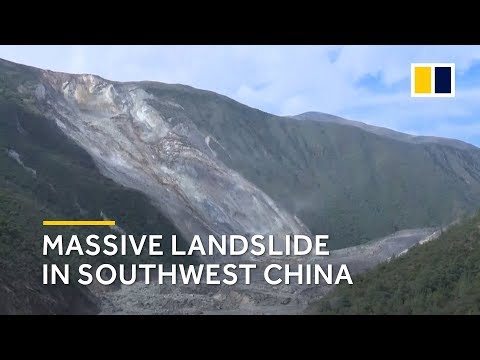
A large landslide hit Bolo Township of Tibet's Qamdo, on the border between Sichuan Province and Tibet Autonomous Region in southwest China, on Thursday, October 11, 2018, blocking a section of Jinsha River. Water levels sharply rose and returned to normal late Sunday. However, landslides are still taking place and there are fears a second barrier lake will soon form.
As of 15:00 local time, October 11, the barrier lake had about 100 million m3 (38.6 mi3) of water. At its peak, the lake had about 200 million m3.
The scale of the landslide is vast, Qamdo authorities said, adding that over 10 000 Qamdo residents have been evacuated on the first day. The number rose to over 24 000 over the next few days.
Lake levels returned to normal late October 14 after water from the upper stream burst through the blockade. State media reported no casualties.
The China National Commission for Disaster Reduction and the Ministry of Emergency Management jointly activated a level-IV emergency response, the lowest level, at 15:00 LT, October 11.
Several villages were affected after water rushed through the blockade, SCMP reports.
"We are still hearing landslides coming from the mountains, making it a possibility for a second barrier lake to form," Wang Wu of Tibet military command of Qamdo said.
A new road has been built to transport disaster relief supplies to the township, local authorities said October 16.
Before its completion, disaster relief supplies were transported in small quantities to the township by ships.

Teo Blašković founded The Watchers in 2011 and edited it until 2026, covering seismic and volcanic activity, extreme weather, space weather and near-Earth objects. Articles on this page are his archive.
Published in the last 24 hours
- Male toads abandoned a pond in Italy five days before a deadly 2009 earthquake, while a scientist was counting them Epicenter
- An asteroid was spotted 19 hours before it exploded over Sudan in 2008, and students picked its pieces off the desert Epicenter
- A wave up to 3 m (10 feet) high rose out of Lake Michigan on a sunny June morning in 1954 and swept fishermen off Chicago’s piers, and when a second came 10 days later, warnings had cleared the shore Epicenter
- Just 12 inches of rushing water can carry away most cars, and more than half of US flood drownings happen to people who drive into flood water Epicenter
