
Japan’s JMA apologizes after issuing false M9.9 earthquake warning across large parts of Japan
The Japan Meteorological Agency (JMA) issued an erroneous M9.9 earthquake early warning across large parts of Japan on October 16, 2026, following an actual M6.9 earthquake near Russia’s Kamchatka Peninsula. The warning was issued at 03:40 UTC, triggering the automatic suspension of Tokaido Shinkansen services before being withdrawn approximately eight minutes later. JMA apologized and began investigating the magnitude estimation error.
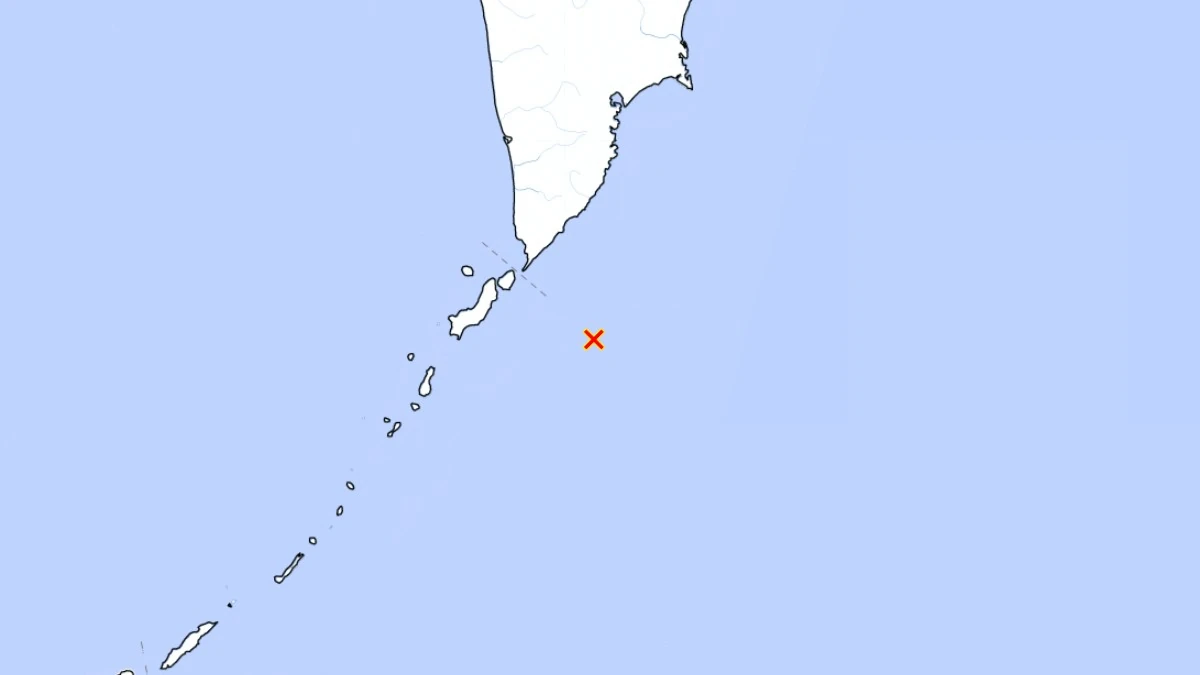
Location of the M6.9 earthquake near Russia's Kamchatka Peninsula on October 16, 2026, which triggered an erroneous M9.9 magnitude estimate by Japan's earthquake early warning system. Credit: JMA, The Watchers
The warning was issued at 12:40 JST (03:40 UTC), covering regions from Hokkaido in northern Japan to the Chubu region in central Japan, including Tokyo and surrounding areas. The automated assessment predicted seismic intensities reaching 7, the maximum on Japan’s seismic intensity scale, although no strong shaking was subsequently observed.
According to JMA, an earthquake measuring M6.9 occurred near the Kamchatka Peninsula at approximately 12:38 JST (03:38 UTC). During the early warning processing, the system incorrectly located the earthquake’s epicenter in the Kuril Islands and assigned it a magnitude of 9.9. The agency’s published warning records identify the incorrectly calculated epicenter at 48.2° N, 153.4° E, with an estimated focal depth of 140 km (87 miles).
JMA’s processing records show that its system detected seismic waves at 12:38:10.1 JST. An intermediate estimate reached M7.3 at 12:38:44.4 JST before increasing to M9.9 at 12:39:23.6 JST. The first emergency warning was issued at 12:40:02.6 JST, approximately 112.5 seconds after the initial seismic wave detection. A subsequent warning update was issued at 12:40:41.6 JST, retaining the incorrect M9.9 magnitude.
The warnings forecast seismic intensities ranging as high as 7 in parts of Hokkaido and northern Honshu, and predicted significant long-period ground motion over extensive areas.
Emergency alerts were transmitted to mobile phones and public warning systems across affected regions, including Tokyo. However, the expected strong shaking did not occur. JMA recorded a maximum observed seismic intensity of 1 in Hakodate, Hokkaido, and withdrew the emergency warning at approximately 12:48 JST (03:48 UTC).
The erroneous earthquake warning caused disruptions to railway services, online platforms, and government activities across Japan. According to JR Central, the Tokaido Shinkansen earthquake protection system activated following the warning, automatically cutting traction power and temporarily suspending services in both directions between Shin-Yokohama and Toyohashi stations.
The suspension lasted approximately 15 minutes, with operations resuming around 13:00 JST (04:00 UTC). Some westbound trains continued experiencing delays as of 15:45 JST (06:45 UTC), Fuji News Network (FNN) reported.
JR Hokkaido temporarily suspended several conventional train services, resulting in minor delays, while JR East reported no automatic service suspensions or operational delays.
The warning prompted a surge in demand for earthquake information, temporarily disrupting access to Yahoo Japan Search. Government activities were affected as well, with Chief Cabinet Secretary Minoru Kihara postponing his scheduled attendance at a parliamentary budget committee session to spend approximately 40 minutes receiving briefings at the Prime Minister’s Office.
Across the affected regions, emergency notifications on mobile phones caused alarm and confusion when the predicted strong shaking failed to materialize. Some residents subsequently received audible cancellation alerts, prompting criticism of the notification procedure.
At a press conference beginning at 14:00 JST (05:00 UTC), JMA officials acknowledged that the system had substantially overestimated the earthquake magnitude and apologized for the disruption.
The agency confirmed that the precise cause of the processing error remained under investigation. Officials stated that they had received no indication of a cyberattack from system administrators and rejected that possibility.
JMA said that the problem might have occurred during information processing rather than as a result of hardware failure, although the underlying technical cause had not been established. They discussed the limitations of earthquake magnitude estimation for seismic events occurring far from Japan’s observation network.
According to JMA Earthquake and Tsunami Monitoring Division Director Ayataka Ebita, the agency’s northernmost observation coverage extends approximately to the Nemuro region of Hokkaido, leaving earthquakes near Kamchatka outside the immediate coverage of its domestic seismic stations.
Ebita explained that earthquake location and magnitude estimates generally become more reliable when more observation stations detect the seismic waves. However, he said it had not been established whether the distance between the actual earthquake and Japan’s monitoring network contributed to the October 16 processing error.
The earthquake early warning system remained operational and capable of issuing warnings normally, the agency added.
According to JMA, this was the first time the agency had withdrawn an earthquake early warning issued at its highest alert level. Previous cancellations involved lower-level earthquake forecasts, including one issued on March 7, 2026.
Japan’s earthquake early warning system uses seismic observations to estimate earthquake location, magnitude, and expected shaking before the strongest seismic waves reach affected locations. Its automated processing is designed to issue warnings rapidly, using preliminary seismic data that may subsequently be revised.
In this case, the automated magnitude estimate was three magnitude units higher than JMA’s M6.9 assessment of the actual earthquake. Because earthquake magnitude is logarithmic, a difference of three magnitude units corresponds to approximately 31 600 times more seismic energy.
The actual earthquake near Kamchatka was also recorded by the Pacific Tsunami Warning Center (PTWC), which assigned it a preliminary magnitude of M7.0. PTWC registered the earthquake at 51.9° N, 157.4° E, at a depth of 148 km (92 miles), with an origin time of 03:36 UTC on October 16.
In its tsunami information statement issued at 03:43 UTC, PTWC determined that available data indicated no tsunami threat from the earthquake and that no action was required.
References:
1 Regarding the emergency earthquake warning issued on October 16, 2026 – JMA – October 16, 2026
2 Emergency earthquake warning issuance records – JMA – October 16, 2026
3 Tsunami Information Statement No. 1: Earthquake near Kamchatka, Russia – NWS/PTWC – October 16, 2026
4 JMA denies cyberattack following emergency earthquake warning cancellation – ITmedia NEWS – October 16, 2026
5 Japan’s earthquake early warning error: M6.9 misidentified as M9.9 – Central News Agency – October 16, 2026

Teo Blašković founded The Watchers in 2011 and edited it until 2026, covering seismic and volcanic activity, extreme weather, space weather and near-Earth objects. Articles on this page are his archive.
