
Daylight meteor seen over North Carolina, US
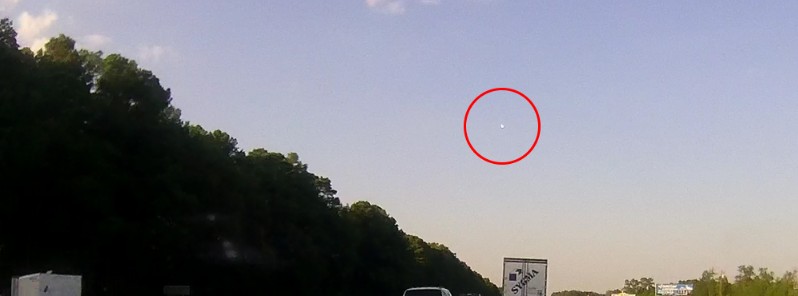
Image credit: TW
A rare daylight meteor was seen over North Carolina around 18:03 EDT on September 8, 2016 (22:03 UTC). At around the same time, a bright meteor exploded over Cyprus and parts of it are believed to have fallen north of the island.
The American Meteor Society received 183 reports by 12:30 UTC on September 9. The meteor was seen primarily from North Carolina but witnesses from Virginia and South Carolina also reported seeing it. Concurrent and delayed sounds were reported by witnesses as well as fragmentation.

The preliminary estimated trajectory plotted from the witness reports shows the meteor was traveling from the northeast to the southwest and ended near Enfield, North Carolina.

AMS Event#3320-2016 – September 8, 2016. First estimated trajectory. Credit: AMS
Featured image copyright: Pedro Martinez

The Watchers team and our contributors bring the latest on extreme weather, earthquakes, volcanic eruptions, space weather, and all things science. We're all about making sense of the natural world and keeping you informed on what’s happening. Got a tip or a question? Hit us up using the form at newstips!
Published in the last 24 hours
- Scientists directly observe how submarine landslides unfold in western Canada Epicenter
- Odisha evacuated 983,642 people before Phailin crossed near Gopalpur on 12 October 2013 with winds of 200-210 km/h gusting to 220, and 44 died, against 9,885 in the 1999 super cyclone. Cyclone Akvan crossed the same coast on 20 November 2026. Epicenter
- Lava fountains reached 1,900 feet (580 m) at Kīlauea Iki in 1959, the highest ever recorded at Kīlauea, as USGS forecasts episode 57 fountaining at Halemaʻumaʻu for November 22-26. Epicenter
- Novarupta in Alaska erupted about 3 cubic miles of magma in roughly 60 hours from 6 June 1912, 30 times Mount St. Helens in 1980, and strong northwesterly winds lifted that same loose ash on 16 November 2026, prompting an NWS SIGMET. Epicenter
