
Bright fireball streaks across the southern U.S.
A bright fireball streaked across the skies of the southern U.S. around 01:19 UTC on March 3, 2026, disintegrating above the Georgia Pacific Wildlife Management Area.
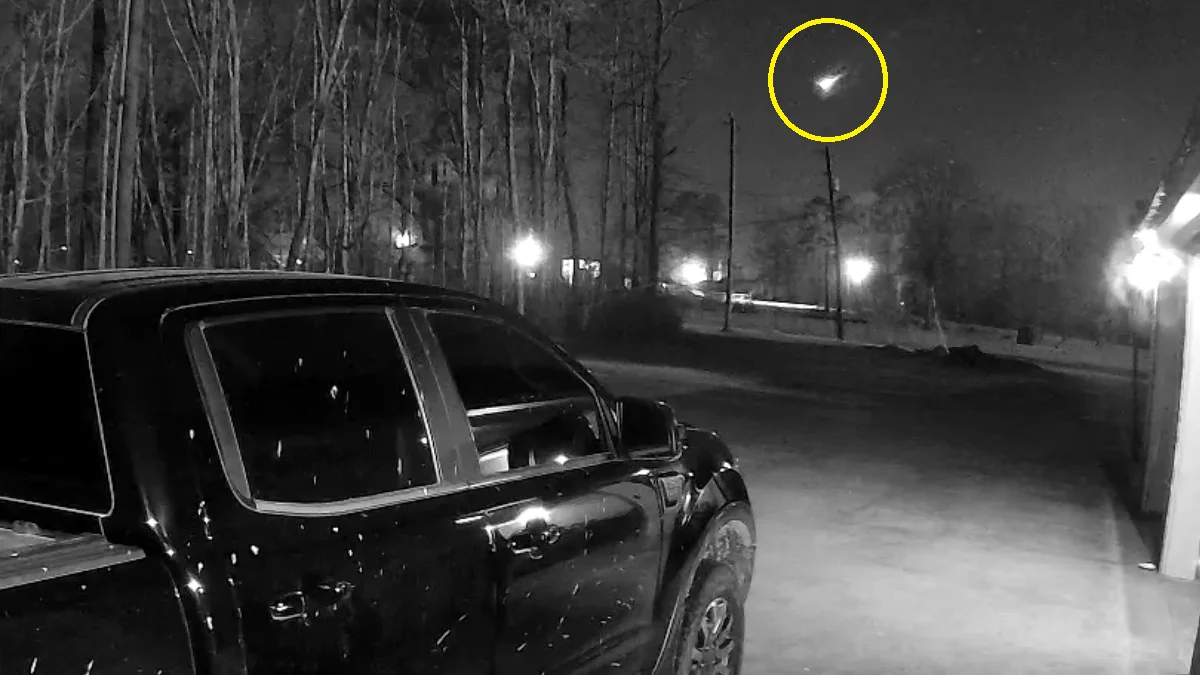
Fireball caught on camera in Walker Louisiana on March 2, 2026. Credit: Joelle LeJeune Sibley
A bright fireball was observed across multiple states in the southern U.S. on March 2, with reports coming in from Louisiana, Texas, Mississippi, and Arkansas.
The meteor was first observed at around 19:19 CST on March 2 (01:19 UTC on March 3) at an altitude of 77 km (48 miles) above the town of Chickasaw in northeastern Louisiana.
The meteor travelled west at approximately 13.4 km/s (8.3 miles per second), covering a distance of over 66 km (41 miles) before disintegrating above the Georgia Pacific Wildlife Management Area at an altitude of 43 km (27 miles).

“This meteor was not associated with any currently active meteor shower and was part of the sporadic (“background”) meteor complex,” said NASA.

While the American Meteor Society has received multiple reports of the sighting, the event is yet to be verified and listed.
Observers reported yellow, green, and white hues, indicating the presence of metals like nickel, copper, magnesium, and sodium, which burn during the re-entry, producing the colorful glow.

Rishav Kothari is Editor-in-Chief of The Watchers, where he runs the newsroom and covers earthquakes, volcanoes, severe weather and space weather.
Published in the last 24 hours
- High Risk of excessive rainfall covers Florida’s Space Coast as St. Johns River near Cocoa reaches 5.67 m
- Four small asteroids will pass close to Earth from November 21 to 23
- Cyclone Akvan weakens after landfall near Gopalpur; more than 300 000 evacuated in Odisha, India
- A broad low over southeastern Florida and the northwestern Bahamas has a 30 percent chance of subtropical or tropical development within 48 hours and a 50 percent chance within 7 days, the National Hurricane Center says
