
Turrialba eruption spews large quantities of ash onto nearby communities, Costa Rica
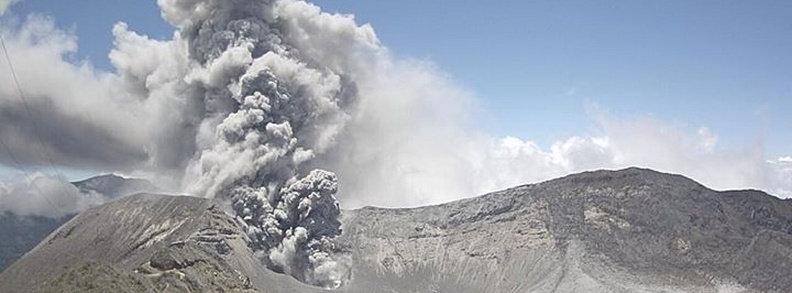
Featured image: Turrialba eruption on April 5, 2015. Image credit: OVSICORI-UNA
Costa Rica's Turrialba volcano erupted at 17:24 UTC on Sunday, April 4, 2015 spewing heavy ash on nearby communities. OVSICORI said the eruption lasted for an hour.
Column of ash reached 500 meters into the sky and rained large quantities of ash. Winds have carried it southwest where it has reached the outskirts of the capital San Jose located about 50 km SW.
There are reports of large quantities of ash East of San José in Tres Ríos and San Pedro as well as in the western suburb of Escazú.

According to media reports, police has evacuated tourists in areas surrounding the volcano. One group of evacuated tourists tried to approach the volcano to watch the explosion.
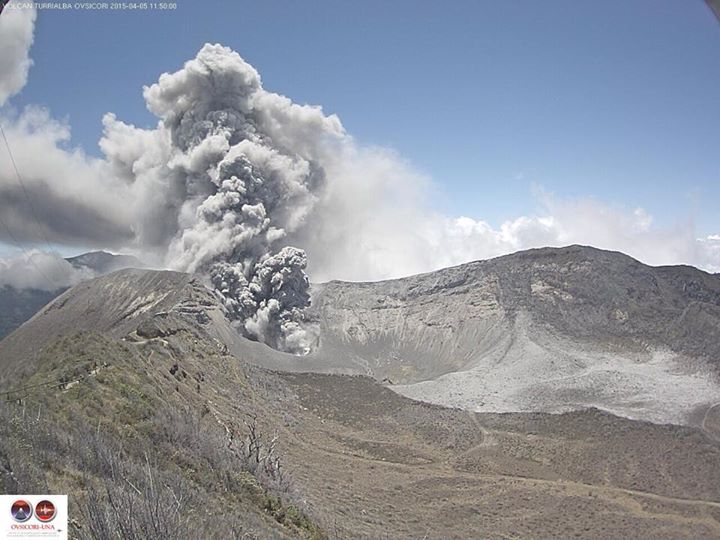
Image credit: OVSICORI-UNA
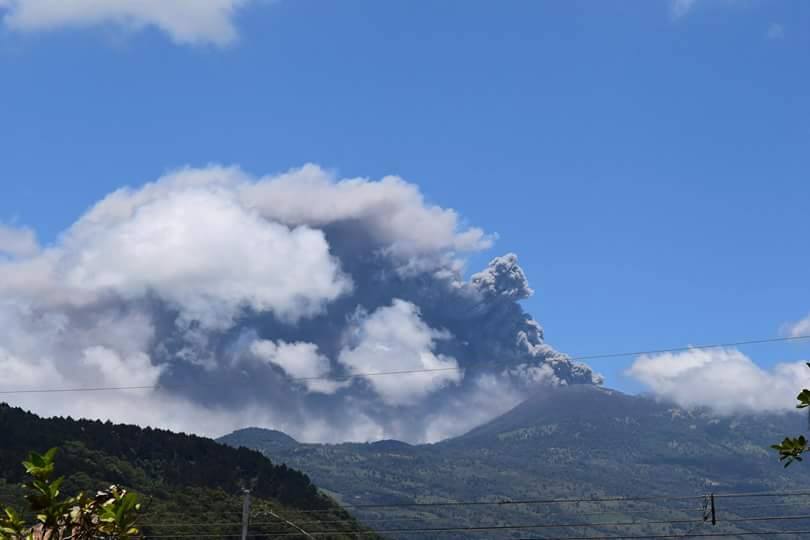
Image credit: Malala Vega Rodriguez
OVSICORI’s equipment also registered a small, three-minute tremor at the time of the eruption, Tico Times reports.
In their 01:51 UTC report on April 6, Washington VAAC said the eruption has ended.
Geologic summary
Turrialba, the easternmost of Costa Rica's Holocene volcanoes, is a large vegetated basaltic-to-dacitic stratovolcano located across a broad saddle NE of Irazú volcano overlooking the city of Cartago. The massive 3340-m-high Turrialba is exceeded in height only by Irazú, covers an area of 500 sq km, and is one of Costa Rica's most voluminous volcanoes. Three well-defined craters occur at the upper SW end of a broad 800 x 2200 m summit depression that is breached to the NE.
Most activity originated from the summit vent complex, but two pyroclastic cones are located on the SW flank. Five major explosive eruptions have occurred during the past 3500 years. A series of explosive eruptions during the 19th century were sometimes accompanied by pyroclastic flows. Fumarolic activity continues at the central and SW summit craters. (GVP)

I'm a dedicated researcher, journalist, and editor at The Watchers. With over 20 years of experience in the media industry, I specialize in hard science news, focusing on extreme weather, seismic and volcanic activity, space weather, and astronomy, including near-Earth objects and planetary defense strategies. You can reach me at teo /at/ watchers.news.

Commenting rules and guidelines
We value the thoughts and opinions of our readers and welcome healthy discussions on our website. In order to maintain a respectful and positive community, we ask that all commenters follow these rules.