
Fireball explodes producing small meteorites near Lake Weiss, Alabama
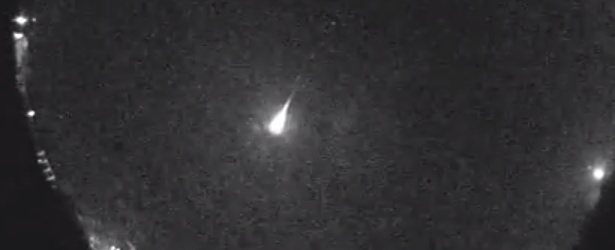
Image credit: NASA / Meteoroid Environmental Office
NASA's All Sky Cameras detected a bright fireball that broke apart in a brilliant flash of light above the Alabama town of Henagar, US, around 03:20 UTC on August 3, 2014 (22:20 EDT on August 2). Based on the meteor's speed, final altitude, and weak doppler radar signatures, it is believed that this fireball produced small meteorites on the ground somewhere between Borden Springs and Lake Weiss, Alabama.
According to Bill Cook, head of NASA's Meteoroid Environmental Office, the fireball was not from the Perseid debris field, but rather from the asteroid belt.
Video courtesy of NASA / Meteoroid Environmental Office
"The meteoroid was about 15 inches [38 cm] in diameter and weighed close to 100 lbs [45 kg]," Cooke said. "Travelling 47 000 miles per hour [75 639 km/h], it broke apart in a brilliant flash of light above the Alabama town of Henagar."
"Our cameras continued to track a large fragment until it disappeared 18 miles [28 km] above Gaylesville, located near Lake Weiss close to the Georgia state line. At last sight, the fragment was still traveling at 11 000 miles per hour [17 702 km/h]. Based on the meteor's speed, final altitude, and weak doppler radar signatures, we believe that this fireball produced small meteorites on the ground somewhere between Borden Springs, AL and Lake Weiss."
Below is a 3D trajectory of the fireball’s entry through the solar system, plotted by the American Meteor Society using data from the witness sightings.

Image credit: American Meteor Society

Teo Blašković founded The Watchers in 2011 and edited it until 2026, covering seismic and volcanic activity, extreme weather, space weather and near-Earth objects. Articles on this page are his archive.
Published in the last 24 hours
- High Risk of excessive rainfall covers Florida’s Space Coast as St. Johns River near Cocoa reaches 5.67 m
- Four small asteroids will pass close to Earth from November 21 to 23
- Cyclone Akvan weakens after landfall near Gopalpur; more than 300 000 evacuated in Odisha, India
- A broad low over southeastern Florida and the northwestern Bahamas has a 30 percent chance of subtropical or tropical development within 48 hours and a 50 percent chance within 7 days, the National Hurricane Center says

Duck and cover