
Delta Aquarid meteor shower live stream from Alabama on July 29-30, 2014
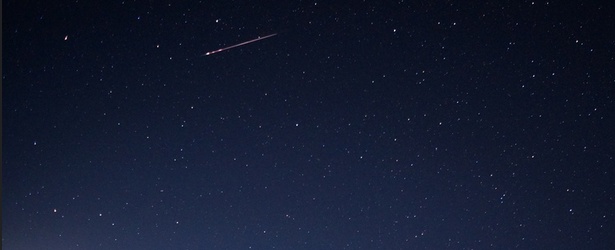
Image credit: Delta Aquarid meteor by Mike Lewinski (CC - Flickr)
A favorable new moon will help darken the skies for 2014 Delta Aquarid meteor shower (the Southern Delta Aquarids) on the night of July 29-30, 2014. If weather permits NASA's Marshall Space Flight Center will offer a live Ustream view of the sky over Huntsville, Alabama.
Although Delta Aquarids are considered a minor meteor shower with projected peak rates at 15-20 meteors/hour, the darker skies will help even faint meteors shine more brightly.
Most of the world can see them, with best viewing in the southern hemisphere and northern hemisphere tropics. With clear, dark skies away from city lights, you can see meteors any time after full dark, with peak viewing times in the two hours before dawn (your local time).
The live stream from Marshall Space Flight Center will begin on July 30 at 01:30 UTC. This is July 29 at 10:30 p.m. ADT, 9:30 p.m. EDT, 8:30 p.m. CDT, 7:30 p.m. MST, 6:30 p.m. PDT, 5;30 p.m. Alaska, 3:30 p.m. Hawaii.
The Delta Aquarids are a meteor shower that occurs each year from mid-July to mid-August. The shower results when Earth passes through the debris fields left by two sungrazing comets, Marsden and Kracht, that broke apart in space. The meteor shower gets its name because the radiant appears to originate near Delta Aquarii, one of the brightest stars in the constellation Aquarius.

Teo Blašković founded The Watchers in 2011 and edited it until 2026, covering seismic and volcanic activity, extreme weather, space weather and near-Earth objects. Articles on this page are his archive.
Published in the last 24 hours
- Lava fountains reached 1,900 feet (580 m) at Kīlauea Iki in 1959, the highest ever recorded at Kīlauea, as USGS forecasts episode 57 fountaining at Halemaʻumaʻu for November 22-26. Epicenter
- Novarupta in Alaska erupted about 3 cubic miles of magma in roughly 60 hours from 6 June 1912, 30 times Mount St. Helens in 1980, and strong northwesterly winds lifted that same loose ash on 16 November 2026, prompting an NWS SIGMET. Epicenter
- A fog linked to about 12 000 excess deaths in London in 1952 puzzled scientists for decades, until researchers reconstructed how coal smoke formed acidic haze Epicenter
- In 2012, cameras filming a thunderstorm in western China caught ball lightning by accident, and its 1.64-second glow carried iron, silicon, and calcium from the soil it rose out of Epicenter
