
Geoeffective region erupts with moderately strong M1.0 solar flare
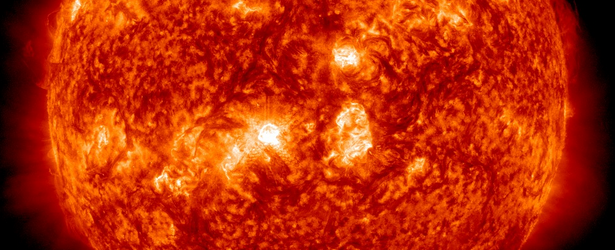
Featured image: M1.0 solar flare from AR 2035 on April 16, 2014. Image credit: SDO AIA 304.
Moderately strong solar flare measuring M1.0 erupted from Region 2035 (S17E18, Fkc/beta-gamma) on April 16, 2014. This event started at 19:54, peaked at 19:59 and ended at 20:04 UTC. A Type II Radio Emission with estimated velocity of 1071 km/s was associated.
Type II emissions occur in association with eruptions on the sun and typically indicate a Coronal Mass Ejection (CME) is associated with a flare event.
This region produced multiple C-class events in last 32 hours. It is continually exhibiting growth and is located almost at the center of the disk.
Update:
Based on limited SOHO LASCO C2/C3 coronagraph and STEREO A and B images, initial analysis indicated an Earth-directed CME with a preliminary speed of 642 km/s. Current Enlil run indicates a potential arrival at Earth on April 19 at approximately 18:00 UTC. Additional analysis will be accomplished with possible adjustments to timing of arrival times as additional data becomes available.

Space Weather Message Code: ALTTP2
Serial Number: 925
Issue Time: 2014 Apr 16 2055 UTC
ALERT: Type II Radio Emission
Begin Time: 2014 Apr 16 1958 UTC
Estimated Velocity: 1071 km/s
Description: Type II emissions occur in association with eruptions on the sun and typically indicate a coronal mass ejection is associated with a flare event.

Sunspots on April 16, 2014. Image credit: NASA SDO/HMI
2032 N12W29 274 160 6 CSO 3 B
2033 N12W18 263 60 2 HSX 1 A
2034 N04E02 242 200 11 EAI 14 BG
2035 S19E26 219 190 16 FAC 18 BG
2036 S18W01 246 270 8 DKC 15 BG
2037 S09E03 242 40 2 DSO 3 BG
2038 S12E64 181 30 2 CSO 2 B
2039 N16E28 217 10 1 BXO 2 B
2040 N24E11 234 0 0 BXO 1 B

Teo Blašković founded The Watchers in 2011 and edited it until 2026, covering seismic and volcanic activity, extreme weather, space weather and near-Earth objects. Articles on this page are his archive.
Published in the last 24 hours
- High Risk of excessive rainfall covers Florida’s Space Coast as St. Johns River near Cocoa reaches 5.67 m
- Asteroid 2026 WJ to pass Earth at 1.7 lunar distances at 04:20 UTC on November 22, with 2026 WD following at 4.4 lunar distances on November 23
- Cyclone Akvan crossed the north Andhra Pradesh and south Odisha coasts close to Gopalpur on November 20 with 70-80 km/h winds gusting to 90, and has weakened into a deep depression
- A broad low over southeastern Florida and the northwestern Bahamas has a 30 percent chance of subtropical or tropical development within 48 hours and a 50 percent chance within 7 days, the National Hurricane Center says
