
Intense earthquake swarm offshore North Iceland – 1 000 quakes in 6 days
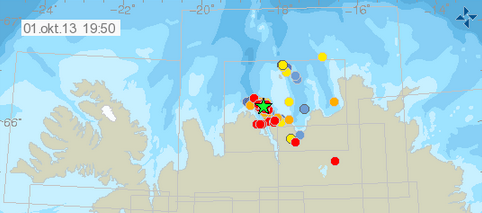
Featured image: Iceland earthquake swarm map - October 1, 2013. Image credit: IMO
An intense earthquake swarm has been going on offshore North Iceland, 10 km NW of Gjögurtá, since September 25, 2013. This morning, 2 earthquakes reaching magnitude 3 and 3.2 occurred at 06:14 and 07:41 UTC. Roughly 1 000 earthquakes have been recorded by Icelandic Meteorological Office in last 6 days (IMO).
The depths of the quakes vary from about 15 km depth (crust-mantle boundary) to near surface. The area is located on an active fault line related to rifting, and a possible cause of the earthquake swarm could be a magmatic intrusion at Tjörnes Fracture Zone volcano (VD).

University of Iceland © Icelandic Meteorological Office
Image above: Map of relative locations, September 25 to October 1, 2013 offshore North Iceland. Roughly 1000 earthquakes have been recorded in the swarm. Topography of seabed: Bryndís Brandsdóttir, Institute of Earth Sciences, University of Iceland.

Location of recent quakes with relation to Tjörnes Fracture Zone volcano. Image credit: Google Earth/Volcano Discovery

Iceland earthquake swarm map – October 1, 2013. Image credit: IMO
The offshore Tjörnes Fracture Zone is an oblique transform zone that separates the northern volcanic zone of Iceland from the Kolbeinsey Ridge, part of the Mid-Atlantic Ridge north of Iceland. A submarine eruption was reported during 1867-1868 at the SE part of the fissure system off the northern coast of Iceland along the Manareyjar Ridge immediately north of Manareyjar Island (GVP).

Teo Blašković founded The Watchers in 2011 and edited it until 2026, covering seismic and volcanic activity, extreme weather, space weather and near-Earth objects. Articles on this page are his archive.
Published in the last 24 hours
- High Risk of excessive rainfall covers Florida’s Space Coast as St. Johns River near Cocoa reaches 5.67 m
- Four small asteroids will pass close to Earth from November 21 to 23
- Cyclone Akvan weakens after landfall near Gopalpur; more than 300 000 evacuated in Odisha, India
- A broad low over southeastern Florida and the northwestern Bahamas has a 30 percent chance of subtropical or tropical development within 48 hours and a 50 percent chance within 7 days, the National Hurricane Center says
