
SAMPEX – Earth’s radiation belts
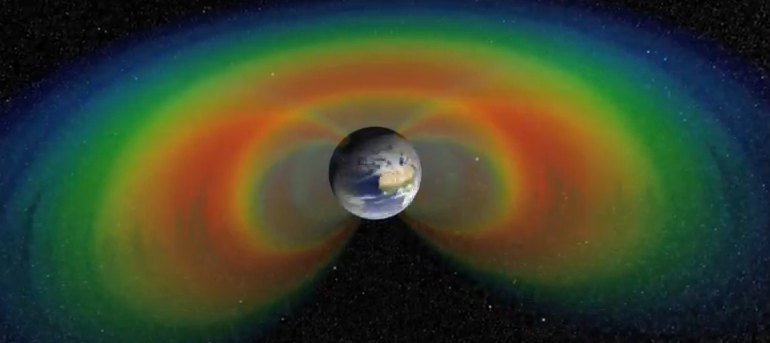
Image credit: TW

This is a simulation of the Earth’s radiation belts constructed from SAMPEX data around the time of the 2003 Halloween solar storms. In this visualization, we present the belts in cross-section to provide a better view of their interior structure.
The Earth’s magnetosphere is a very large magnetic structure around the Earth, and gets stretched into a large, teardrop-shaped configuration through its interaction with the solar wind. A number of the magnetic field lines, while they may originate on the Earth, do not connect back to the Earth, but connect into the magnetic field carried by the solar wind. However, near the Earth, the magnetic dipole component of the field is stronger than the solar wind field, and this allows all the magnetic field lines to connect back to the Earth, forming (approximately) the classic magnetic dipole configuration. In this region, lower energy electrons and ions, many from the Earth’s ionosphere, can become trapped by the magnetic field to form the radiation belts.
The radiation belt model is constructed from particle flux information from the SAMPEX mission, with the flux mapped to constant L-shells of the Earth’s dipole magnetic field. The model is anchored to the Earth’s geomagnetic field axis, which is not perfectly aligned with the Earth’s rotation axis. This creates a small wobble of the radiation belts with time, which can be seen in this visualization.
The data driving the radiation belt structure is from the 2003 Halloween solar storms, a series of strong solar eruptions that began in late October 2003 and continued into the first week of November. During this time, the particle content of the belts change rapidly due to the variation in the energetic particle flux from the Sun buffeting the Earth’s magnetosphere.
This dataset was also used to generate radiation belts for the RBSP prelaunch visualizations.
Credit: NASA Goddard / Scientific Visualization Studio

Teo Blašković founded The Watchers in 2011 and edited it until 2026, covering seismic and volcanic activity, extreme weather, space weather and near-Earth objects. Articles on this page are his archive.
Published in the last 24 hours
- Male toads abandoned a pond in Italy five days before a deadly 2009 earthquake, while a scientist was counting them Epicenter
- An asteroid was spotted 19 hours before it exploded over Sudan in 2008, and students picked its pieces off the desert Epicenter
- A wave up to 3 m (10 feet) high rose out of Lake Michigan on a sunny June morning in 1954 and swept fishermen off Chicago’s piers, and when a second came 10 days later, warnings had cleared the shore Epicenter
- Just 12 inches of rushing water can carry away most cars, and more than half of US flood drownings happen to people who drive into flood water Epicenter
