
New radiation belts found following G5 – Extreme geomagnetic storm in May 2024
Two new radiation belts, one containing electrons and another containing protons, were detected by NASA’s CIRBE CubeSat after the May 10, 2024, G5 – Extreme geomagnetic storm.

The May 2024 solar storm created two extra radiation belts, sandwiched between the two permanent Van Allen Belts. One of the new belts, shown in purple, included a population of protons, giving it a unique composition that hadn’t been seen before. Image credit: NASA/Goddard Space Flight Center/Kristen Perrin
- Scientists identified two previously unknown radiation belts containing high-energy electrons (1.3–5 MeV) and protons (6.8–20 MeV) after the May 10, 2024, geomagnetic storm.
- NASA’s CIRBE CubeSat, after suffering an anomaly, resumed operations on June 16, 2024, allowing researchers to study the new radiation belts with high-resolution data from the REPTile-2 instrument.
- The long-lived proton belt, expected to persist for a year or more, poses radiation risks for satellites and spacecraft in low-Earth and geostationary transfer orbits, requiring improved shielding and space weather models.
Two previously unknown radiation belts containing high-energy particles were identified by a team of scientists from the Laboratory for Atmospheric and Space Physics (LASP) at the University of Colorado Boulder and the National Aeronautics and Space Administration (NASA).
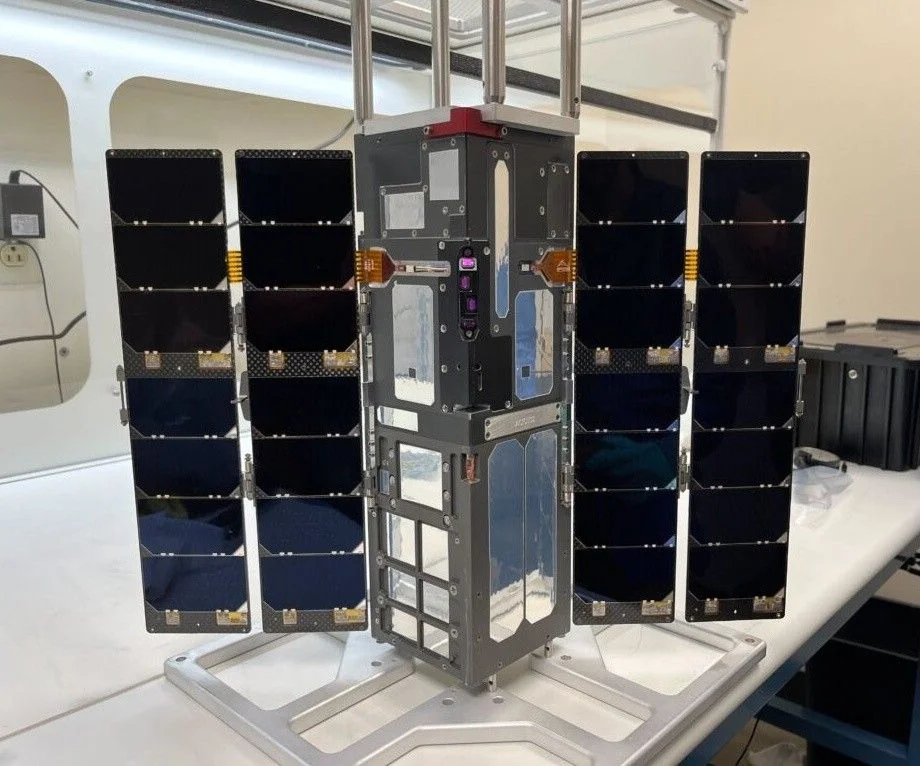
The discovery was made using data from NASA’s Colorado Inner Radiation Belt Experiment (CIRBE) CubeSat, raising concerns for space missions navigating through Earth’s magnetosphere.
One belt, located at an L-shell range of 2.5 to 3.5, contained electrons with energies between 1.3 and 5 MeV, while another belt at L = 2 harbored protons with energies between 6.8 and 20 MeV. The belts were formed in the aftermath of the May 10, 2024, G5 – Extreme geomagnetic storm, which had a Disturbance Storm-Time (Dst) index of approximately −400 nanotesla (nT), making it the most severe storm recorded in 20 years.
“When we compared the data from before and after the storm, I said, ‘Wow, this is something really new.’ This is really stunning,” Xinlin Li, the lead author of the study and Professor in the Ann and H.J. Smead Aerospace Engineering Sciences Department and the LASP at the University of Colorado Boulder, said.
CIRBE resumes operations and detects new belts
NASA’s CIRBE CubeSat, launched on April 15, 2023, had been operational for a year before suffering an anomaly on April 15, 2024, just 25 days before the storm.
The malfunction disrupted its ability to collect data at a critical time. Despite the setback, researchers continued monitoring space weather using alternative satellite observations, though none matched CIRBE’s high-resolution capabilities.
On June 16, 2024, CIRBE unexpectedly resumed operations, capturing important data on the aftermath of the storm. CIRBE’s primary instrument, the Relativistic Electron and Proton Telescope integrated little experiment-2 (REPTile-2), was designed to detect high-energy particles in Earth’s magnetosphere with unmatched precision. Its data revealed an increase in high-energy electrons trapped at L = 2.5–3.5, a region typically devoid of relativistic electrons because of wave-particle interactions.
One key finding was that the electrons remained trapped for over a month, suggesting that usual loss mechanisms such as plasmaspheric hiss waves were less effective at these higher energies.
A subsequent geomagnetic storm on June 28, 2024 (Dst ∼ −80 nT), partially disrupted the electron belt, providing insights into space weather effects on radiation belt structures. Meanwhile, the newly detected proton belt at L = 2 remained stable, persisting beyond the observation period.
Long-lasting radiation belts and their implications
Temporary radiation belts observed in past storms, such as the 2012 event, generally dissipated within weeks. The newly discovered electron belt lasted over three months before being disrupted, while the proton belt remained stable with no signs of rapid decay. This raised important questions about the mechanisms that allowed these high-energy particles to remain trapped.
Possible explanations include a post-storm geomagnetic field configuration that facilitated particle trapping or wave-particle interactions that influenced particle retention.
“These are really high-energy electrons and protons that have found their way into Earth’s inner magnetic environment. Some might stay in this place for a very long time,” said David Sibeck, a former mission scientist for NASA’s Van Allen Probes.
The presence of the belts has significant implications for spacecraft, as satellites in geostationary transfer orbits (GTO) face increased radiation exposure, which can cause single-event upsets (SEUs) in onboard electronics, degrade solar panels, and increase shielding costs.
High-resolution measurements from REPTile-2
REPTile-2, with its 60 electron energy channels (0.25 to 6 MeV) and 60 proton channels (6.5 to 100 MeV), captured high-energy particle data with exceptional resolution.
The capability allowed researchers to distinguish fine energy structures in the newly formed belts.
Lower-energy electrons (<1.3 MeV) were quickly scattered by plasmaspheric hiss waves while higher-energy electrons (1.3 to 5 MeV) persisted. This provided data into the selective scattering process shaping radiation belt evolution.
Proton flux at L = 2 remained stable, indicating different loss processes compared to electrons. The stability challenges previous assumptions about proton behavior in the inner magnetosphere.
Proton belt stability and expected duration
The proton belt, observed at L = 2, showed an increase in proton flux between 6.8 and 20 MeV by more than an order of magnitude. Unlike the electron belt, which experienced partial decay because of wave-particle interactions and subsequent storms, the proton belt remained unaffected by the June 28, 2024, geomagnetic storm. This suggests a robust trapping mechanism influenced by different physical processes.
Protons are more resilient because of their higher mass and interactions with Earth’s magnetic field. While electrons are highly sensitive to wave-particle interactions, protons experience slower depletion through atmospheric collisions, allowing them to persist longer.
The primary loss mechanism for these high-energy protons is interaction with Earth’s neutral atmosphere, which occurs at a much slower rate compared to electron scattering. The proton belt is expected to last a year or more, making it one of the most persistent radiation structures formed after a geomagnetic storm.
If no additional extreme storms occur, the proton belt may remain undisturbed. Future geomagnetic storms could introduce new wave-particle interactions, potentially altering its stability.
Understanding the proton belt’s behavior is important for refining space weather prediction models. Scientists still need to determine whether similar belts form after every extreme geomagnetic storm or if specific conditions in the May 2024 event uniquely contributed to its formation.
References:
1 NASA CubeSat Finds New Radiation Belts After May 2024 Solar Storm – NASA – February 6, 2025
2 A New Electron and Proton Radiation Belt Identified by CIRBE/REPTile-2 Measurements After the Magnetic Super Storm of 10 May 2024, Xinlin Li, Zheng Xiang, Yang Mei, Declan O’Brien, et. al., AGU – February 6, 2025 – https://doi.org/10.1029/2024JA033504 – OPEN ACCESS

Rishika holds a Master’s in International Studies from Stella Maris College, Chennai, India, where she earned a gold medal, and an MCA from the University of Mysore, Karnataka, India. Previously, she served as a Research Assistant at the National Institute of Advanced Studies, Indian Institute of Science, Bengaluru, India. During her tenure, she contributed as a Junior Writer for Europe Monitor on the Global Politics website and as an Assistant Editor for The World This Week. Her work has also been published in The Hindu newspaper, showing her expertise in global affairs. Rishika is also a recipient of the Women Empowerment Award at the district level in Haryana, India, in 2022.

Commenting rules and guidelines
We value the thoughts and opinions of our readers and welcome healthy discussions on our website. In order to maintain a respectful and positive community, we ask that all commenters follow these rules.