
Sun turns black! Fear not, it’s only SDO eclipse season
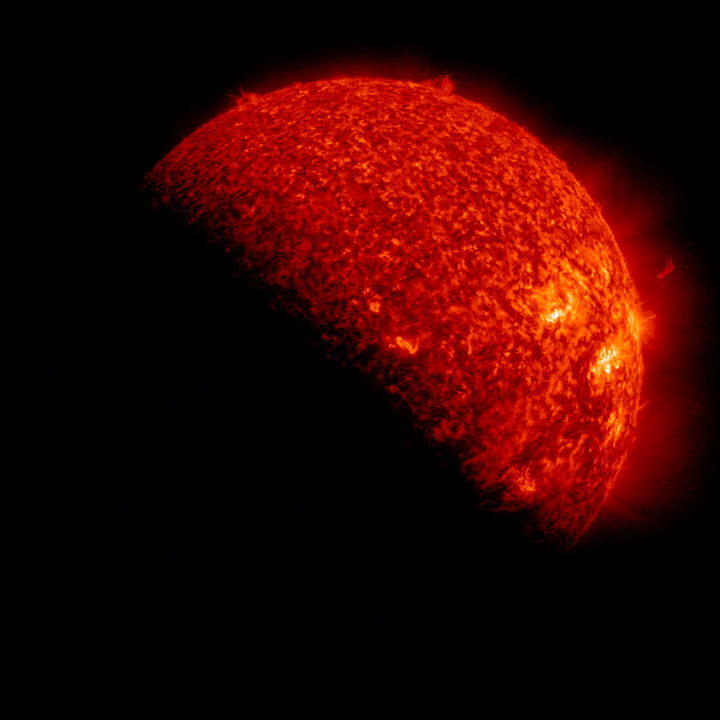
Image credit: TW
NASA’s Solar Dynamics Observatory (SDO) has moved into its second eclipse season of 2012. September 6, 2012, marks the first day of the SDO Fall Eclipse Season. Today’s eclipse lasted 8 minutes and 15 seconds only. Earth blocks SDO’s view of the sun for a period of time each day. Over the next few days eclipses will grow to about 72 minutes long. From now until September 29, 2012 planet Earth moves through the field of view of NASA Solar Dynamics Observatory’s telescopes.

Eclipses happen near the solstices when the Sun, Earth, and the SDO orbit come into alignment. SDO is a geosynchronous observatory. SDO has no recording system so it depends from ground station. That’s why SDO is placed in a geosynchronous orbit (GEO) at an altitude of 36,000 kilometres (22,000 miles), at 102° W longitude, inclined at 28.5°. It rotates at the same speed as the Earth and it is always directly above and in constant communication with its ground station in New Mexico. Because SDO is in an inclined orbit the eclipse season is not centered on the solstice.
Watch SDO’s Geosynchronus Orbit
The boundaries of the shadow of Earth on the sun are not perfectly sharp since SDO can see some light from the sun coming through Earth’s atmosphere. This movie bellow shows Earth moving across the sun from 06:25 to 07:25 UTC on Sept. 6, 2012.

Here are some videos of last year’s SDO eclipse season. Enjoy!


Published in the last 24 hours
- High Risk of excessive rainfall covers Florida’s Space Coast as St. Johns River near Cocoa reaches 5.67 m
- Asteroid 2026 WJ to pass Earth at 1.7 lunar distances at 04:20 UTC on November 22, with 2026 WD following at 4.4 lunar distances on November 23
- Cyclone Akvan crossed the north Andhra Pradesh and south Odisha coasts close to Gopalpur on November 20 with 70-80 km/h winds gusting to 90, and has weakened into a deep depression
- A broad low over southeastern Florida and the northwestern Bahamas has a 30 percent chance of subtropical or tropical development within 48 hours and a 50 percent chance within 7 days, the National Hurricane Center says

[…] Sun turns black! Fear not, it’s only SDO eclipse season NASA’s Solar Dynamics Observatory (SDO) has moved into its second eclipse season of 2012. September 6, 2012, marks the first day of the SDO Fall Eclipse Season. Today’s eclipse lasted 8 minutes and 15 seconds only. Earth blocks SDO’s view of the sun for a period of time each day. Over the next few days eclipses will grow to about 72 minutes long. From now until September 29, 2012 planet Earth moves through the field of view of NASA Solar Dynamics Observatory’s telescopes. Eclipses happen near the solstices when the Sun, Earth, and the SDO orbit come into alignment. SDO is a geosynchronous observatory. SDO has…… […]
[…] Sun turns black! Fear not, it’s only SDO eclipse season NASA’s Solar Dynamics Observatory (SDO) has moved into its second eclipse season of 2012. September 6, 2012, marks the first day of the SDO Fall Eclipse Season. Today’s eclipse lasted 8 minutes and 15 seconds only. Earth blocks SDO’s view of the sun for a period of time each day. Over the next few days eclipses will grow to about 72 minutes long. From now until September 29, 2012 planet Earth moves through the field of view of NASA Solar Dynamics Observatory’s telescopes. Eclipses happen near the solstices when the Sun, Earth, and the SDO orbit come into alignment. SDO is a geosynchronous observatory. SDO has…… […]