
Total solar eclipse of December 4, 2021
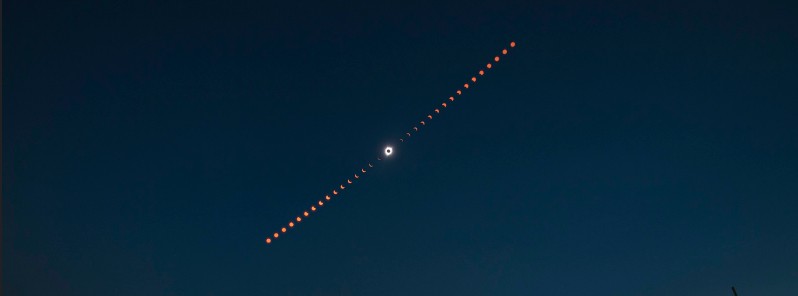
Image credit: NASA, Goddard
A total solar eclipse will take place on December 4, 2021, just two weeks after a partial lunar eclipse on November 19 – the longest since 1440 and until 2669.1
The total eclipse will be visible from Antarctica and partially visible from South Africa and south Atlantic.
The instant of greatest eclipse will take place at 07:33 UTC, 0.1 days before the Moon reaches perigee. During the eclipse, the Sun is in the constellation Ophiuchus. The synodic month in which the eclipse takes place has a Brown Lunation Number of 1224.2
The animation above shows the path of the Moon's shadow across the Earth. The red circle shows the edge of the Moon's shadow: all places inside the red circle will see the Moon covering some part of the Sun's disk. Within this, contours show where various fractions of the Sun's disk are covered. The green cross in the center of the Moon's shadow indicates the point of the central eclipse, where the Moon appears exactly centered on the middle of the Sun's disk, and where a total eclipse will be seen. Animation courtesy: Dominic Ford
The eclipse belongs to Saros 152 and is number 13 of 70 eclipses in the series. All eclipses in this series occur at the Moon’s descending node.
The Moon moves northward with respect to the node with each succeeding eclipse in the series and gamma increases.

References:
1 Partial lunar eclipse of November 19, 2021 – the longest since 1440 and until 2669 – The Watchers
2 Total solar eclipse of December 4, 2021 – Mr. Eclipse

Teo Blašković founded The Watchers in 2011 and edited it until 2026, covering seismic and volcanic activity, extreme weather, space weather and near-Earth objects. Articles on this page are his archive.
Published in the last 24 hours
- The storms drenching California this week are fed by a river in the sky, a band of water vapor that can carry up to 15 times the flow of the Mississippi River, and this winter’s near-record El Niño could keep aiming more of them at the West Coast
- Malawi continues Bris AI weather forecasting tests ahead of operational integration Epicenter
- Right about now, Voyager 1 is crossing a line no human-made object has ever reached, a full light-day from Earth, which means a message NASA sends tonight won't arrive until tomorrow night, and the spacecraft's answer won't make it home until the night after that
- G1 geomagnetic storm watch remains in effect as NOAA forecasts Kp 4.67 late on November 17 and early on November 18

Interesting that the totality lasted about 2 minutes and at about the same exact time that the eruption of Mount Semeru, on the island of Java, Indonesia started.