
‘Ring of Fire’ – Annular solar eclipse of June 10, 2021
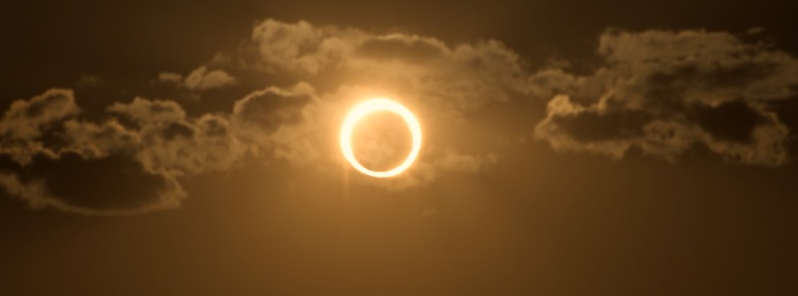
Image credit: Flickr
An annular solar eclipse of June 10, 2021, will be visible from northern Canada, Greenland, and Russia, with a partial eclipse visible from northern North America, Europe, and Asia. During the event, a bright ring will surround the moon silhouette at the peak of the eclipse, hence, the Ring of Fire name.
After a total lunar eclipse of May 26, parts of the Earth are now anticipating the first solar eclipse of 2021.
On June 10, the annular solar eclipse best known as the Ring of Fire event will start at sunrise over the northern part of Lake Superior in Ontario, Canada. It will continue across the Arctic region over Greenland, across the North Pole through midday, and will end up over northeast Siberia at sunset.
The instant of greatest eclipse takes place at 10:41 UTC. This is 2.3 days after the Moon reaches apogee.
During the eclipse, the Sun is in the constellation Taurus. The synodic month in which the eclipse takes place has a Brown Lunation Number of 1218. The eclipse belongs to Saros 147 and is number 23 of 80 eclipses in the series. All eclipses in this series occur at the Moon’s ascending node.
The Moon moves southward with respect to the node with each succeeding eclipse in the series and gamma decreases, according to Fred Espenak's Five Millennium Canon of Solar Eclipses.
The annular phase will last for a maximum of 3 minutes and 51 seconds at the point of the greatest eclipse.
While this kind of eclipse is considered partial, it is expected to be a very dramatic celestial show with the ring of bright light surrounding the moon.
"The shaded area of the map below shows the parts of the world where any part of the eclipse will be visible. The red contours within this region indicate where the Moon will cover at least 20 percent, 40 percent, 60 percent, and 80 percent of the Sun, as well as the narrow strip where the annular eclipse will be visible," Dominic Ford of In The Sky noted.

The eclipse will be visible from 09:55 to 10:47 UTC in Canada, 10:32 to 10:41 UTC in Greenland, and from 11:22 to 11:29 in Russia.
A partial eclipse will be much more widely visible from other countries as well, including the following:

Image credit: In The Sky
Many who had witnessed such a breathtaking event can tell you that it is indeed, a spectacular one to experience.

Published in the last 24 hours
- The Leonid meteor shower peaks on the night of November 17, exactly 60 years after the 1966 storm, when some observers reported meteors falling at up to 40 a second, though this year’s show should be closer to 15 an hour
- Weather radar tracked meteorites falling into Cape Cod Bay after a 1.1-kiloton fireball over Massachusetts on 30 May 2026; researchers have now traced its orbit almost out to Jupiter. Epicenter
- 10 named storms, one hurricane for the first time since 1925: Why has the Atlantic been so quiet in 2026 Epicenter
- Amazon fire hotspots rise 82.6% in October 2026 as El Niño intensifies Epicenter
