
Comet and Coronal mass ejection

Image credit: TW
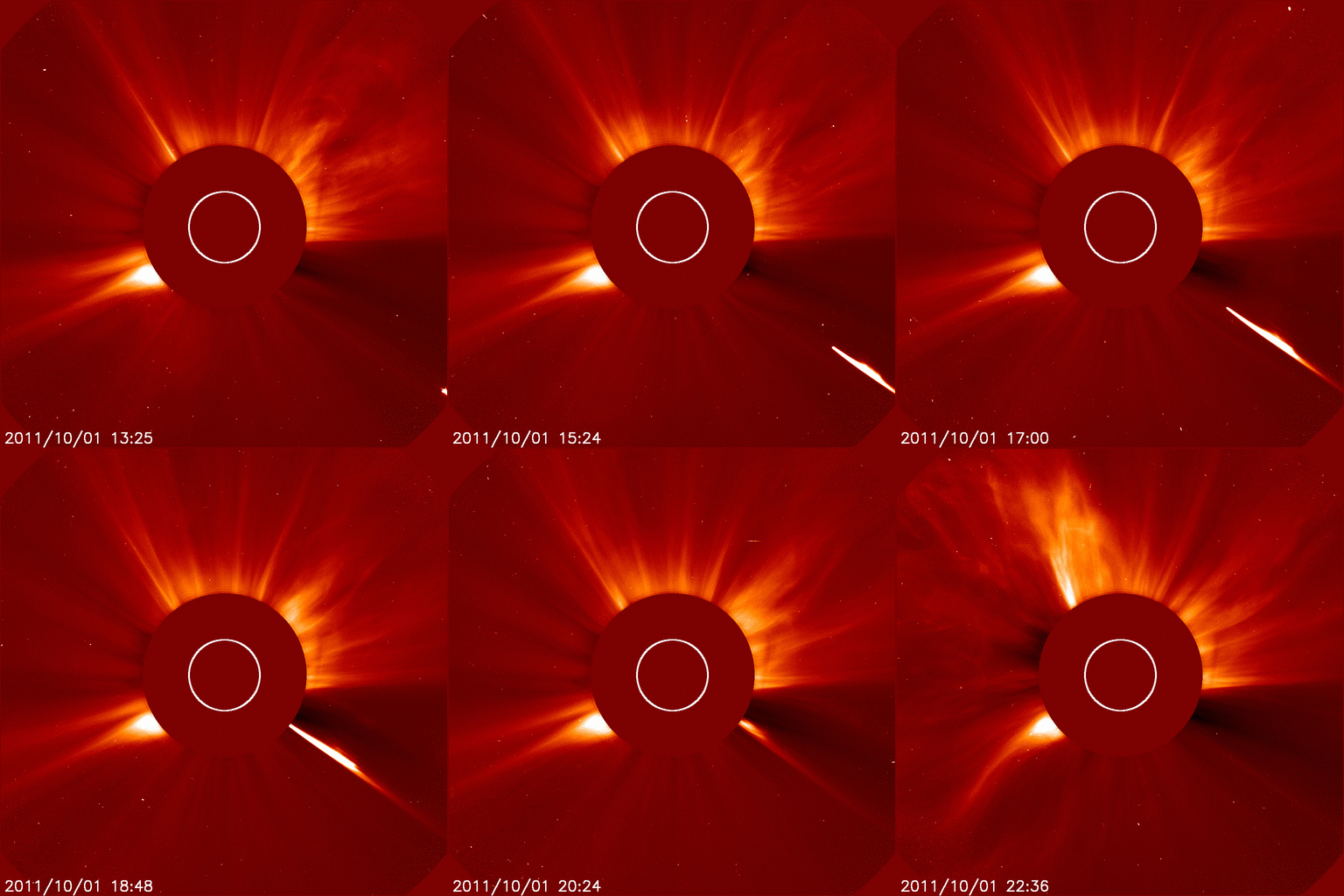
A comet discovered by amateur astronomers on Friday, Sept. 30th, disintegrated in spectacular fashion the very next day when it plunged into the sun. The Solar and Heliospheric Observatory recorded the comet’s last hours. The end was punctuated by an unexpected explosion:
Watch the movie again. The timing of the CME so soon after the comet dove into the sun suggests a link. But what? There is no known mechanism for comets to trigger solar explosions. Before 2011 most solar physicists would have discounted the events of Oct. 1st as pure coincidence–and pure coincidence is still the most likely explanation. Earlier this year, however, the Solar Dynamics Observatory (SDO) watched another sungrazer disintegrate in the sun’s atmosphere. On July 5, 2011, the unnamed comet appeared to interact with plasma and magnetic fields in its surroundings as it fell apart. Could a puny comet cause a magnetic instability that might propagate and blossom into a impressive CME? The question is not so crazy as it once seemed to be. (SpaceWeather)

Earlier reporting
Nothing on Watchers was published in the last 24 hours. These are older articles.
- On October 22, 2017, a single flash of lightning stretched 515 miles from eastern Texas to near Kansas City, a distance that takes eight hours to drive, and nobody realized how far it had gone until scientists went back through the satellite data years later Epicenter
- CPC posts a slight risk of heavy rain from the Gulf Coast to the Northeast urban corridor November 25-29, and a moderate risk of West Coast wind and Sierra snow on November 25
- Florida's east coast faces a moderate flash flood risk Wednesday through Friday, with 4 to 8 inches of rain forecast and the St. Johns River near Cocoa already in major flood at 17.13 feet
- Cyclone Akvan to make landfall between Nellore and Visakhapatnam around noon on November 20, IMD forecasts 120-130 km/h winds gusting to 145

[…] Comet and Coronal mass ejection A comet discovered by amateur astronomers on Friday, Sept. 30th, disintegrated in spectacular fashion the very next day when it plunged into the sun. The Solar and Heliospheric Observatory recorded the comet’s last hours. The end was punctuated by an unexpected explosion: Watch the movie again. The timing of the CME so soon after the comet dove into the sun suggests a link. But what? There is no known mechanism for comets to trigger solar explosions. Before 2011 most solar physicists would have discounted the events of Oct. 1st as pure coincidence–and pure coincidence is still the most likely explanation. Earlier…… […]
“Before 2011 most solar physicists would have discounted the events of Oct. 1st as pure coincidence–and pure coincidence is still the most likely explanation.”
Nassim Haramein would have no problem explaining this video but his explanation would make too much sense for most people.