• Gravitational anomaly in 2007 hints at rapid changes near Earth’s core

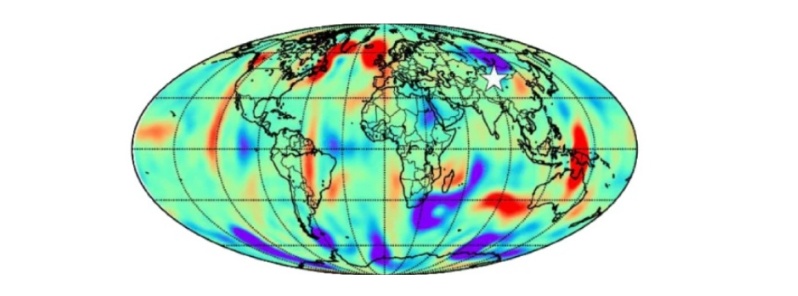
    A gravity anomaly recorded by NASA–German GRACE satellites in early 2007 over the Atlantic Ocean points to mass redistribution near Earth’s core–mantle boundary, around 2 700–2 900 km (1 700–1 800 miles) deep. Researchers suggest a perovskite-to-post-perovskite mineral phase change produced decimetric boundary shifts, offering the first evidence that deep mantle processes can unfold within just a few years and potentially affect Earth’s magnetic field.

  • How humans adapted to increased cosmic radiation during geomagnetic excursion 41 000 years ago

    Around 41 000 years ago, Earth’s magnetic field weakened by up to 90 percent during a geomagnetic excursion known as the Laschamps event. This rare event reduced the planet’s natural shielding against solar and cosmic radiation, exposing the surface to increased ultraviolet energy. A new study combining space weather modeling and archaeological evidence shows that early humans adapted to these extreme conditions through the use of ochre, clothing, and caves, while Neanderthals may have lacked such protective strategies, which may have contributed to their extinction.

  • Major network outages in U.S. following two X-class solar flares

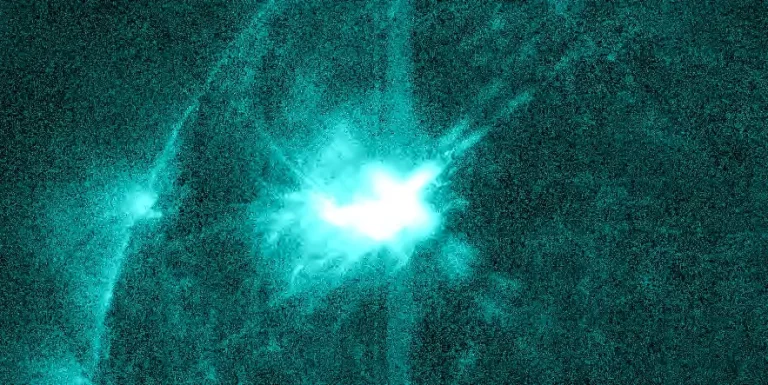
    A widespread network outage was reported in the United States on Thursday morning, February 22, 2024, following two major eruptions on the Sun, an X1.8 flare at 23:07 UTC on February 21 and X1.7 at 06:32 UTC on February 22. Both erupted from Active Region 3590.

  • Swarm mission discovers interannual waves in Earth’s core

    Using information from ESA’s Swarm satellite mission, scientists have discovered a completely new type of magnetic wave that sweeps across the outermost part of Earth’s outer core every seven years. The discovery offers a way to probe the cylindrical radial component of the magnetic field inside Earth’s core.

  • Unsettled geomagnetic field due to CH HSS influences

    Solar wind parameters in 24 hours ending 12:30 UTC today were indicative of a slightly enhanced and disturbed interplanetary magnetic field (IMF) due to weak coronal hole high speed stream (CH HSS) influences. Total IMF strength was variable, but steadily increased…