
Repeated kicks as the Sun sheds mass could destabilize the giant planets far sooner than expected
Numerical experiments suggest that thousands of small recoils experienced by the Sun as it loses its outer envelope could radically rearrange the orbits of Jupiter, Saturn, Uranus and Neptune. Under the study’s fiducial assumptions, about 90% of simulated outer Solar Systems became unstable within 3 billion years, replacing a picture in which the giant planets were expected to remain dynamically intact for far longer.
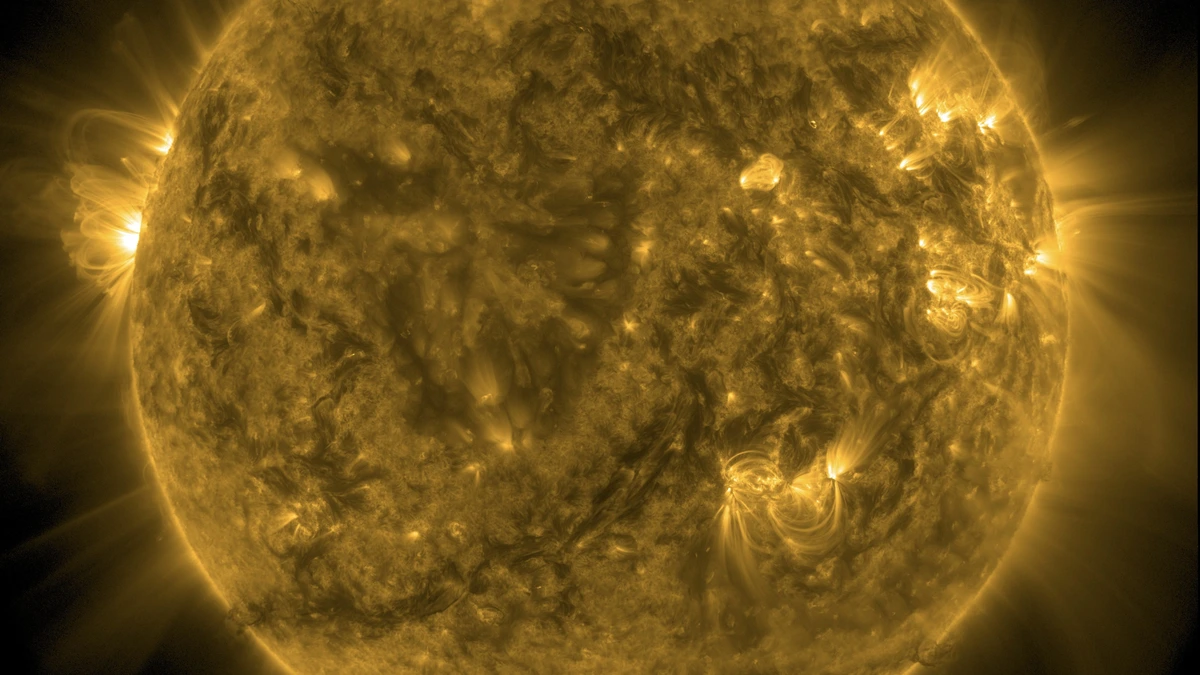
The Sun observed by NASA’s Solar Dynamics Observatory on September 10, 2025. Researchers studying long-term geomagnetic activity found substantial differences in predictability between even-to-odd and odd-to-even solar-cycle transitions. Credit: NASA/GSFC/Solar Dynamics Observatory
For decades, calculations of the Solar System’s remote future treated the Sun’s post-main-sequence mass loss as essentially smooth. In that limit, the giant planets move outward as the Sun becomes less massive but retain much of their present orbital architecture. Batygin, Fuller and Adams (2026) tested a different physical picture motivated by evidence that newly formed white dwarfs receive recoil velocities: the stellar envelope leaves through many discrete, asymmetric ejections, each giving the star a small kick in the opposite direction. The new calculations show that the accumulated kicks can become dynamically important even though each individual impulse is small.
That distinction changes the scientific question. Earlier work placed the intrinsic chaotic lifetime of the outer Solar System near 1018 years, while calculations including solar mass loss and disruptive stellar flybys produced estimates of roughly 30–100 billion years. The new study finds that if future solar mass loss has the granularity implied by the episodic-ejection model, instability can develop during the Sun’s giant-branch evolution and becomes widespread on billion-year rather than tens-of-billions-to-quintillions-of-years timescales.
The physical mechanism is a random walk in the planets’ orbits. An asymmetric ejection removes a parcel of stellar material and produces a recoil of the Sun. From a planet’s frame of reference, that sudden change in the star’s motion perturbs the planet’s heliocentric orbit. One kick has little effect, but thousands occurring at unrelated orbital phases accumulate rather than averaging away, changing orbital periods, eccentricities, inclinations and the spacing between neighboring planets.
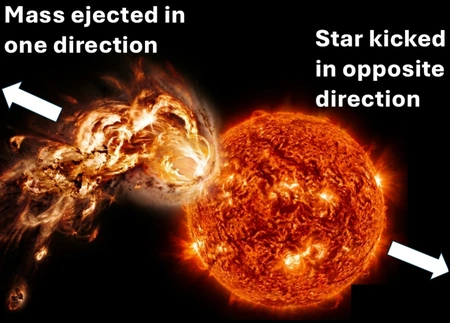
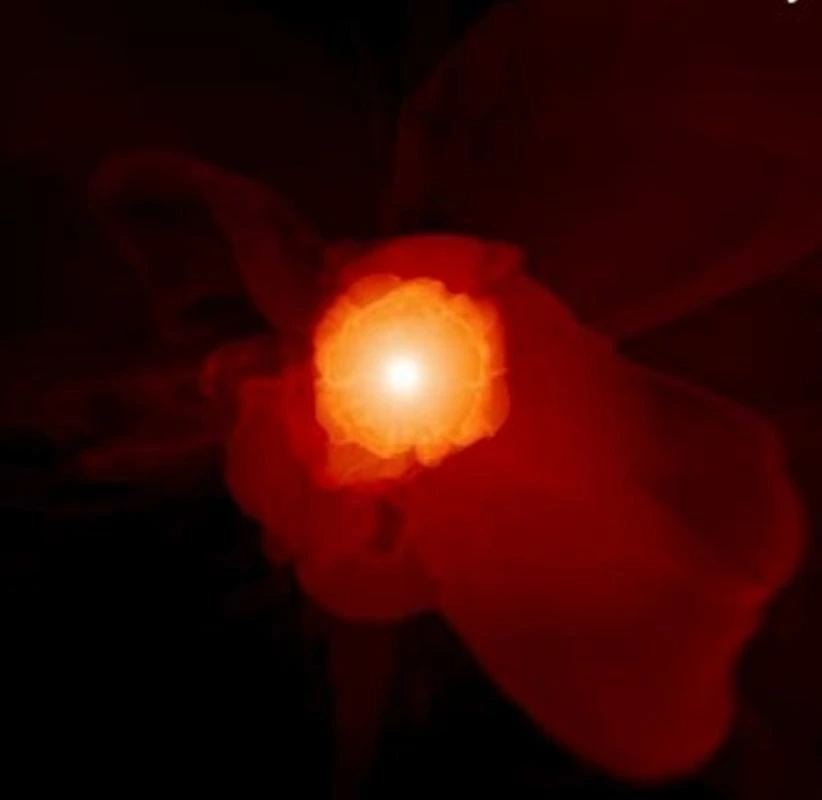
In the study’s fiducial case, each ejection carries about 10⁻⁴ solar masses and the Sun experiences approximately 4 600 recoils, with a median impulse near 7 m/s. The researchers examined 672 realizations spanning a range of ejection masses. The chosen fiducial scale is tied to models developed to explain white-dwarf recoil: Fuller (2026) found that asymmetric ejections of order 10⁻⁴ solar masses can accumulate into net stellar kicks of order several tenths of a kilometer per second.
The resulting orbital evolution differs sharply from the smooth-loss control experiments. More than 60 integrations with smooth solar mass loss remained qualitatively stable as the Sun evolved toward a modeled 0.538-solar-mass white dwarf. The giant planets’ orbital radii expanded by a factor of about 1.85, while their period ratios and broader dynamical architecture remained largely preserved.
Discrete recoils produced a much broader set of outcomes. At the fiducial ejection scale, 37 of 48 realizations in the study’s all-phases experiment developed orbit-crossing configurations before solar mass loss ended. By the time the white dwarf formed, 19 of 48, or about 40%, had undergone disruption or violent scattering. Representative simulations included Saturn being ejected and Uranus and Neptune exchanging their orbital order.
The researchers then followed the post-mass-loss systems for 3 billion years without external stellar perturbations. At the fiducial ejection scale, 96% of systems in the all-phases calculation became unstable, compared with 83% when episodic ejections were restricted to the asymptotic giant branch (AGB). The paper summarizes the fiducial result as roughly 90% instability within 3 billion years. Instability onset ranged from a few million years to beyond 2.5 billion years after white-dwarf formation.
The difference between the two prescriptions is an important limitation. The physical episodic-ejection model is best motivated for the AGB, a late evolutionary phase in which a swollen star loses its envelope rapidly. Extending the same prescription through other giant-branch phases gives the kicks more time to perturb the planets and permits instability to begin earlier. The AGB-only calculations produced no red-giant-branch disruption, although most fiducial systems still became unstable during the subsequent 3-billion-year integrations.
Orbital instability did not take a single form. Stochastic recoil altered the ratios of planetary orbital periods, increased eccentricities and changed mutual inclinations. Neptune reached eccentricities near 0.5 in some realizations. Repeated kicks could also move pairs of planets into mean-motion resonances, configurations in which their orbital periods become locked into simple numerical relationships. Eight of the 672 realizations formed both the Jupiter-Saturn 5:2 and Uranus-Neptune 2:1 resonances simultaneously, although resonant capture did not guarantee long-term survival in the more strongly perturbed cases.
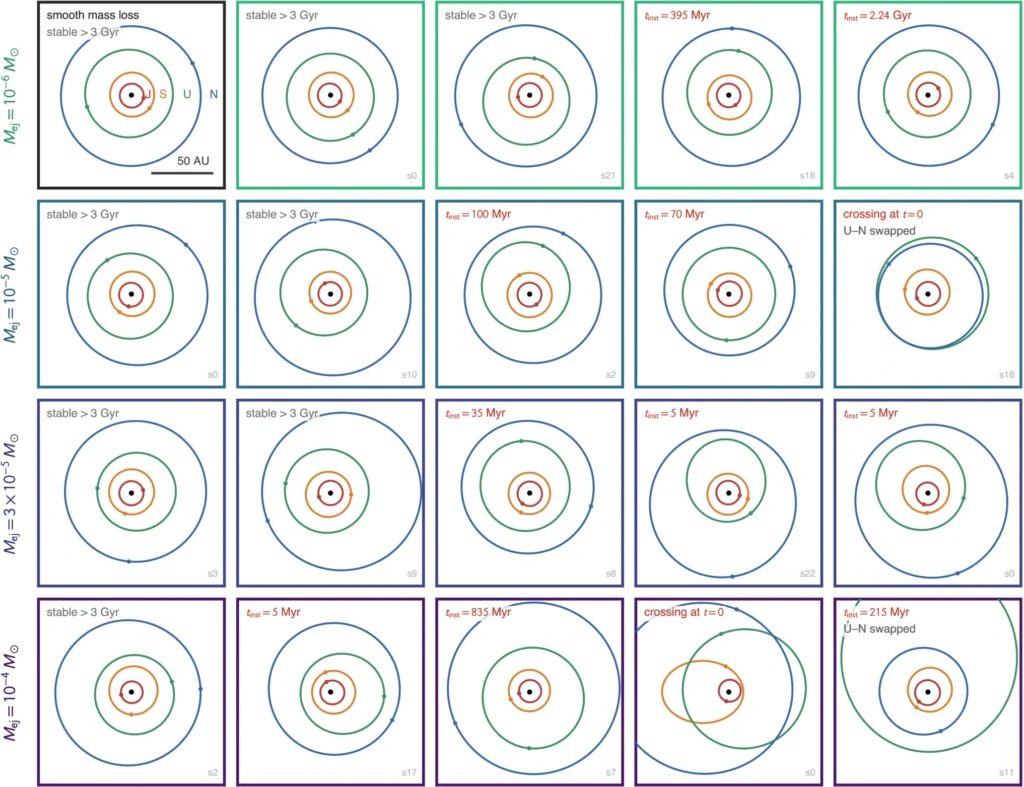
The amount of mass expelled in each event is therefore central to the result. At the low end of the simulated ejection-mass range, the planets stayed close to the smoothly expanded Solar System. As individual ejections became larger, each recoil became stronger, orbital diffusion increased and disruptive outcomes became more common. The study consequently does not predict a single unavoidable future for the outer Solar System; its outcome depends on how granular and asymmetric the Sun’s eventual mass loss actually is.
That dependence is also the largest scientific uncertainty. White-dwarf observations constrain the cumulative stellar recoil, but translating that recoil into thousands of individual ejection events requires a model of how evolved stars shed their envelopes. Fuller’s episodic-ejection model provides one physically motivated explanation, with convection and pulsation producing asymmetric mass-loss events, but the future Sun’s exact distribution of ejection masses, directions and timing cannot be measured in advance.
Batygin, Fuller and Adams used the REBOUND N-body package with the IAS15 and TRACE numerical integrators and combined those calculations with a MESA stellar-evolution model. Jupiter, Saturn, Uranus and Neptune were initialized from their present state vectors, allowing the researchers to compare a smoothly expanding control Solar System with systems receiving repeated recoil impulses as the star lost mass.
The mechanism could have consequences beyond the Solar System. Planetary systems around other stars also have to respond when their host stars lose substantial mass and become white dwarfs. The authors argue that stochastic recoil may contribute to planetary scattering, the production of free-floating planets and the delivery of planetary material toward white dwarfs. Those wider implications remain conditional on the same unresolved mass-loss physics that controls the Solar System simulations.
The main observational test is therefore not whether the future Solar System can be watched evolving, but whether astronomers can better determine how mass actually leaves red-giant and AGB stars. Improved measurements of white-dwarf recoil, resolved observations of asymmetric stellar outflows and more detailed hydrodynamic models can constrain the size and frequency of individual ejections. Those constraints will determine whether the strongly disruptive regime explored in the simulations represents a typical outcome for Sun-like stars or one possible branch of their late evolution.
References:
1 Batygin, K., Fuller, J., & Adams, F. C. (2026). Terminal instability of the Solar System triggered by stochastic solar mass loss. The Astrophysical Journal Letters, 1009(2), L22. https://doi.org/10.3847/2041-8213/aea290
2 Fuller, J. (2026). White dwarf kicks via episodic mass ejection from red giant stars. Publications of the Astronomical Society of the Pacific, 138(9), 094208. https://doi.org/10.1088/1538-3873/aea448

I’m a science journalist and researcher at The Watchers, contributing to the Epicenter edition, where I cover peer-reviewed scientific research and emerging discoveries across Earth and space sciences. With a background in astronomy and a passion for environmental science, I’ve worked in shark and coral conservation in Fiji, conducting reef and shark-behavior research, contributing to mangrove restoration, and earning PADI Open Water and Coral Reef Certifications. I bring a blend of scientific rigor and storytelling to illuminate the discoveries shaping our planet and beyond.
Published in the last 24 hours
- A fireball over northern China on 6 November 2026 punched a crater into a wheat field at Beigucheng village in Hebei; the Institute of Geochemistry has now classified the fallen stones as L6 ordinary chondrites. Epicenter
- Weather radar tracked meteorites falling into Cape Cod Bay after a 1.1-kiloton fireball over Massachusetts on 30 May 2026; researchers have now traced its orbit almost out to Jupiter. Epicenter
- Bay of Bengal system to become Cyclone Akvan, landfall forecast between Nellore and Tuni on November 20, India
- El Niño floods kill 2 in Guayaquil as 172.8 mm of rain swamps Milagro, Ecuador's toll rises to 14
