
Ocean overturning persists for centuries after North Atlantic deep-water formation stops
A weaker cross-hemispheric Atlantic overturning circulation persisted for centuries after North Atlantic Deep Water formation stopped in an extreme-warming climate-model experiment. The result shows that continued overturning after the loss of deep-water formation can represent a prolonged reorganization of the global ocean rather than a stable surviving circulation.
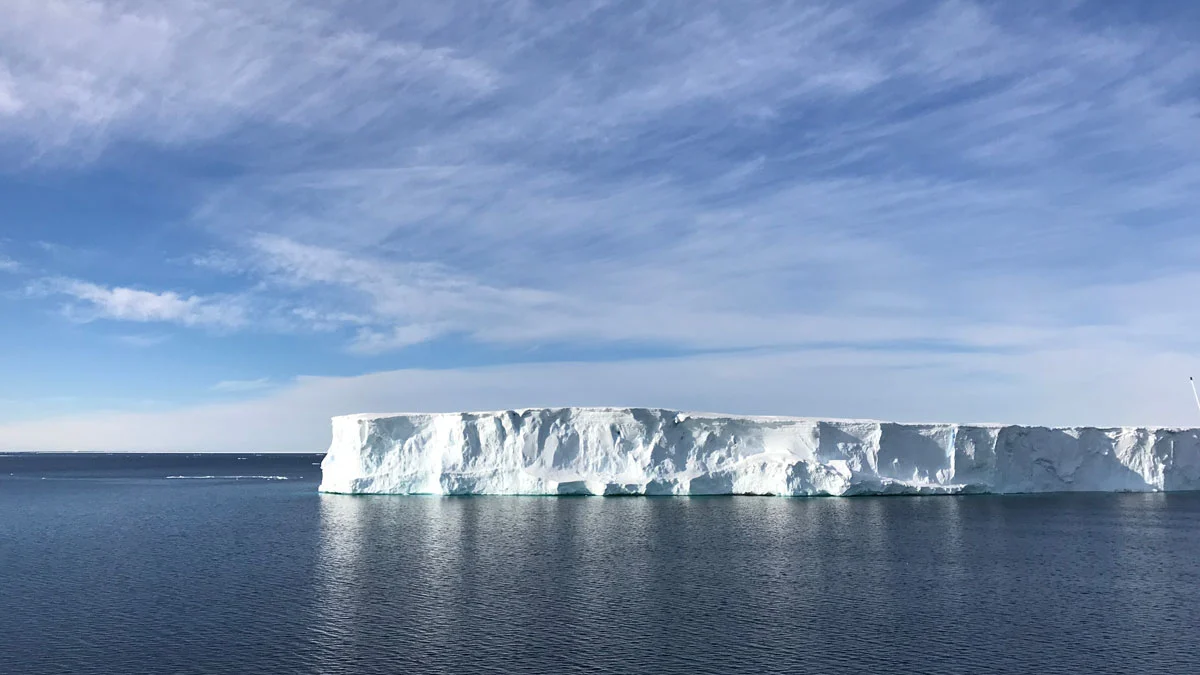
An iceberg floats in the Southern Ocean’s Amundsen Sea, an area that could be drastically affected by a weakened AMOC
Shantong Sun of the Laoshan Laboratory and Andrew F. Thompson of the California Institute of Technology examined a problem that complicates interpretation of extreme AMOC simulations: some models retain substantial cross-equatorial overturning even after the North Atlantic process that forms deep water has shut down. Their analysis shows that the remaining flow can be a centuries-long transient response as ocean density layers move progressively deeper, rather than evidence that the original overturning state has reached a new equilibrium.
That distinction changes what persistent circulation means in these experiments. The Atlantic Meridional Overturning Circulation (AMOC) transports warm upper-ocean water northward and returns colder, denser water at depth. North Atlantic Deep Water (NADW) formation contributes to this deep branch. If NADW formation stops but transport across the equator remains, the existence of that transport alone does not establish that the circulation mechanism responsible for the pre-existing AMOC is still operating.
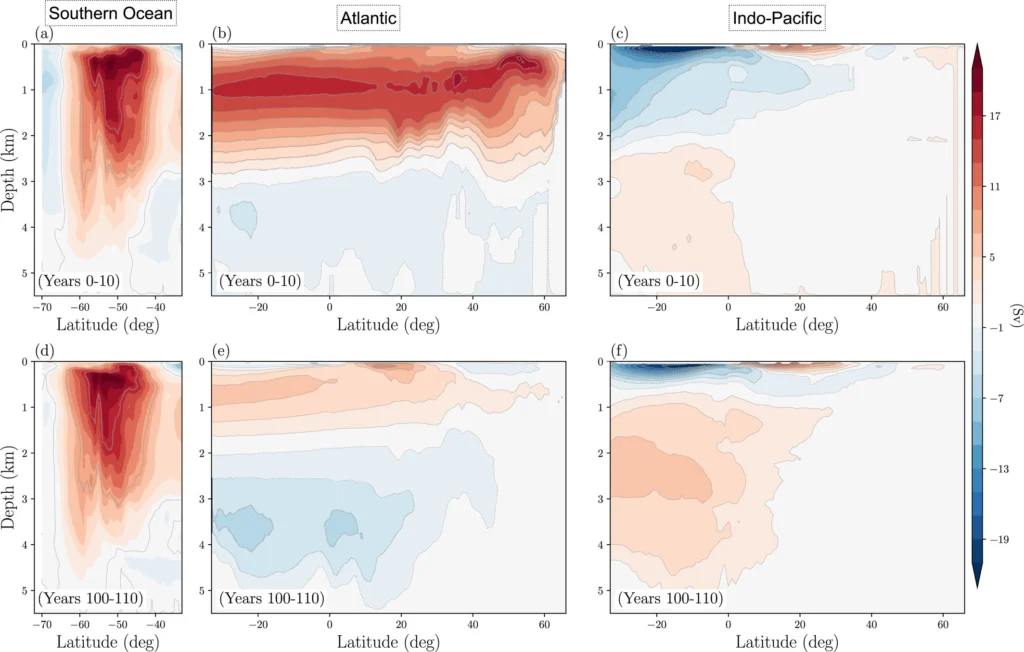
Sun and Thompson analyzed a Community Earth System Model 2 (CESM2) experiment in which atmospheric CO₂ was instantaneously increased to four times its initial concentration. The simulation was designed as an extreme forcing experiment rather than a forecast of a plausible emissions pathway. During years 100–110, NADW formation had ceased and AMOC strength measured in the high-latitude formation region had fallen from about 24 Sv to below 2 Sv, while overturning transport across the Atlantic equator remained above 5 Sv.
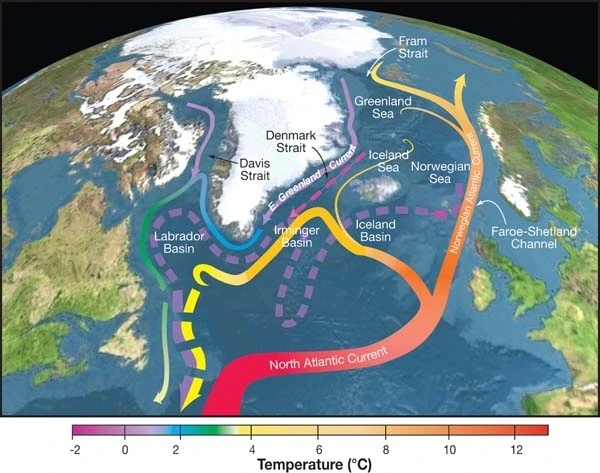
A sverdrup (Sv) is a unit of volume transport equal to 1 million m³ of water per second. In this experiment, the difference between less than 2 Sv in the former high-latitude formation region and more than 5 Sv at the equator is physically important: the strongest remaining cross-hemispheric transport was no longer tied to active NADW formation in the North Atlantic.
The researchers used a buoyancy and volume-budget analysis to determine how water could continue moving downward across large parts of the Atlantic and Indo-Pacific without renewed deep-water formation. The model showed that this downwelling was mainly adiabatic. Water was not being transferred downward primarily by enhanced mixing across density surfaces; instead, the density surfaces themselves were sinking.
Oceanographers describe surfaces of equal potential density as isopycnals. As those surfaces deepen, water that remains on the same density layer can occupy progressively greater depths without crossing into a denser layer. In the simulation, this large-scale rearrangement of stratification produced an apparent basin-wide downwelling response while diapycnal upwelling, the movement of water across density surfaces, changed comparatively little during the first century.
The team then reproduced the main behavior in an idealized 1.5-layer reduced-gravity ocean model. After a 3 000-year spin-up, prescribed NADW formation was reduced from 20 Sv to zero over 100 years, followed by another 900 years with no NADW formation. The simpler model removes much of the complexity of a coupled Earth-system simulation, allowing the researchers to isolate the dynamics associated with the large-scale movement of the density interface.
Both models produced a long-lived cross-basin adjustment. As Atlantic overturning weakened, the Indo-Pacific developed a clockwise overturning response even though it lacked corresponding deep-water formation. In the reduced model, upper-ocean transport across 30°S in the Indo-Pacific reversed from 2.8 Sv southward to 6.0 Sv northward while the global northward transport at that latitude changed by less than 4 Sv during the same adjustment.
The modeled response also changes how heat and tracers are distributed through the ocean. Sun and Thompson report that the transient overturning moves heat into intermediate depths and reorganizes ventilation pathways and biogeochemical tracers. Less nutrient-rich water reaches parts of the upper ocean in their analysis, while ventilation age changes in the deep ocean as water masses spend different lengths of time away from contact with the atmosphere.
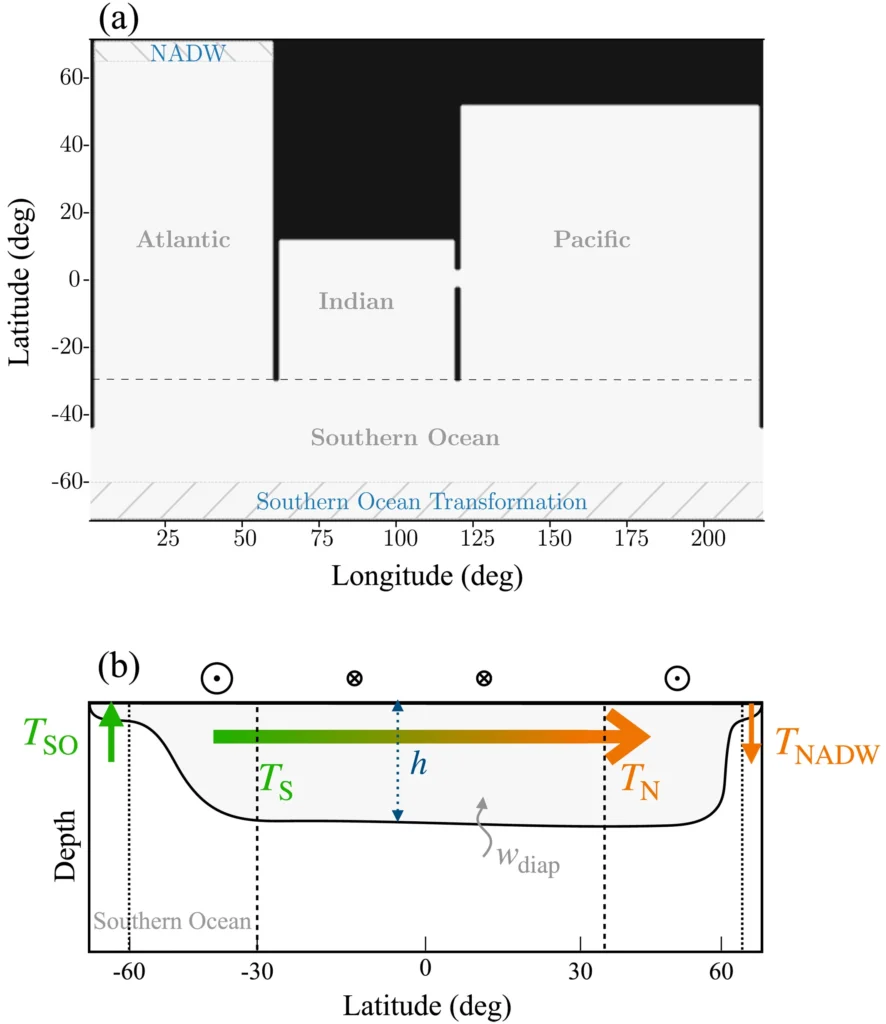
S, where the inter-basin volume exchanges are examined. (b) Meridional transect of the reduced-gravity model in the Atlantic sector. The colored arrow represents northward volume transport from the Southern Ocean to the North Atlantic. Credit: Shantong Sun
The work addresses a disagreement over how to interpret persistent overturning under extreme forcing. Earlier modeling had attributed continued cross-hemispheric circulation in part to wind-driven Southern Ocean upwelling that must be balanced by sinking elsewhere. Sun and Thompson’s budget analysis shows that the compensating downwelling in their experiment is dominated by the transient deepening of density surfaces rather than by a newly established steady balance of interior diapycnal sinking.
The result does not establish that the real-world AMOC can withstand collapse, nor does it estimate when or whether such a collapse will occur. The authors explicitly limit the analysis to the dynamical adjustment following a hypothetical cessation of NADW formation. They also note that the magnitude, timing and possible recovery of AMOC differ among models, and that their analysis is based on one CESM2 simulation together with an idealized model.
Direct AMOC observations also impose a separate constraint on conclusions about the present ocean. The RAPID array at 26°N has measured overturning for more than 20 years, but that record is short relative to the timescales considered in the new modeling work and contains substantial year-to-year variability. The study therefore resolves a problem of model interpretation rather than the present trajectory of the observed AMOC.
The unresolved question is what happens after the transient adjustment has run its course. Sun and Thompson state that whether cross-hemispheric overturning survives beyond the centennial-scale response depends on the longer-term evolution of AMOC, including whether NADW formation eventually recovers. Their experiment provides a physical framework for identifying a circulation that can look persistent for centuries while the ocean is still moving toward a different density structure.
References:
1 Sun, S., & Thompson, A. F. (2026). Transient global overturning following the shutdown of North Atlantic Deep Water formation. AGU Advances, 7(5), e2026AV002462. https://agupubs.onlinelibrary.wiley.com/doi/10.1029/2026AV002462

I’m a science journalist and researcher at The Watchers, contributing to the Epicenter edition, where I cover peer-reviewed scientific research and emerging discoveries across Earth and space sciences. With a background in astronomy and a passion for environmental science, I’ve worked in shark and coral conservation in Fiji, conducting reef and shark-behavior research, contributing to mangrove restoration, and earning PADI Open Water and Coral Reef Certifications. I bring a blend of scientific rigor and storytelling to illuminate the discoveries shaping our planet and beyond.
Published in the last 24 hours
- A fireball over northern China on 6 November 2026 punched a crater into a wheat field at Beigucheng village in Hebei; the Institute of Geochemistry has now classified the fallen stones as L6 ordinary chondrites. Epicenter
- Weather radar tracked meteorites falling into Cape Cod Bay after a 1.1-kiloton fireball over Massachusetts on 30 May 2026; researchers have now traced its orbit almost out to Jupiter. Epicenter
- 10 named storms, one hurricane for the first time since 1925: Why has the Atlantic been so quiet in 2026 Epicenter
- Bay of Bengal system to become Cyclone Akvan, landfall forecast between Nellore and Tuni on November 20, India
